Maybeboard


General Deck Introduction

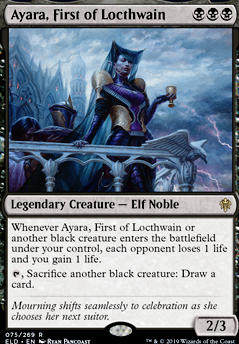
This Ayara, First of Locthwain list is a high powered casual combo / aristocrats deck, and probably my personal favorite deck (just because I put so much work into it). The original inspiration was to play Reassembling Skeleton and similar effects for the most value. When goldfishing, it can typically threaten a turn 5 - 6 win (turn 4 wins are also not uncommon), which puts it as pretty fast for casual but keep in mind that interaction will slow this down (if the speed is a concern, see the Powering Down section below). This likely puts the deck at a Bracket 4 / power level 8. Your aim when playing this deck is to sacrifice your self-reviving creatures and bring them back in order to gain value, often creating infinite loops. The value gain normally takes the form of card draw (e.g. Grim Haruspex), mana generation (e.g. Pitiless Plunderer), opponent life drain (e.g. Blood Artist), or token generation (e.g. Blight Mound). Token generation effects also trigger drain from Ayara, First of Locthwain. You will typically win by draining out your opponents with these triggers. I tend to value the trigger types from most to least valuable in this order:

Mana > Tokens > Card draw > Life drain

Originally this was built as a Teysa Karlov deck, but I found I kept cutting a majority of the white cards so I made the transition from Teysa Karlov to Ayara, First of Locthwain. By making that transition, I found there were 3 major benefits.

Not only are the lands cheaper budget wise, but the chance of color screw is greatly reduced (can still happen with colorless sources). Because you have to spend a lot less resources on color fixing, you can instead opt towards some more utility lands without worrying too much about not having the right colors. Do still keep in mind Ayara has a triple black casting cost so you don't want too many colorless sources of mana. I ended up not including as many utility lands as I expected to because I valued the consistency of basic lands so much.

Ayara, First of Locthwain provides 3 pivotal things that helps your deck get established right away 1) A drain effect, 2) A sac outlet, and 3) a draw source. This means that with only a single self-reviving creature, the deck can basically start doing its thing, while drawing into more pieces to help increase the efficiency. This decreases the chance that your deck will draw into pieces it can't utilize and stall out. Even if this does happen, you can simply sacrifice less useful creatures to her in order to try to dig towards more relevant components. In contrast, Teysa's effect will only activate if you are ALREADY doing your thing (have a reviving creature, a sacrifice outlet, and triggers when they die), making her far less reliable. Additionally, many of the effects that we are triggering are not death triggers (e.g. Desecrated Tomb), so she is only doubling a portion of the triggers. The reliability Ayara, First of Locthwain brings to the deck is simply far more valuable than this.

This is a silly reason, but looking at more colors means looking at more cards which makes cutting decisions more difficult. By reducing the card pool, I found it a lot easier to condense the list down to 100 cards. In future this will also make considering new sets easier (this has became WAY more relevant now considering how frequently new content is released). We are losing out on some really good cards for us like Requiem Angel, Divine Visitation, Cruel Celebrant, Teysa, Orzhov Scion, and the best removal spells in commander, but there is more than enough good black cards to fill out a deck. Decision making is hard sue me.

Strengths

This deck is very consistent and resilient. While there are 4 overall different combo wincons, there are at least 80+ different permutations of those combos, with tutor support and a steady stream of cards to help find any missing pieces. This means that if one combo gets stopped, the deck often is capable of attempting to combo out again very soon after. Even if the different combo game plans do not work out, the deck is still very capable of winning via a more standard aristocrats game plan or even by swarming opponents with tokens. In addition, the commander simultaneously provides several of the resources the deck is looking for, but is also not necessary to win, increasing consistency. I would guess that the deck is able to win by turn 6 90% of the time in goldfish scenarios.

The deck is also a strange combination of subtle and quick due to the extreme amount of synergy and redundancy. Often the deck does not need to draw excessively or tutor for any combo pieces because a combo is just already in hand. Frequently, the deck's play pattern ends up looking like "regular play, regular play, regular play, I win" with very little / subtle telegraphing. This means that often players won't even know they should be holding up interaction for you. For many pods, a turn 5 win attempt is considered very fast so depending on context, this deck may count as a form of turbo.

Weaknesses

The deck has a very weak interaction suite. The only interaction included in the deck are cards that also serve the deck's main gameplan. As a result, there are few removal cards and most only kill creatures (and often poorly) alongside 2 grave hate effects. The closest thing the deck has to an ace in the hole is Blast Zone which is slow and clunky, but can remove vital things. Realistically if you need to use it you've already lost however. This means the deck can really struggle against faster decks, and you are banking on your opponents to answer those.

The deck is also somewhat soft to stax. While things that increase the cost of our actions are annoying, we can fight through those and still get value as either an aristocrats deck or a slower combo deck. The real killers of the are deck are rules-setting cards and grave hate. The deck requires a lot of fiddly ability activations and triggers, so something like a Null Rod, Linvala, Keeper of Silence or Torpor Orb can really cause us a headache. In addition, having our graveyard exiled through effects like Bojuka Bog and Tormod's Crypt can trip up the deck until it finds another self-reviving creature. But of course, the worst are persistent grave hate cards like Soulless Jailer and Rest in Peace, especially versions that remove death triggers, which can leave the deck playing weenie beatdown. If a particularly brutal stax pieces shows up, the deck has very few answers for it.

Combos

This deck contains multiple game winning combos that you should be aware of when piloting. Importantly, all of the combo pieces are individually useful to the sac-revive deck plan even without the full combo enabled. You will find as you play that you will doing the typical aristocrats plan, and notice that you suddenly have access to a combo then quickly pivot in order to enable it. Depending on how you like to play the game or what your playgroup etiquette is, you will want to know about the combos in order to remove them from the deck, avoid playing them, or actively aim to enable them. These cards will still provide a lot of value to the deck if some of the combo is missing.

This is the staple Ayara, First of Locthwain combo. As long as you have more health than your opponents (which is likely because you will be draining them) you can pay more life into the spell than they have total. The ETBs from the rats with Ayara will then drain them out completely. Even if you cannot directly kill from the ETBs, the life swing from the rats plus any other potential sac value effects will likely end the game that turn (I'm half tempted to almost list any drain effect with this as a combo). The nice thing is that you only need to decide how much life to pay as Plague of Vermin resolves, so if Ayara, First of Locthwain dies at instant speed, you can adjust how much life to pay accordingly (I would still suggest pay some, as the rats have value as sac fodder). However you have to be careful if any of the opponents have instant speed damage, as they can cheese you out of the win if they burn you before the Ayara, First of Locthwain triggers resolve. If this is a concern, just leave some health as a buffer.

This is the most common type of combo simply because there are several cards that can lead into this loop. The main limiting factor is going to be the black mana requirement, so the major infinite enablers to look out for are Pitiless Plunderer, Warren Soultrader, Carnival of Souls, Phyrexian Altar, Defiler of Flesh, and K'rrik, Son of Yawgmoth. Of the list, the standout best one is Warren Soultrader since it both fits the requirement of a sac source and a source of black mana. While the card combination may seem convoluted, about 1/2 of the deck fills one of the requirements, so you will stumble on this combo very easily. If you have one of these black mana enablers, you should take a second look at your cards to ensure you don't already have the combo win.

Even if you're not able to activate any of the two card combos with it, Exquisite Blood / card: Bloodthirsy Conqueror will put in work absolutely padding your life total, making it much more difficult to kill you off. Do keep in mind that Exquisite Blood is one of the most well known combo pieces, so this will often draw a lot of attention towards you when it hits the field. If you want to include more combo synergy alongside this, you can include Defiant Bloodlord, Sanguine Bond, Aetherflux Reservoir, and Epicure of Blood. I didn't include these as they are far weaker due to the mana cost.

Without the combos, Bolas's Citadel can use your life total to absolutely rip through your deck at monster speed, often just winning the game outright. With Golgari Thug, you can cut out the mana cost and have "free" infinite sac fodder (essentially do combo #2 from our established combo list). All you need is enough life gain per sac-revive cycle, and you win. Golgari Thug otherwise serves as a strange tech piece that can serve as either a self-revive source, graveyard packer via dredge, grave hate dodger, or a method to pull any creature out of the yard (allowing Entomb effects to act as regular tutors).

Mulligans

You have a lot of redundancy and a decent land count, so you can afford to be a bit greedy with your mulligans. Because of this, I would recommend the following mulligan strategy. This is a general guideline, and you should also use your own judgement when piloting. One pitfall I have noticed however is to be extra cautious with hands with both Chrome Mox and Gemstone Caverns, as the early card disadvantage will essentially force you to play turbo. Any hand with both of these needs to have some form of draw available quickly.

Fist Mulligan Choice (free mulligan)

You want the minimum for the first hand:

  • 2 Black sources of mana (Non-ritual)
  • A turn 1 or 2 play
  • Either A) An infinite in hand B) A draw source C) 2 of the 3 following: Combo-able black mana source, Sacrifice outlet, or Repeatable Sac Fodder D) Bolas's Citadel E) A tutor that can allow you to complete A, B, C, or D

Second Mulligan Choice

You want at least the following:

  • 2 sources of mana (Non-ritual), at least one black
  • Either A) An infinite in hand B) A draw source C) 2 of the 3 following: Combo-able black mana source, Sacrifice outlet, or Repeatable Sac Fodder D) Bolas's Citadel E) A tutor that can allow you to complete A, B, C, or D

Third Mulligan Choice

You want at least the following:

  • 2 Sources of mana (Non-ritual)

Fourth Mulligan

If you ever get down here you are probably done for. Don't mulligan past this point and pray the top deck saves you. Try to keep 2 mana and draw if you can.

Powering Down

This deck probably can't be brought to a random game store without some pregame discussion beforehand. However. if you want to power down the deck to more comfortably fit into a typical Bracket 3 pod, I've created three sections that address typical pain points. The key is to add cards that somewhat fulfill the roles of the replaced cards (outside of pure combo). In addition, my picks are a bit more removal focused as I find that this is a bit healthier in a lower powered game. The full list of is also included in the maybe section.

Combo type 1: Infinite Sac Loops

The vast majority of combo cards revolve on generating black mana based on our sacrifice loops. Therefore, the best replacements for these cards are going to either be A) cards that generate value from sacrificing, or B) Cards that generate mana (potentially a lot of it to allow for big loops). However, Warren Soultrader, and Phyrexian Arena also acts as sacrifice outlets, so we want to be careful also add in some sacrifice outlets. Based on this I would suggest the following changes:

Remove Carnival of Souls, Defiler of Flesh, K'rrik, Son of Yawgmoth, Phyrexian Altar, Pitiless Plunderer, Warren Soultrader

Add Nyx Lotus, Ogre Slumlord, Funeral Room / Awakening Hall, Sephiroth, Fabled SOLDIER  , Sadistic Hypnotist, and Phyrexian Plaguelord

Combo Type 2: Bolas's Citadel and Plague of Vermin

I think in the deck, the closest casual equivalent is big card drop splash / swing plays that can make the game go over the top in value. For this purpose, I like the devotion cards the best. I also considered Army of the Damned instead of Gray Merchant of Asphodel, but mana value wins.

Remove Bolas's Citadel and Plague of Vermin

Add Abhorrent Overlord and Gray Merchant of Asphodel

Combo Type 3: Bloodthirsty Conqueror and Exquisite Blood

Without the combo, these cards buy time by adding a ton of life. Therefore, I think the best equivalent is adding control pieces that also buy us time.

Remove Bloodthirsty Conqueror and Exquisite Blood

Add Grave Pact and Attrition

Tutors in this deck can be divided into 2 categories: Grave tutors and general tutors. Grave tutors should largely just be replaced with sacrificial creatures.

Remove Entomb, Buried Alive, and Unmarked Grave

Add Cult Conscript, Tenacious Dead, and Persistent Specimen

The general tutors are a little bit trickier to replace, as they serve to smooth out play by grabbing whatever necessary piece we need. Therefore, I decided the best way to replace them is by adding a bunch of cards that fill various roles of the deck.

Remove Beseech the Mirror, Lively Dirge, Vampiric Tutor

Add Open the Graves, The Darkness Crystal, Spawning Pit *list*

The previous 2 panels have already addressed 2 of the game changers. Therefore the only one left is Chrome Mox. Very simply put in a Swamp instead.

Remove Chrome Mox, Vampiric Tutor, Bolas's Citadel

Add Swamp, Open the Graves, Abhorrent Overlord

Change Log

Meteor Golem is over-costed for the effect, and we have no good ways of exploiting it. Swamp will help get the turn 5 land drop more consistently. The effect of Witch of the Moors is very powerful, but also a bit too straight up and honest. We can only trigger it once per turn, and graveyard recursion effect on the card isn't something we care too deeply about. Ideally Witch of the Moors wants a very long controlled game where it can eek out value over time, which makes it a bit underwhelming for a 5 mana spell. Our other top end control spells like Dictate of Erebos can essentially board wipe the opponents if we have our engine really humming. In contrast, Bolas's Citadel is not an honest card. The turn it comes down we want to be ripping through the top of our library at extraordinary speeds and hopefully either find a combo or cheat in enough value the turn it comes down to outright win. This far quicker effect is ideally what we want for one of our top end spells.

The goal of this change was to make the early game more consistent by cutting large CMC cards and increasing the number of sac-fodder cards in the deck. Except for Embalmer's Tools, all the cards cut had good effects, but were too expensive to justify. Embalmer's Tools was removed due to being too situational. Carrion Feeder, Viscera Seer, and Grave Pact were brought in as lower CMC variants. I wanted to increase the number of sac fodder cards from 11 to 14, that way we could consistently have access to one on turn 2 76% of the time (ideally when we'd want to play it) and on turn 4 86% of the time (the latest we'd want to play it) assuming we have no draw effects. Realistically (including Ophiomancer), we have 4 fodder cards that cost more than 2 so we actually have a 63% chance to be able to play one on turn 2 (assuming we don't draw and we ignore sol ring ramp). Gravecrawler feels very iffy to me, since we don't have many zombies in the deck, but it costs just so I'm going to give it a whirl and our other options at budget are mostly very bad. If it ends up too bad, I'll use Nim Deathmantle or break budget and go Bitterblossom.

The Meathook Massacre does what Massacre Girl does but also acts as a drainer. Easy replace. I decided to get Phyrexian Altar after all since it improves the power of the deck so much. Blasting Station was probably the weakest of the sacrifice outlets, so it gets the shaft.

They printed a new self-reviver in Persistent Specimen and it looks pretty good. Also, Entomb just can get us our best revivers in our yard. Both are better than the token generators for us so we cut out those. I am kind of iffy about bringing Entomb into the deck because I don't want to bring too many tutors into the deck, but it is very good. I may cut it again if I find myself not enjoying it. Cabal Stronghold and Reliquary Tower have too small of an upside to justify losing the consistency of a basic land, so they are getting replaced by basics. I'm also keeping my eye on High Market, but it largely depends on how reliably I can find sac outlets. Butcher of Malakir was just way too expensive at 7 CMC to justify for the effect. Caged Sun, Black Market, and Gauntlet of Power all have the potential to accelerate our game into an absolutely absurd state, but they come down late, requires us to untap with it, and draws a TON of hate from the table. I found the 4 CMC big mana cards (Crypt Ghast and Nyx Lotus) share the same problems, but come down early enough to have a higher chance not to be dealt with or hurt as bad from the investment loss. Some early mana cards have been brought in place of these, as I've found that just getting the setup pieces early can substitute for having big mana. I went heavier on the rituals because I wanted things that give specifically , I dislike the 2 CMC rocks that come in tapped (they aren't bad, just a preference), the 0 CMC rocks are absurdly expensive, and rituals seem kind of fun and I don't play with them often. If I end up disliking them I'll replace them with 2 CMC tap rocks.

I found that a frequent problem for the deck was not having a sacrifice source. After looking at the hyper geometric calculator, it seemed to confirm that I should increase my repeated sac outlet count by about 2 if I want consistent access to a repeated sac source by turn 5. Spawning Pit *list* and Bloodthrone Vampire costs only 2 mana, giving us more early plays. Getting tokens off of Spawning Pit *list* is also kind of neat. Bloodthrone Vampire was included over Altar of Dementia because we don't care about the activated effect anyhow, and Bloodthrone Vampire is cheaper budget wise. Panharmonicon is commander reliant, doesn't provide a super unique effect, and costs a lot of mana for our deck, so gets the cut. As for Stronghold Assassin, it was a much harder choice, since it represents one of the only sources of targeted removal in our deck, while also acting as a limited sac outlet. The biggest two problems with the card are the 3 CMC cost, which conflicts with a lot of cards in our deck, and the fact that it is limited and requires a turn before it starts tapping. There are many cases where it serves practically the same purpose as our commander, and we'd often just prefer to have the commander. This may come back in if I find I am missing out on a lot of board control, but we'll see.

Fixed typos and edited sections to reflect the current state of the deck. I removed the "Big X Spell" section from the possible other directions because I think it went from being kind of bad in the deck to being very bad in the deck, and I don't want to mislead people. Also yay drop down menus! I can look at this now without my eyes glazing over! I also added a replacement cards section.

I'm just playing around with different utility lands, there's a decent chance these come right back out after testing them. Blast Zone hides a second form of possible artifact / enchantment removal in our land base, but the mana cost and time to set up and activate it may be a bit too prohibitive for our deck. I'm guessing that this will be worse than a Swamp in most games, but at least it gives us a second insurance policy against awful effects for us like Rest in Peace and may be useful in games that get grind-y. It remains to be seen if the consistency loss is worth the insurance policy.

Castle Locthwain in contrast has very little downside. The only major drawback is that it doesn't count as a swamp for Crypt Ghast or Bubbling Muck. However, effectively 4 mana to draw a single card is only going to be useful to us if games get extremely grind-y (but in theory we should be doing sac-revive triggers with that mana). The only place where I see this card shining is after all non-land cards get wiped. I suspect most of the time where activating this is the best play we lose the game anyhow. Since the benefits and drawbacks of this card are so marginal, I will have to keep an active tally for how many times it loses me 1 mana and how many times I activate it (and how many times the activation actually did anything). Just put the Swamp back if you want to save the money.

The real lands I want to add are Nykthos, Shrine to Nyx, Phyrexian Tower, and Urborg, Tomb of Yawgmoth, but they are too expensive currently to justify me buying them at the moment. I probably will never bother with Urborg, Tomb of Yawgmoth, but Nykthos, Shrine to Nyx looks very appealing as a card, and I may end up just getting it at the end of the day (I've seen Nyx Lotus absolutely make multiple hands pop-off). Phyrexian Tower will just act like High Market but a lot better, so I know it's good in the deck.

I knew for awhile that I wanted to put in Unmarked Grave, but I wasn't sure whether to cut Endless Cockroaches or Silversmote Ghoul in the revive slot. The problem with Endless Cockroaches is simple, per revive cycle is resource intensive, meaning it is harder to infinite or value game with. This outperforms Silversmote Ghoul when we are doing very badly and all we can do is repeatedly cast Endless Cockroaches (although that game would end up likely being a loss anyhow), and when we are doing very well where we can sacrifice the card a ton or infinitely (although this card will immediately be outclassed as soon as we have almost any other unlimited revive creature, which you are likely to draw into).

Analyzing Silversmote Ghoul is however more difficult, since it acts as an inconsistent mediocre band-aid in a variety of scenarios. It can help us play a value game by giving us 1 free sac fodder a turn or supplement a lack of card draw / sacrifice sources with its activated ability. As for more fringe cases, this card makes card: Soldevi Adenate tap for 3, which absolutely slaps, and is the only self-reviving zombie that can pair with Gravecrawler. I suspect with the now 3 graveyard tutors in the deck, the Gravecrawler instance is going to become far more relevant. To access any of this, we need to be gaining 3 life a turn, which is doable, but not exactly trivial. In the worst case scenario, Silversmote Ghoul is a one-off sac fodder for 3 mana, which is really bad but still something. This means that Silversmote Ghoul is most valuable when our deck is performing moderately. Even if we sac Silversmote Ghoul early on for very little value, once our deck starts recovering, it will come out of the graveyard and start assisting with that recovery.

Very hard decision, but I think that ultimately it is better to cut Endless Cockroaches.

I admittedly haven't been playing much magic recently, but when I do, I've found that the players I've been playing with now have found the degree at which this deck combos out to be unfun. I decided it was then pressing to finish off the section about replacement cards (with a special emphasis on the "combo-less" section for personal use). I also cleaned up the description a bit while I was at it.

After some testing, I think that Dark Ritual and Culling the Weak are a bit worse than just straight up mana rocks. The rituals look best when slamming Bolas's Citadel or Plague of Vermin early. But the rocks will give us a more consistent early development, which means less variance and potentially an easier time setting up combo types 2 and 4, since they require several smaller pieces. This also means we will have to mulligan less starting hands.

While working on the description, I decided to try and add an extensive list of all the possible combos and HOLY CRAP that was a bad idea. Quite frankly, the list of possible combos was far too extensive. I started out by typing it and that took forever. Mid-way typing it I was considering putting together a basic python script to generate a list of all the combos in a form that tappedout would like (would require me to re-learn how to python again). However, that idea was quickly scrapped because when I went to save what I had, it didn't even display properly. After some testing, I suspect the reason it wouldn't display is sheer volume. The whole thing is pointless anyhow, because nobody is going to remember an extensive list of combos. I think there was something like 132 possible combinations of just Bolas's Citadel combos, and there would be WAY MORE type 2 combos than that. And if I ever changed the deck afterwards, the whole thing needs to be updated. I think it's much better to leave the general framework of the combos like I already have, which will help players identify the combos in game, assuming others even look at or try out this deck. Even if not, I enjoy cataloguing this thing even for just myself. If you're not me reading this, then hi :).

Haven't touched this deck (or magic) in awhile because life got in the way. However, seeing Cult Conscript and Defiler of Flesh come out made me want to revisit this.

After reviewing all the self-reviviers to find a spot for Cult Conscript, I realized I've been reading Gutterbones wrong the entire time. It actually returns TO HAND instead of the battlefield, making it a lot worse than I thought (sorry for all the games I accidentally cheated). Cult Conscript goes directly to field (I double checked) for just two mana, so it's good. A bit harder to sac a non-skeleton than cause life loss, but still quite doable to trigger.

Defiler of Flesh is like mini K'rrik, Son of Yawgmoth, and so is absolutely excellent for our deck. The problem however, is that it's really hard to cut any of the mana sources I have. After hemming and hawing, I decided to instead look at cutting one of the four cost card draw effects, as they represent some of my least played cards, since I can still draw with my commander, and they are rather pricey mana-wise. Once I came to this realization, I decided that ALL of my 4 cost draw effects were overpriced, so I replaced them with cheaper repeatable draw alternatives. Black Market Connections is an insane amount of value out of a 3-cost enchantment and quite frankly I'm embarrassed I didn't add it earlier. I added Dark Confidant and Keen Duelist as cheap draw alternatives. It was close between adding them and Morbid Opportunist, but I decided the saved mana value was worth it.

With the switch, I still had no more room for Defiler of Flesh, so more thought had to be put in. I decided that my target was the tapped mana rocks, as I found that they were the most awkward, and I found rituals more fun anyhow. So I cut them both, and added back in Culling the Weak, as it allowed for more explosive turns than Dark Ritual.

I've always been eyeing replacing Vindictive Vampire with Blood Artist, but could never stomach the massive damage loss per cycle. However, the more I think about it, I'm still able to target one person with the same level of damage output (the most threatening), the tempo advantage cannot be written off, and because it looks at all death triggers, it counters other aristocrat style decks. I don't know if I like it, but I think it's the smarter choice.

Decided to eat the cost of adding card: Nkythos, Shrine to Nyx and Phyrexian Tower, which just make the deck almost straight up better. Cut High Market for being Phyrexian Tower at home. Also cut Tectonic Edge because it's been more of a liability than a boon. If I want land answers, I'll just go straight for Strip Mine because the cost and restriction on Tectonic Edge has been painful.

Changed my mind about Blasting Station vs Woe Strider in this deck. Because of the redundancy of effects, I think the bonus of board control ends up being more relevant than graveyard recursion. Dross Hopper is still getting a look just because mana value.

A host of exchanges, let's take them one at a time.

Jet Medallion is really good for us, but have to find the right thing to cut for it. Crypt Ghast seemed like the right cut because of the mana cost. It requires a turn to go around to be truly effective, and less reliably leads to the win than Nyx Lotus if it gets that time.

I don't know why I stuck out so long on this one. Epicure of Blood is too much mana to justify, even if it pings everyone. Vito, Thorn of the Dusk Rose is just much cheaper to get down, still does the combo, and even has the potential for an alternative wincon with its lifegain swing ability.

Buried Alive is a card I skipped out on too often. It just makes sense to stuff a cycle creature or two in the yard, along with some of the value creatures like Bloodghast. Because this card adds a ton of value to Silversmote Ghoul I am far less tempted to cut it. That left Persistent Specimen and Cult Conscript as the worse. I decided that the increased cycle cost was worse than the harder revive condition, so the adjustment was made. Less turn 1 plays however always sucks.

This was the hard one. Sanguinary Priest seems absolutely dominant for the deck, even if it is on the high end of the mana curve. However when you look at the draining cards, there is no obvious candidate to cut. If I were to cut a drainer, I decided it was down to either Blood Artist or Bastion of Remembrance. Blood Artist is the cheapest to go down and can potentially counter other aristocrats decks, but can only drain 1 deck at a time. Bastion of Remembrance has the exact effect our deck is looking for and even gives us a 1/1 white body to freely sac, but it's at that 3 cmc spot our commander wants. After a lot of thinking my eyes drifted over to the mana section and spotted Bubbling Muck and started really thinking about it. We don't get the same value that your typical High Tide player would get since we don't untap our lands. That being said, it can really push our mana mid game to get us either that big drop or those extra revive cycles to close a win. This card only starts getting strong value once we get 4 lands into the game, which is a bit late. I am not confident this is the right choice, but I am cutting Bubbling Muck for now. Special attention will be paid to these 3 cards to see which is relatively underperforming, and I may put muck back in.

The other card I have been eyeing is Contamination, but this seems too cruel to add to my table. I may change my mind.

Can confirm, Sanguinary Priest is too much mana, suspected as much. Replacing with Dark Ritual as it allows for earlier pop-offs than Bubbling Muck (Equal mana gain at 3 swamps + mana source, usually 4 swamps). The main downside is that Bubbling Muck can later on just add more value and is more likely to lead directly to a win based on pure value. In future I may add both.

In my current list, the cards I am keeping an eye on are Blasting Station as I have found myself using the one and two drop sac outlets more, so may just prefer a straight Dross Hopper. Black Market Connections is also doing slightly less than I expected, as I find I'd rather play an engine piece in most circumstances. That being said, I've just not drawn it much so more testing is needed. I have noticed that the panels are now broken, and are dumping paragraphs outside of the appropriate panels despite no change to previous sections. I'm assuming that this is some kind of strange temporary bug and I don't want to bother fixing it right now.

I've now had several games where I've wanted to be able to easily get an infinite sac outlet. With the grave tutors now added Woe Strider looks a lot better now. Cut Black Market Connections because I never played it in favor of an engine piece.

A bunch of replacements, I haven't really looked at the game much since I've last updated, so I have a bunch of changes to make.Marionette Apprentice is a 2 mana drain, which is cheaper than the 1 mana drain that Bastion of Remembrance offers. Skeleton Crew is cheaper than Open the Graves so makes sense as a replacement. While the tokens from Open the Graves are slightly easier to access in the case we can't revive a creature, Skeleton Crew can act as a self-revive creature if we are in a desperate position. Ultimately cheaper mana is king.

I've decided 5 mana just to control creatures is a not good enough, so Dictate of Erebos gets the axe. Therefore I'm replacing it with Braids, Arisen Nightmare as the card is cheaper, acts as a limited sac outlet, and can even draw us cards. In the same vein, Ogre Slumlord is too expensive. I'm replacing it with Poxwalkers because it provides sac value that we can get via grave tutor and I kind of love Nurgle in warhammer. This is probably one of the best adds to the deck, as it becomes a grave tutor-able way to get sacrifice value.

Warren Soultrader is kind of a disgustingly good card for our deck since it provides both a sacrifice outlet, and mana that can potentially infinite combo, so it will replace Attrition since it was the only repeatable sacrifice outlet that requires repeated mana to activate.

Forsaken Miner is a 1 mana revive so I wanted to add it to replace Tenacious Dead. However, we don't commit crimes reliably enough to justify the card. However, after thinking about it for a long time, I decided I wanted to cut Tenacious Dead anyhow since it's just the worst revive creature we have. I also decided I wanted to cut Oblivion Stone as I've given up on having overpriced universal answers. I'm a bit hesitant about it, but I'm going to try adding some regular tutors into the deck through Mausoleum Secrets and Vampiric Tutor, which will no doubt increase the power level of the deck

I don't really have cards that specifically care about swamps anymore, so I'm adding in a bunch of the spell lands in place of swamps (specifically ones that can come in untapped). Casting options are always nice. However, I'm replacing Ghost Quarter with Chrome Mox, as I'm just not getting enough value out of the land and decided I wanted to splurge on the only deck I consistently update.

I decided to cut Thornbite Staff as it did not combo with enough cards to justify, and on its own was just a somewhat overpriced sacrifice outlet in combination with the commander. I think 10 repeatable sacrifice outlets on its own is enough for the deck in combination with its limited tutor suite, so I don't feel a need to replace it with another repeatable sacrifice outlet. I've also decided to cut Priest of Forgotten Gods and Soldevi Adnate as while they are both good cards, they were mostly being justified by Thornbite Staff. In their places I've put Springleaf Drum as it's a really good mana accelerant, Orcish Bowmasters as it gives us a threat that while it works with our main strategy, does not require it and can punish opponents who get up to nonsense, and Beseech the Mirror because trying tutors.

I didn't see this potential combo piece when I made my last edit, so it's in. Replacing Bloodghast because I think just straight honest value is a bit weak for this deck now. In addition, I just really like the cheap reusable card draw Skullclamp provides. I think at this point it's fine if I cut one Swamp due to the extra tutors, card draw, and non-land ramp the deck has now.

It has been a long time since I've touched magic at all and even longer since I touched it in any serious way and a lot has changed. The way I've thought about the game has changed a lot since as well, which has led me to make some changes that may seem unusual, so I'll start with those.

Pro player Sam Black has gone on record stating that he believes 2-3 CMC mana rocks that tap for 1 mana typically hurt EDH decks more than they help them, and that early turns are usually better spent on other value pieces that more directly contribute to their game plan. Instead Sam suggests that players typically play more lands in most decks. I had no particular spell I was trying to ramp towards nor any particular synergy with mana rocks so I tried cutting Arcane Signet and other minor early mana cards that involved setup (i.e. Culling the Weak and Springleaf Drum). After the adjustment, I found that my deck became much more consistent and resilient overall with the only noticeable downside is that I was less likely to get low probability early wins. I also ended up cutting Chrome Mox, but not due to it being bad, but just because I wanted to limit myself to 3 gamechanger pieces in my deck.

Since I just brought up running more lands, I want to talk about the addition of utility lands to the mana base since the deck no longer runs many cards that care about swamps. Cabal Pit, Ifnir Deadlands, and Spymaster's Vault all add untapped black mana and so are essentially free. Tomb Fortress comes into play tapped, but the revive effect both adds extra resilience into the deck, and opens up more angles for grave tutoring and reanimating targets that do not revive themselves. When goldfishing, I've both been delayed by a turn from the land and occasionally had combo lines open due to it. I believe it will feel better in real games where interaction happens. I've also been eyeballing Barad-dur and Memorial to Folly as possible includes in future (Barad-dur is far more likely due to it potentially coming in untapped).

The next big shift is that I have become more adamant that my deck should employ the Vulture Strategy presented by the Distraction Makers youtube channel. The strategy is build on a couple of fundamental premises:

1) If player 1 uses removal on player 2, player 3 gets the most value. Therefore, you should not waste resources on any removal and instead invest your resources on making you win more.

2) You should invest in your own resources first and foremost.

3) Most commander games are better thought of as a 3v1 where the strongest looking player is the main target. Therefore, you should look generally look inconspicuous and win suddenly, killing the entire table at once.

While I was already on some level employing this strategy, it really did get me to think about the card Grave Pact a lot more. While it does create a form of card advantage through locking the board state, it doesn't affect all type of opponents' decks, doesn't directly lead to a win, and leads to a grind-y board state that puts me in a 3v1 scenario for longer. Therefore, it is a prime candidate for removal from the deck. As for my other removal pieces, They either serve a dual purpose (e.g., Braids, Arisen Nightmare draws cards and card: Orcish Bowmaster curves out turn 2 and gives sac fodder) or are trivial and very rarely disrupt the game plan of the deck (e.g., Boggart Trawler   can just be played as a shock land).

Now for the other adjustments that are more typical:

Timeline Culler is simply one of if not the best self-revive creatures now, replacing Cult Conscript due to it being the hardest 2 CMC revive to trigger.

Morbid Opportunist has a lower power ceiling to other draw on death effects, but a typically higher floor as it can also trigger of opponent deaths. It replaces Dark Prophecy as can sometimes be a difficult casting cost.

I re-added Bloodghast as a repeated value engine on 2 is something the deck really likes and I missed it after removing it. It replaced Silversmote Ghoul as 3 cost was comparatively harder and it was less consistent at generating value. Plus, now that Timeline Culler is in the deck, having a card that sets up Gravecrawler is no longer as vital (although it is still good).

Lively Dirge is quite franky amazing for the deck. It often acts as an alternate Beseech the Mirror, but it can also act as pricey Entomb or a reanimation for 1 or 2 pieces in a pinch. The spell usually is game-winning on cast. In the sprit of trying to remove setup cards that require setup, I decided to remove Mausoleum Secrets. This may be a mistake, as I didn't playtest Mausoleum Secrets heavily.

Bloodthirsty Conqueror is just Exquisite Blood with legs, which is of course amazing for our deck. Have 2 versions of this half of the combo makes finding the infinite far more consistent. In addition, by being a creature, our deck can interact with this card much more easily, such as using it as a tutor reanimation target or even sacrificing it for value in a pinch. This is the card that ended up replacing Grave Pact.

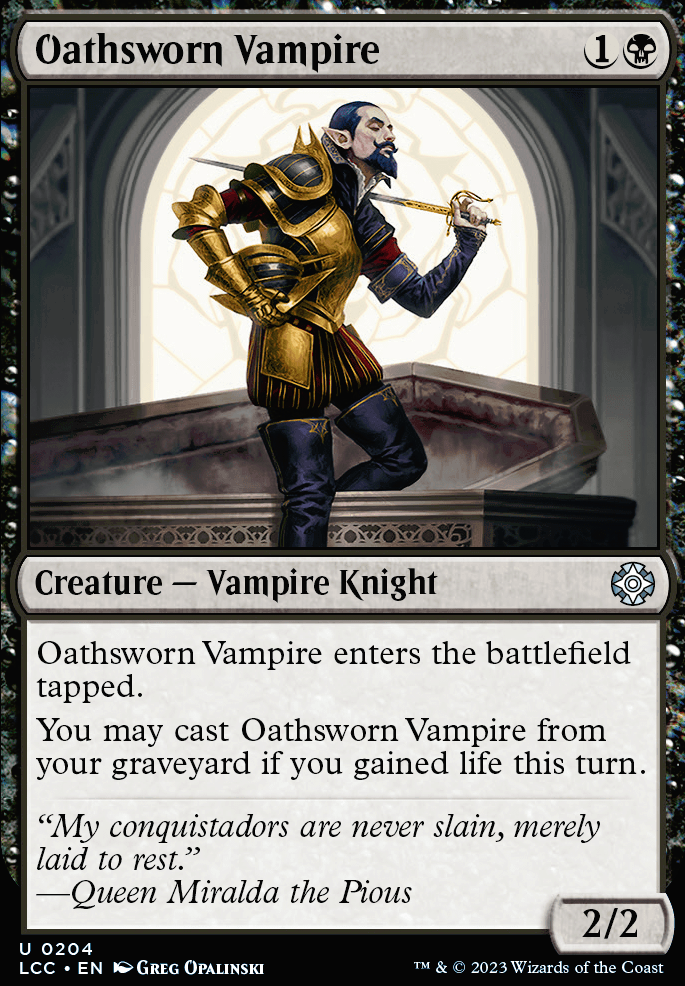
While Gravebreaker Lamia has two effects that are amazing for the deck, 5 CMC is simply now too much for the deck to justify running. Every other 5+ CMC effect in the deck threatens to win the game the turn it is played, and Gravebreaker Lamia simply does not. In addition, the only creature left that uses the graveyard cast discount is Oathsworn Vampire.

I'm shocked that I would ever find myself in a place where I would end up cutting Aetherflux Reservoir, but I genuinely think it has too high of a CMC to justify its impact. Aetherflux Reservoir is mostly useful when the deck either has an Exquisite Blood effect in which case you need to already have 50 life (not always the easiest since you end up paying a lot of life), or if you are repeatedly casting (probably from graveyard). In either case Aetherflux Reservoir does not do enough to activate the combos to justify the cost.

I'm very uncertain about my decision to cut Keen Duelist since Dark Confidant is such a great card for the deck. However, there is an unfortunate problem, either the opponent is going to have cheap cards and is likely to cause us problems, or they are going to have expensive cards and have a chance of nuking our own life total. However, card draw is really good and it's nice to be able to draw cards for 2 mana. I might end up adding it back, I'm uncertain.

I decided to replace the pieces with 2 CMC value cards to smooth out the mana curve. Sign in Blood and Night's Whisper both are card advantage at a really good mana cost. Umbral Collar Zealot is a 2 mana sac outlet with an actually useful sac effect, which is amazing. Vengeful Bloodwitch is a super store brand Blood Artist but 2 mana for the effect is still really good (possible target to swap back out for Keen Duelist).

Gemstone Caverns had me missing Chrome Mox. If I'm keeping myself to only 3 gamechangers, this is better than Orcish Bowmasters in the deck. Springleaf Drum is also potentially fast mana and can help smooth out curves. For these 2 cards, it makes sense to cut a Swamp.

Probably the card that I'm the most often annoyed that I draw is Grim Haruspex, as it fits a bit awkwardly into the curve, and requires setup to help setup. In really good situations the card is redundant and in really bad situations it can sometimes be unable to help us to get out. In contrast Insatiable Avarice is a lot more dynamic of a card, that can help us get a necessary combo piece, draw 3 cards, or both immediately. Both the floor and the ceiling of Insatiable Avarice are better than Grim Haruspex, making it a pretty logical replace.

Being able to self-mill into a self-reviver with Altar of Dementia is better than occasionally getting to get funny token value from Spawning Pit *list*. It also serves as an alternative wincon which is kind of cute. It might be worth running both I'm unsure, I'll evaluate the list more later to make that determination.

I love Nyx Lotus, as the mana explosion can often push the deck over the edge to a win. However, it is one of the slowest cards in the deck, allowing opponents a full turn cycle to respond. Additionally, it can occasionally brick if there is nothing great to do with the mana. As much as it hurts me, I think it is worse in the deck than Keen Duelist, which provides much more consistent value, even if it is not as immediately game-winning.

I also finally added in some of the sections I've been meaning to add for a long time and updated some of the out of date sections.

It turns out that Insatiable Avarice still has the awkward turn 3 problem Grim Haruspex had, but just a bit better. Caustic Bronco will probably allow me to have more smooth play patterns when it is in my opening hand, and has the upside of sometimes being able to act as sac fodder.

Closing

Thank you for reading my deck tech. Feedback is welcome!

Suggestions

Updates Add

Comments

96% Casual

Competitive