Combos Browse all Suggest
Legality
| Format | Legality |
| 1v1 Commander | Legal |
| Archenemy | Legal |
| Canadian Highlander | Legal |
| Casual | Legal |
| Commander / EDH | Legal |
| Commander: Rule 0 | Legal |
| Custom | Legal |
| Highlander | Legal |
| Leviathan | Legal |
| Limited | Legal |
| Oathbreaker | Legal |
| Planechase | Legal |
| Premodern | Legal |
| Quest Magic | Legal |
| Tiny Leaders | Legal |
| Vanguard | Legal |
| Vintage | Legal |
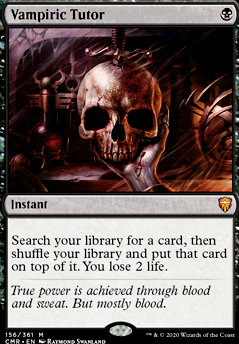
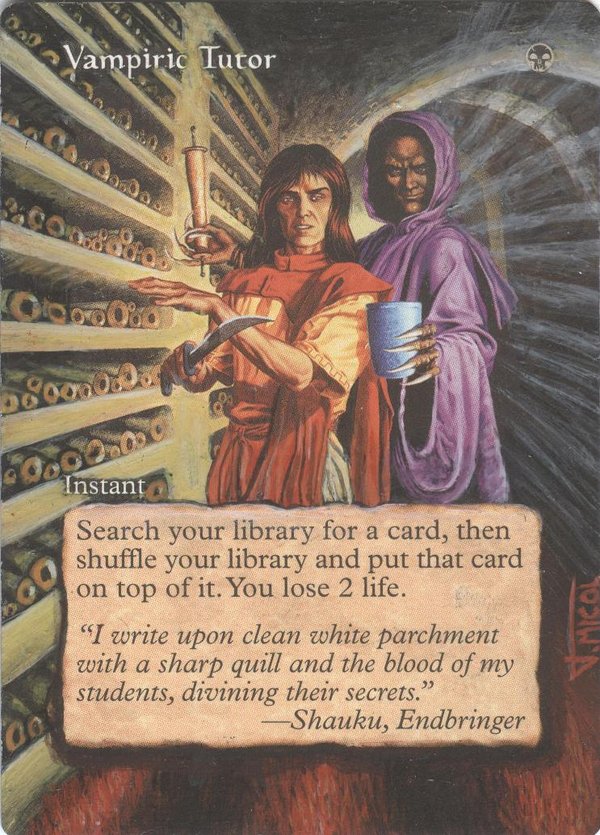
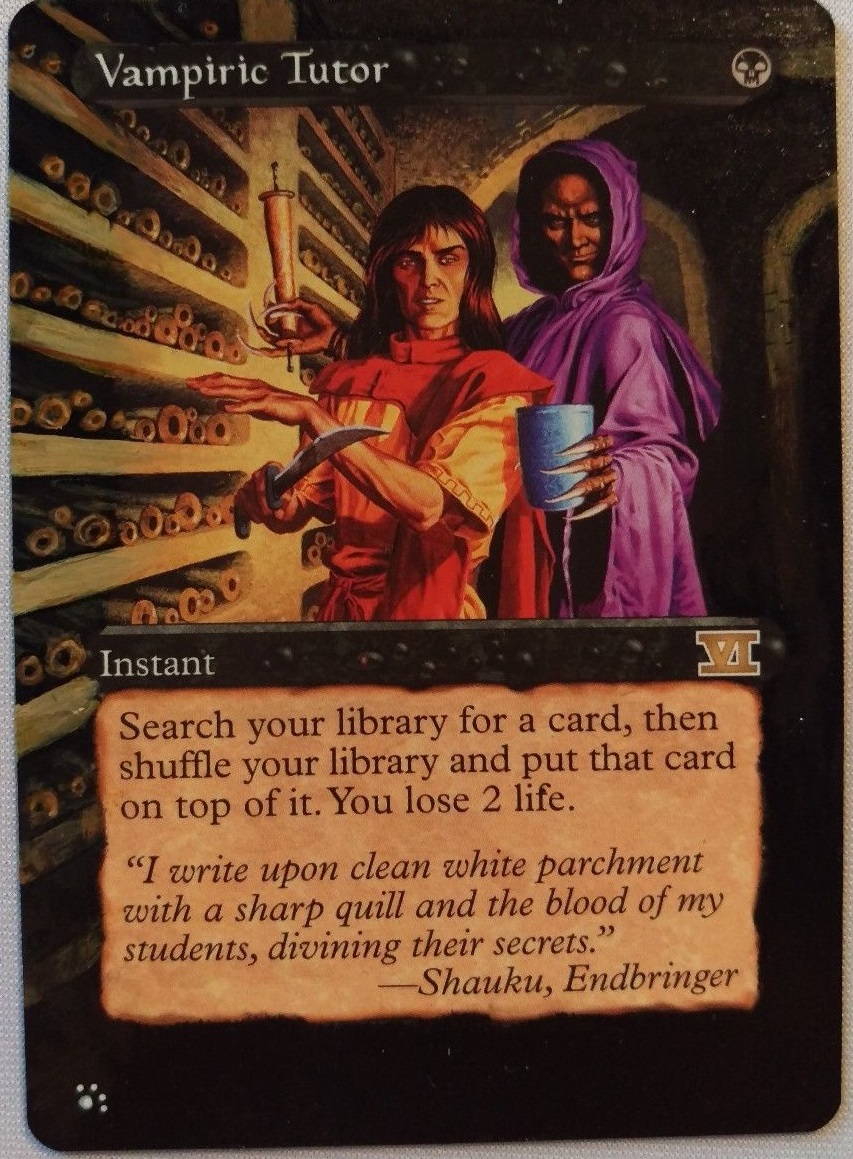
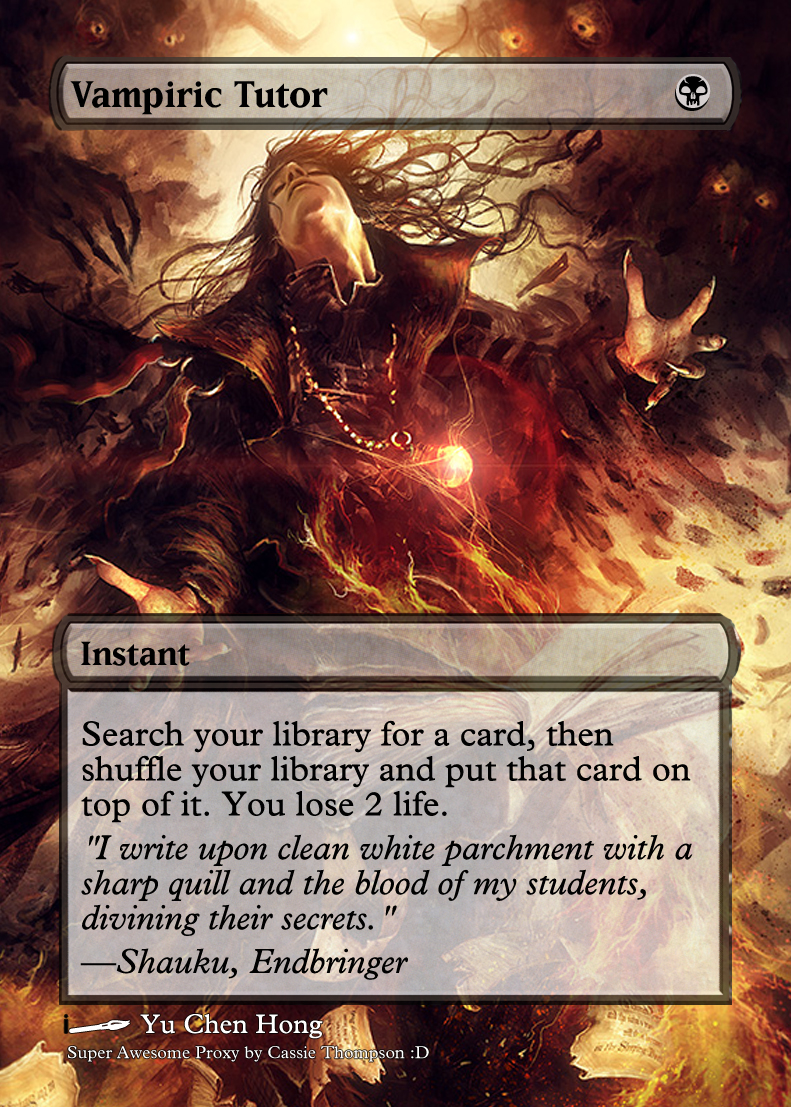
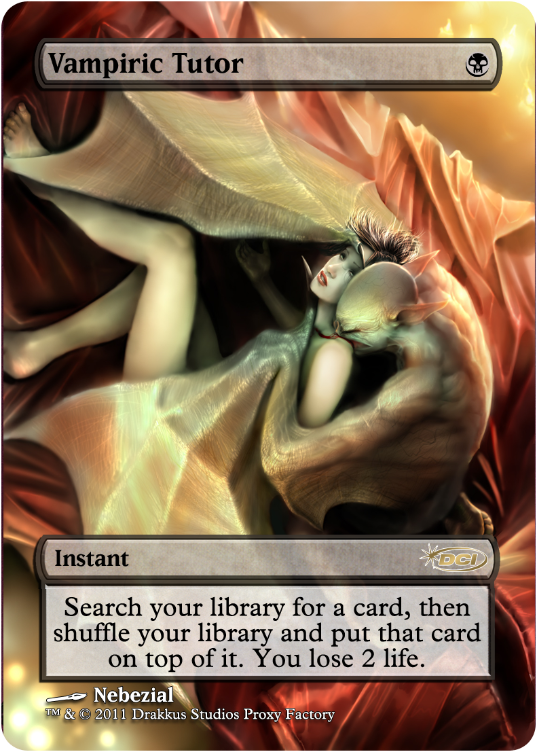
Vampiric Tutor
Instant
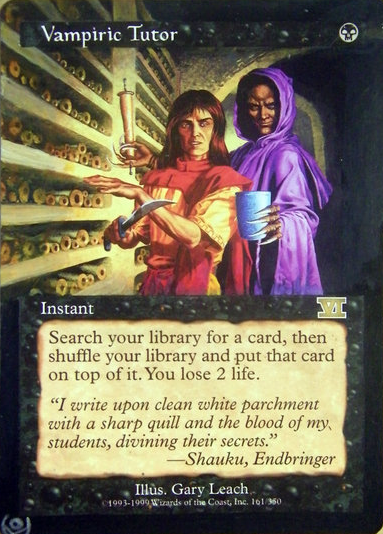
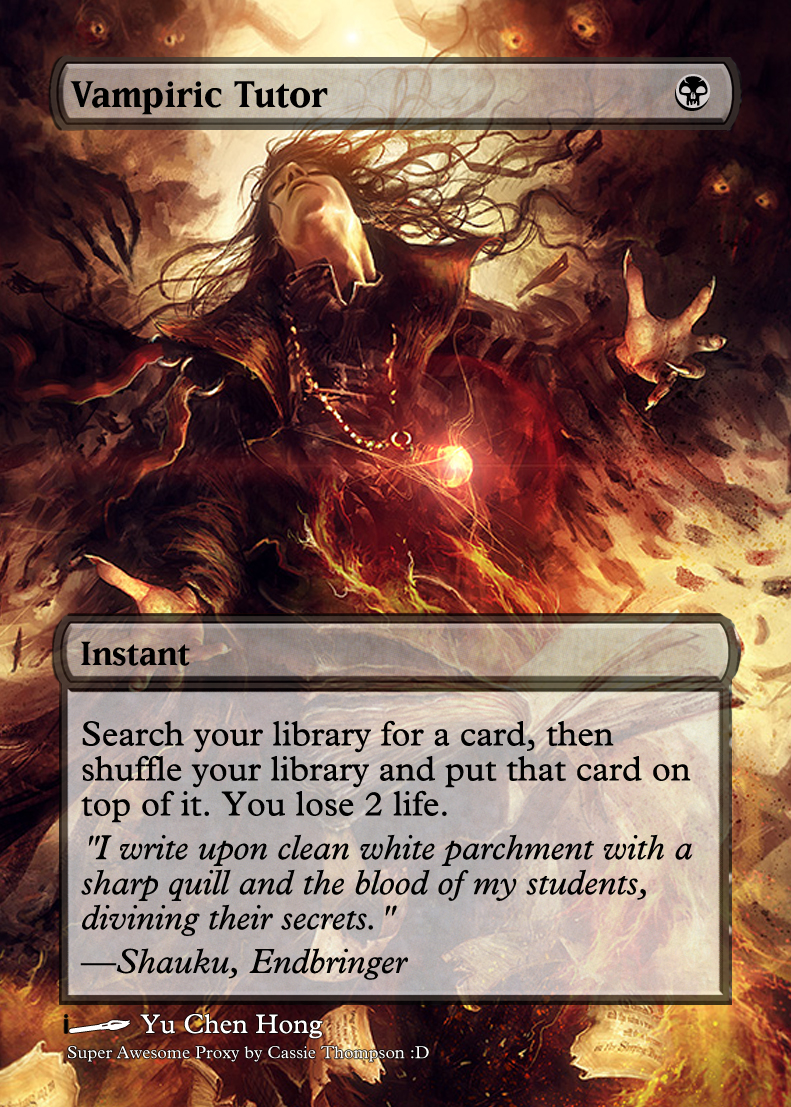
Search your library for a card, then shuffle your library and put that card on top of it. You lose 2 life.







Gidgetimer on
 EDH Merens Reanimator

2 days ago
The most compact Hulk line is going to be Mikaeus, the Unhallowed and Walking Ballista which requires you to add only Protean Hulk and Walking Ballista both of which are decent outside of the combo. The combo does require a sacrifice outlet, and I was having trouble thinking of how to grab one since the combo already uses all 6 CMC of the tutor and I am most familiar with the combo in Abzan where you get Karmic Guide. Luckily DreadKhan supplied the missing piece, if you add in Activated Sleeper you can tutor the Sleeper and Viscera Seer to provide the sacrifice outlet.
Combo I am describing in case you are not familiar with Mike and Ballista. Mikaeus, the Unhallowed gives non-human creatures +1/+1 and undying, so the Ballista enters as a 1/1 and doesn't die. Sacrifice Walking Ballista and it comes back with a +1/+1 counter. Remove the counter from Ballista and deal 1 damage to an opponent. Repeat loop of sacrificing Ballista and removing counter until all opponents are dead.
You are also already running Yawgmoth, Thran Physician, so you can add in a few low cost undying creatures and get that combo with low opportunity cost. Young Wolf and Butcher Ghoul are the easiest to cast ones since they only have a single colored pip. Treacherous Pit-Dweller, Geralf's Messenger, and Strangleroot Geist are perfectly defensible options too, though the pit dweller is more all-in on having a way to sacrifice for value before the trigger to give an opponent control resolves and as such I think isn't a great fit here.
In general you can also up the power level of the deck by adding tutors. The "good" ones you are not running are Worldly Tutor, Grim Tutor, and Vampiric Tutor.
Profet93 on
 K'rrik, Blatant Cheater
2 weeks ago
Beseech the Mirror > Diabolic tutor - It has another black symbol for your commander, can act as a sac outlet and even a potential free spell. Pretty much a strict upgrade.
Cabal stronghold should be cut IMO because it isn't impactful enough. You need 4 basics just to break even and 5 basics just for 1 mana. It doesn't get a benefit from urborg like coffers does. If this was a more basic, budget deck I could see it's inclusion, but I don't feel its impactful enough for a build of this quality. What has your experience been with it? Perhaps swap in a Bojuka Bog and/or a fetchland? Bog is nice given your lack of grave hate (meta dependent). The fetchland is nice because it can bring in bog at instant speed or even witches cottage. Not to mention potential shuffling synergy. None of needed of course, just wanted to offer a potential alternative utility land that could still tap for black (unlike stronghold). Urborg allows you to keep the fetch until you need it too!
Should neither of those lands interest you, perhaps a Deserted Temple to untap coffers/nykthos/crypt + politics?
I notice a lot of your deck is devotion based, how has that been going for you? How often did you need devotion on board for a card like Sanguimancy where it just didn't pan out as needed? I think sanguimancy is a ripe cut, expensive cost and boardstate required.
At the risk of winmore, Alhammarret's Archive?
In Garruk's Wake - 7-9 mana for a wipe is a bit expensive. How has it been? Same idea with Increasing Ambition. 5 mana for a card and then 8 for 2 cards is a bit steep. I think Vampiric Tutor to help you set up draws, cast "for free" and at instant speed is better.
One thing I will say, I love the synergy of the entire deck, seems to flow very nicely without too much fat on it. I know most Krrik decks focus on a lower avg cmc to go with their speedy commander. What made you chose a more midrange approach, the resiliency? Have you thought of cutting down the avg cmc from 4.00 to 3.8 or potentially 3.6? Speeding it up would make this even more deadly!
Balaam__ on
 Dark Depths combo

4 weeks ago
I’m curious about something here. The cards that give poison counters—namely Infectious Inquiry, Phyresis Outbreak and Prologue to Phyresis—is that an intended strategy, or are the poison counters just incidental?
I ask because I don’t think incorporating poison counters is a useful road to go down for this particular build. It doesn’t contribute much at all, and ideally you want to be locating/playing Dark Depths as fast as possible (which I think you’ve done a good job at), and likewise with Vampire Hexmage.
I’d consider replacing those combination draw/poison counter spells with straight up Tutors, of which Vintage has access to the very best. Vampiric Tutor and Demonic Tutor and so forth.
Also, and this isn’t relevant to deck building, but if you want to link a card in the description for easy viewing you can just enclose the card name with double square brackets.
Goyfs-R-Us on
 Sliver Overlord

1 month ago
DoctorMunchiesPHD Crypt Sliver winds up being more mana efficient in board states without Training Grounds. Love Brood Sliver always have always will. Frenetic Sliver is more a last resort removal protection and more often then not is a blue card to pitch for Force of Will or used to get Dormant Sliver off the board if I need to attack to finish someone. Don't really need mana reduction from Herald's Horn and it winds up not discounting a number of important Slivers in the deck. I'm not the biggest fan of the tutors that put the card on the top of the deck and not in hand, Worldly Tutor was the closest to making the deck among your suggestions but I chose Vampiric Tutor over it, due to the greater versatility and not having to reveal the card.
Profet93 on
Mind-Gnawer
1 month ago
Cabal Coffers/Cabal Stronghold - Ramp
Deserted Temple - Untap the above / politics
Thespian's Stage/Vesuva - Copy cabal
Urborg, Tomb of Yawgmoth - Color fixing, not needed but nice to have if you include coffers.
Mind Twist - Random discard, super effective ramped into and as counterspell bait
Imp's Mischief - "Counter" counterspells and redirect targeted removal, draw and extra turns. Given your deck is extremely reliant on your commander, having some protection/bluff ability/utility is very valuable.
Bubbling Muck - Ramp
Feed the Swarm - Enchantment removal
Syphon Mind - Draw 3, each opponent discard 1
Vampiric Tutor - Tutor
DoctorMunchiesPHD on
 A Pimp Named Sliver Overlord

1 month ago
haki2022 Funnily enough I used to run a more Zur-Heavy list. In my experience he seemed to end up less useful as I bought more cards like Vampiric Tutor, just seemed more consistent and less-likely to get pathed the second it hit the board. Also I get why people run graveyard recursion style Overlord decks for sure they make for very explosive plays, but I'm going for a more control-heavy deck myself to better protect my combos and win-cons. It's been nasty in playtesting so far, current list is 4-1. Also Intruder Alarm is definitely in my deck, I use it to lock people out of games with Telekinetic Sliver lmao people do NOT like that interaction.
Profet93 on
Visions of Erebos
2 months ago
Sheoldred, the Apocalypse - Offsets commander lifeloss, great against blue/draw decks. Deathtouch is nice. Synergy with Peer into the Abyss (which also goes well with underworld dreams).
MAYBE Heartstone? - I'm unsure if this works with your commander only if he's a creature or even if he's just an enchantment.
Cabal Coffers - Ramp. Cabal Stronghold is more budget.
Deserted Temple - Untap coffers + politics
MAYBE Rings of Brighthearth - Copy commander ability without paying life. Also Coffers + Deserted temple + rings = . Urborg, Tomb of Yawgmoth - Makes you need less swamps but is not budget (or needed, but helpful).
Imp's Mischief - "Counter" counterspells while redirecting targeted removal, extra turns and draw.
Necropotence - Draw
I am unsure what your wincon is, beatdown? You lose a lot of life with your commander's ability. Perhaps a The Meathook Massacre could help as a wipe + lifegain effect?
Diabolic Tutor/Beseech the Queen/Beseech the Mirror. Tutors are black's biggest strength, utilize it for consistency.
Alhammarret's Archive - Extra draw
Black's 3rd biggest strength is massive mana. Aside from coffers, Crypt Ghast, Nirkana Revenant, Caged Sun, Gauntlet of Power
Once you determine your wincon, you can start to mold the deck to achieving that goal.
EDIT: Removed the non-budget options
Azoth2099 on
 Nekusar Control/Wheels v4

3 months ago
The story behind this deck is so cute, I love it. Let's get to it.
The first thing I noticed when evaluating the potential consistency of this list is that you need to trim some fat from your gameplan. Personally, I'd cut down to 30 lands, include a list of mana rocks & mana rituals, dial into the key pieces that are actually going to win you the game like Windfall & Ojer Axonil, Deepest Might Flip by cutting stuff like Omniscience & Price of Knowledge for tutors like Mystical Tutor & Vampiric Tutor.
If you'd like, we can strip the list down and rebuild it from scratch together, I love Nekusar lol.

| Have (2) | metalmagic , Azdranax |
| Want (12) | TRANNYDAN , Goji , CrimsonKing , devtor360 , TechNoble , zachi , StayFrosty110 , Kripkenstein , Gweedi , pnkghst9 , Azoth2099 , bladeoathkeeper |