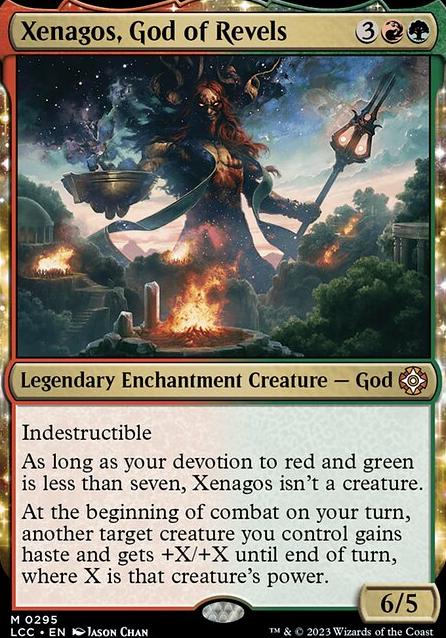
Welcome to King Stranger Makes Me Strong!

Hi there! Welcome to the primer of this Gruul, Aggro-Ultra-Attack deck; commanded by Xenagos, God of Revels; King Stranger himself. Throughout his hedonist life, this Satyr has displayed an utter disregard for life. It is there to be taken advantage of, to be desired and enjoyed for nothing but pure pleasure. Yet maybe also for the purpose of chasing one’s ambitions of absolute rule over a pantheon; or an entire plane perhaps. So, prepare yourself for a fast, powerful, unstoppable tide of Gruul’s forces, supported by a deity that empowers his favored children to destroy all that opposes them. This deck is meant to be played casually. It’s not meant to be used in a competitive fashion, but of course anyone is welcome to try! Feel free to comment on anything you (dis)like throughout this description; hope you will enjoy it!

Because his boosting ability is quite remarkable. Anything (big) that was just summoned gets the ability to attack immediately at double its power and toughness. What makes it even better is that it’s triggered at the start of every combat phase during the deck’s turn, meaning that if one can somehow convince forces to forms ranks more than once per turn, one can also use Xenagos to boost (one of them) more than once a turn. Being a Theros-God, means that by default he is also indestructible, which means he’s not easily removed. That saves a bit on recasting resources.

The following ten parameters have been used to determine the strength of the deck. For each, a score of 5 (very good), 4 (good), 3 (mediocre), 2 (bad) or 1 (very bad) has been allocated; when totalized this score represents the power rating of the deck (maximum score is 50 points).

  • Mana: indicates the availability of mana sources within the deck.
  • Ramp: indicates the speed at which mana sources within the deck can be made available.
  • Card Advantage: indicates availability of filter- and draw resources represented within the deck.
  • Overall speed: indicates the deck’s potential for pace, based on resource availability and mana curve.
  • Combo: indicates the measure of combo-orientation of the deck.
  • Army: indicates the deck’s creature-army strength.
  • Commander: indicates how much the deck is commander-oriented/dependent (less dependency is better).
  • Interaction: indicates how much this deck can mess with opponents’ board states and turn-phases.
  • Resilience: indicates whether the deck can prevent and take punches.
  • Spellpower: indicates the availability and strength of high-impact spells.

Mana: 5

This deck’s gameplan of multiple attacks per turn and summoning new creatures after each attack requires quite a bit of energy to function well. Thus, it’s well equipped to handle that; featuring six dorks, four creatures that provide mana through triggering mechanisms, four mana rocks, two cards that cheapen creature casting and two cards that can be triggered to untap all lands.

Ramp: 3

Fetching lands quicker boosts energy production. This deck features eight resources that either allow to top-deck land, play additional land per turn or allow to fetch land from the library (some of the included cards feature multiple of these abilities).

Card Advantage: 5

Having copious amounts of mana at one’s disposal to cast creatures has no meaning unless one has lots of access to said creatures. To ensure that, the deck contains four direct-draw cards, six conditional-draw cards, two scry cards and several individual cards that allow to top-deck, tutor or even steal.

Overall speed: 3

In some senses, this deck is a bit like X-men’s Juggernaut. If it’s allowed to achieve momentum, it basically becomes unstoppable. Due to its relatively high average CMC of 3.56, this usually takes a few turns but since well over half the deck’s non-land cards are resources of some type, the number of turns required is on average not more than four.

Combo: 2

Two types of infinite combos have been added to this deck: infinite mana and infinite attacks.

Army: 5

Quite a powerful army resides within the depths of this deck. Of its thirty-eight creatures, twenty have power 4 or better. Its attack-power is further strengthened through the distribution of deadly abilities (deathtouch is an important one) and through the application of significant power-boosts (six options in total). It should be noted that its army strength is especially potent when it attacks, and a bit less so when it defends.

Commander: 5

Xenagos, God of Revels’s ability is truly quite scary when applied to certain creatures. Yet this isn’t necessarily a win-condition. Due to its massive resources and attack potential, this deck is perfectly capable at fending for itself while Xenagos gazes on from his position in the command-zone.

Interaction: 2

Not much interaction going on here, other than the odd bit of destruction, non-combat damage, inhibition and theft.

Resilience: 1

Not really built with staying-power in mind, though a few gems have been included that prevent creature spells from being countered by some ambitious blue player(s), as well as a few cards that grant the deck’s creatures hexproof.

Spellpower: 3

Most important to this deck’s non-creature casting arsenal includes five spells that increase the number of attacks one can execute per turn, along with four overall haste enablers, two massive untap-enablers and a very potent power/toughness enhancer.


Total power score: 34

This is a solid, high-powered deck. It’s got plenty of resources available and only needs a few turns before it really starts to pick up pace. Its army strength is quite potent, and its assault capabilities are just about second to none. It does lack a bit in the interaction- and resilience departments, but it makes up for it through its pure ferocity. Xenagos’ doubling power fits perfectly within this setting as he adds those shattering hammer blows to already powerful attacks.

This deck has been set up in such a way that attacking yields energy through the generation of mana and/or treasure tokens AND hopefully also some additional draw. The produced energy will be used to quickly expand the army OR pump said energy into spell/abilities that fuel additional attacks towards the opposition again. The aim is to reach the ability to attack multiple times a turn by the time the mid-game starts and to vastly outpace opponents in term of available sources on the field asap.

At least three cards in the starting hand ought to be lands (or two lands and a cheap-to-cast rock like Arcane Signet or Sol Ring). It is recommended not to start a game without this hand (even if one has to mulligan down to three cards). The ideal hand would also contain some additional ramp and/or low-cost draw options.

Ideally, it’s recommended to begin games by casting either some dorks (Birds of Paradise, Bloom Tender, Delighted Halfling, Lotus Cobra, Selvala, Heart of the Wilds, casting some ramp-spells (Augur of Autumn, card:Dryad of the Illysian Grove, Exploration, Nature's Lore, Three Visits) or rocks. In case none of these options are in hand during the first few turns, turn to filtering/draw options like Garruk's Uprising, Greater Good, Mirri's Guile, Scroll Rack, Sensei's Divining Top.

Once some basic resources are available, start by summoning Xenagos, God of Revels. He can grant haste to whatever follows him onto the field (not to mention a substantial combat-stat bonus). However, if he’s still too expensive to summon at this stage, it’s possible to settle for other, cheaper haste enablers (like Rhythm of the Wild + Rising of the Day) followed up (in order of priority) by some cheap combatants and/or utility creatures. Examples of these include Beast Whisperer, Prowling Serpopard, Saryth, the Viper's Fang, Toski, Bearer of Secrets and Vexing Shusher.

Once the first combats have been fought, it’s time to get on with summoning the core cards required to pull off wins: triggered mana sources and spells/creatures that grant additional combat phases. The goal is to create a vicious circle of generating mana by attacking and/or through the application of combat damage and then using that mana as fuel for the creation of new combat phases. The deck’s most potent mana sources for this are Ancient Copper Dragon, Klauth, Unrivaled Ancient, Neheb, the Eternal and Old Gnawbone. The cards Nature's Will and Sword of Feast and Famine can also untap all lands upon a successful attack, which by this stage should grant enough potential energy to fuel a new attack.

Additional attacks can be granted through the use of permanents like Aggravated Assault, Hellkite Charger, Karlach, Fury of Avernus and Moraug, Fury of Akoum or maybe through the use of non-permanents like Relentless Assault and World at War.

While major battles are being fought, work on adding those finishing touches required to blow the opposition away completely. Doubling or enhancing creatures’ scores (again) through means like Pathbreaker Ibex, Unnatural Growth and Zopandrel, Hunger Dominus will help in this regard. Finally, Shaman of Forgotten Ways has a really dirty trick up its sleeves that can set opponents’ lives to 0 in an instant.

This deck contains a few interesting combos and synergies that are fun to use.

Reliable sources of mana, and some utility:

The cards used to accelerate mana-availability:

What’s needed to draw, tutor or steal additional cards with:

  • Augur of Autumn: she allows to top-deck three-fourths of the deck.
  • Beast Whisperer: bit of a no-brainer in a deck featuring this many (non-token) creature spells.
  • Eladamri, Korvecdal: top-decking creatures on the battlefield is almost free!
  • Etali, Primal Storm: imagine facing three opponents. Now imagine having this in a deck that can easily attack multiple times per turn. You’re in value-heaven!
  • Garruk's Uprising: will be triggered by loads of creatures’ ETB-triggers within this deck.
  • Greater Good: just in case the deck’s stuff croaks, this will provide some last-ditch value.
  • Lurking Predators: they can cast all they want, if they don’t mind this deck’s battlefield presence growing as a result.
  • Mirri's Guile: incredibly powerful ‘sort-of-scrying’ card that helps to choose what card ought to be drawn this turn.
  • Ohran Frostfang: such an amazing card; turns all the deck’s creatures into no-touchies-unless-you-have-a-deathwish and then proceeds to punish opponents for not sacrificing their creatures to block mine by granting draw.
  • Ojer Kaslem, Deepest Growth  : lots of potential free land drops and cheating of creatures onto the battlefield with this beauty.
  • Scroll Rack: famous EDH card for increasing one’s (virtual-)hand-size.
  • Sensei's Divining Top: perfect scrying card as well as a nice draw-enabler in a pinch.
  • Surrak, Elusive Hunter: trying to counter this deck’s creature spells, proves advantageous to its wielder.
  • Toski, Bearer of Secrets: every attacker that successfully damages opponents allows a single draw. As games progress, that can quickly become pretty ridiculous.
  • Worldly Tutor: sometimes it helps to just search for that single creature that can tip the scales or make a win even more certain.

See that horizon of teeth and claws over there? It’s heading towards you …

  • Aggravated Assault/Hellkite Charger: in a deck that features multiple ways to generate mana by damaging creatures (or opponents), these make it easy to keep attacking until everyone is dead.
  • Halana and Alena, Partners: bonus power and toughness for something when combat starts!
  • Heroic Intervention: good luck damaging/wiping these creatures.
  • Karlach, Fury of Avernus: only one attack per turn is so boring; why not have two?
  • Nature's Will: attack blue players with this on the table and then watch them squirm when they can’t do anything to prevent your casts in the post-combat main-phase.
  • Pathbreaker Ibex: by itself, it’s a repeatable Overrun. Include a stronger creature when attacking though, and it turns into a win-condition.
  • Quartzwood Crasher: as this deck features plenty of ways in which it can grant its occupants trample, this guy has the potential to create some truly stunning tokens.
  • Relentless Assault/World at War: even more combat!
  • Rhythm of the Wild/Rising of the Day: more haste-enablers as back-up for Xenagos.
  • Saryth, the Viper's Fang: severely impedes the opponents’ choices in terms of blocking and targeting (untapped) stuff. The untap-ability can also come in very handy on occasion.
  • Zopandrel, Hunger Dominus: more doublers to support Xenagos and make creatures’ power/toughness scores even more ridiculous.
  • Vigor: attacking/blocking won’t hurt this deck’s creatures anymore.
  • Warden of the Grove: bonuses to every creature that comes onto the battlefield OR perhaps a new spirit to keep them company.

Bits and bobs that helps our games while undoing yours:

  • Blasphemous Act: massive damage spell one can cast to wipe the slate clean.
  • Dragonmaster Outcast: bit of a small, vulnerable dragon generator, but can become very problematic when combined with Saryth, the Viper's Fang or Domri Rade’s ultimate.
  • Elder Gargaroth: holy moly; a very powerful beast that allows draw, gain life or it drops one of its kids upon dealing damage.
  • Hexing Squelcher: nothing will be countered anymore; blue is screwed.
  • Kogla, the Titan Ape: he pounces on artifacts and enchantments before he strikes.
  • Silverback Elder: such great options to apply when casting a new creature; most important one being the removal option for opposing enchantments/artifacts.
  • Sword of Feast and Famine: just another great way to make mana available after an attack; the forced discard is nifty too.
  • The Great Henge: mana and card-advantage for a seemingly hefty price; until you notice its caveat.
  • Ulvenwald Tracker: helps to remove unwanted creatures by making them fight something of mine that’s powerful. Especially useful for commander-removal.

Currently not in here, for reasons described below.

  • Bloodthirster: it’s a savage combatant, but its major drawback is that it only untaps itself when damaging an opponent (instead of all creatures), making it less effective for repeated assaults on the enemy compared to alternatives.
  • Deflecting Swat/Lightning Greaves/Swiftfoot Boots: nothing in this deck is so unique as to be completely indispensable, so the need to go out of one’s way to overly protect specific stuff is not really required.
  • Ilharg, the Raze-Boar: currently not in the collection. Also not sure on all its up- and downsides in this deck.

Appreciate the time you took to read this description. Hopefully it was entertaining and useful to you. If so, feel free to leave a +1 and/or feedback of any kind in the comments below. Thanks again!

Suggestions

Updates Add

Comments View Archive

93% Casual

Competitive

Revision 8 See all

(2 months ago)

+1 Blasphemous Act main
-1 Fervor main
-1 Forest main
+1 Hexing Squelcher main
+1 Kogla, the Titan Ape main
+1 Lurking Predators main
-1 Moraug, Fury of Akoum main
-1 Mountain main
-1 Quilled Greatwurm main
-1 Rhino, Barreling Brute main
+1 Rising of the Day main
+1 Shinka, the Bloodsoaked Keep main
+1 Taiga main
-1 Unnatural Growth main
-1 Vexing Shusher main
+1 Vigor main