Overview
Fault Lines is a high-power lands deck built around recursive resource loops, explosive landfall turns, and the conversion of geography itself into a weapon. Rather than treating lands as passive infrastructure, the deck views them as stored energy, continuously cycling them between the battlefield and graveyard until enough pressure has accumulated to trigger catastrophic turns. Whether that release manifests as overwhelming creature armies, volcanic barrages of direct damage, or devastating recursion chains, every game follows the same underlying philosophy: pressure builds beneath the surface until the battlefield can no longer contain it.
What Is The Deck
At first glance, Fault Lines looks like a fairly traditional Lord Windgrace lands deck.
It ramps.
It recurs lands.
It fills the graveyard.
It generates landfall triggers.
All of those observations are true, but they describe how the deck functions rather than what it actually is.
Most landfall decks are built around growth. They cultivate resources, expand their mana base, generate incremental value, and eventually overwhelm opponents through superior economy. Their philosophy is constructive. Every additional land represents another step toward something larger.
Fault Lines approaches the battlefield from a completely different perspective.
This is not a deck about growth.
It is a deck about pressure.
Lands are not merely mana sources waiting to be tapped. They are fuel waiting to be spent, ammunition waiting to be fired, and potential energy waiting to be released. Every fetch land cracked, every land discarded, every sacrifice effect resolved, and every recursion spell cast contributes to the same overarching process: building tension beneath the battlefield.
The graveyard is central to that philosophy.
Most decks treat the graveyard as a place where resources go after they have been exhausted. Fault Lines treats it as a reservoir. Lands that leave the battlefield are rarely considered lost. Instead, they move into another stage of the deck's resource cycle, waiting to return in far greater numbers than before. Effects like Life from the Loam, The Gitrog Monster, and Aftermath Analyst ensure that lands are constantly moving between zones, making the graveyard feel less like a discard pile and more like an underground magma chamber storing immense geological pressure.
That pressure eventually has to go somewhere.
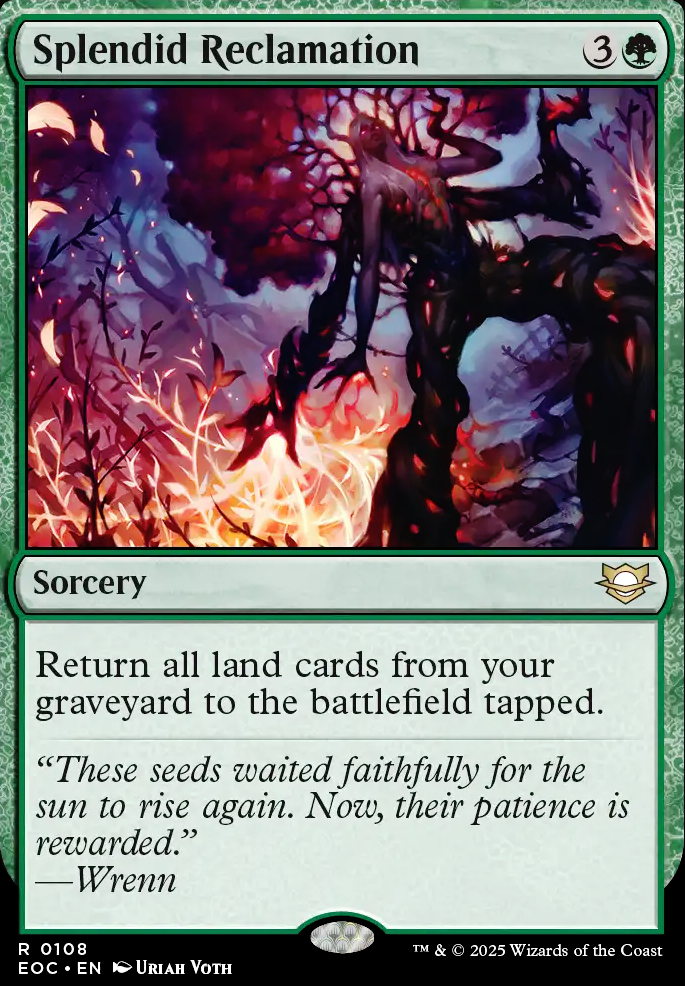
Sometimes it erupts through Valakut, the Molten Pinnacle, transforming ordinary land drops into devastating barrages of direct damage. Sometimes it manifests as overwhelming board states through Scute Swarm, Avenger of Zendikar, or Field of the DeadGC. Other games end with enormous landfall chains fueled by Scapeshift or Splendid Reclamation, where several turns of preparation suddenly become a single catastrophic turn that reshapes the entire battlefield.
What ties all of these victories together is not their mechanics, but their atmosphere.
The battlefield never feels stable.
Every additional land drop feels less like development and more like another crack spreading across the world's crust. Every recursion spell feels like buried forces pushing closer to the surface. Opponents often spend the early turns believing they are facing another value-oriented lands deck, only to realize much later that the terrain itself has become the primary threat.
Even the deck's largest payoff creatures reinforce this identity.
Cards such as:
do not simply reward landfall. They transform landfall into disaster. As more lands move through the deck's ecosystem, the battlefield itself begins participating in the destruction of the table.
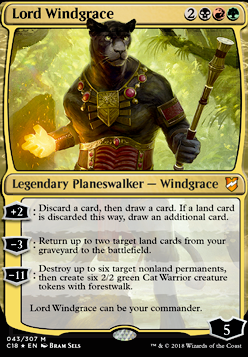
Lord Windgrace perfectly supports this strategy, but he is not its centerpiece. His ability to recycle lands, generate resources, and accelerate the movement between zones makes him an exceptional commander for the deck's game plan, yet Fault Lines is fundamentally larger than any single card. Windgrace is not the disaster.
He is merely the geologist reading the warning signs.
Fault Lines is ultimately a deck about tectonic instability. It spends much of the game quietly storing pressure beneath the battlefield before converting that accumulated energy into overwhelming bursts of landfall, recursion, direct damage, and battlefield dominance.
It is not building a thriving ecosystem.
It is preparing for an eruption.
What's In A Name?
The name Fault Lines emerged naturally as the deck evolved and its identity became clearer.
Early versions already contained recursive lands, graveyard engines, landfall payoffs, and explosive turns capable of overwhelming the table. Mechanically, many of the pieces were already present, but they lacked a unifying concept. The deck felt like a collection of powerful interactions rather than a strategy built around a single idea.
Over time, a pattern became impossible to ignore.
The deck was constantly building toward moments of release.
Lands entered the battlefield. Resources accumulated. The graveyard slowly filled with future recursion targets. Additional land drops stacked on top of one another while engines quietly assembled beneath the surface. From the outside, the board often appeared stable. Beneath that stability, however, enormous pressure was accumulating.
That process immediately called to mind geological fault lines.
Fault lines form as immense forces build beneath the earth's crust over long periods of time. The surface may appear calm while unimaginable stress continues accumulating underneath. Eventually, that pressure exceeds what the landscape can contain, and the result is sudden, violent, and impossible to ignore.
Fault Lines plays exactly the same way.
Cards such as:
do far more than generate value. They continuously move lands between zones, storing potential energy until an entire battlefield can be transformed in a single turn. Lands disappear into the graveyard only to return in overwhelming numbers, creating explosive chains of landfall triggers that feel less like incremental advantage and more like a natural disaster unfolding in real time.
The name also reflects the deck's relationship with the battlefield itself.
Most decks treat lands as passive infrastructure whose primary purpose is producing mana. Fault Lines weaponizes the landscape. Lands become direct damage through Valakut, the Molten Pinnacle. They become armies through Scute Swarm, Avenger of Zendikar, and Field of the DeadGC. They become sacrifice fuel, recursion targets, and engines capable of repeatedly rebuilding the battlefield after tearing it apart. The terrain is no longer supporting the game.
It has become the danger.
As the list became more refined, the name only grew more appropriate. Earlier versions leaned more heavily toward traditional landfall value, steadily generating resources until they eventually overwhelmed opponents. The current version is much more interested in converting accumulated pressure into catastrophic outcomes. Growth still exists, but growth is no longer the destination.
Growth is simply how instability is created.
That distinction is what ultimately defines the deck. Fault Lines is not cultivating an ecosystem or constructing an empire. It is widening stress fractures beneath the battlefield until the entire structure reaches its breaking point.
Eventually the pressure becomes too great.
The fault lines rupture.
Everything standing above them comes crashing down.
Primary Win Conditions
⚔️ Catastrophic Landfall
The deck most frequently wins by transforming accumulated lands into overwhelming battlefield pressure.
Cards such as:
convert ordinary land drops into enormous armies capable of overrunning entire tables. Individually, each payoff is threatening. Combined with recursive land engines and multiple-land turns, they create battlefield states that expand far faster than opponents can realistically contain.
The critical resource is not mana.
It is momentum.
As lands repeatedly cycle between the battlefield and graveyard, every recursion spell threatens to multiply the number of creatures already in play until the battlefield resembles an ecosystem consuming everything around it.
⚔️ Volcanic Devastation
Not every game requires combat.
Cards such as:
allow the deck to convert landfall and creature generation directly into damage. In these games, creatures function less like attackers and more like ammunition, while lands become artillery capable of ending games without ever entering combat.
By the time recursion engines begin returning entire graveyards to the battlefield, opponents often discover that stabilizing against creatures no longer matters because the battlefield itself has become the weapon.
♾️ Reality Collapse
Fault Lines contains one victory condition that feels fundamentally different from every other path the deck can take. Worldgorger Dragon and Necromancy create an infinite loop that repeatedly exiles and returns nearly every permanent under your control until the game can be ended. Mechanically, it is a combo finish. Thematically, it feels like the final consequence of everything the deck has been building toward.
Throughout most games, Fault Lines resembles earthquakes, volcanic eruptions, and shifting continents. The battlefield fractures, rebuilds itself, and gradually becomes more unstable with every passing turn.
When Worldgorger Dragon awakens, that instability becomes something far worse.
The world is no longer breaking apart.
Reality itself begins to fail.
Most games never require the Dragon. Landfall, direct damage, and overwhelming board states are more than capable of closing games on their own. But its presence reinforces the deck's identity perfectly. Buried beneath every other strategy is one final catastrophe waiting for the moment when all remaining containment finally gives way.
Playing The Deck
Fault Lines rewards patience far more than speed.
One of the easiest mistakes a new pilot can make is treating the deck like a conventional landfall strategy. The presence of additional land drops, powerful landfall payoffs, and enormous finishers can create the temptation to simply ramp as quickly as possible and overwhelm the table through sheer scale.
The deck is certainly capable of doing that.
It is rarely the strongest line.
Unlike many lands decks, Fault Lines does not become dangerous simply because lands enter the battlefield. Its strength comes from lands continually moving between zones. Lands are discarded, sacrificed, dredged, replayed, and returned from the graveyard in an ongoing cycle that steadily increases the amount of pressure stored beneath the battlefield.
Because of this, the graveyard should usually be viewed as an extension of your hand rather than a collection of lost resources.
Discarding lands to Lord Windgrace is often beneficial rather than costly. Sacrificing lands to Scapeshift or Nahiri's Lithoforming is usually preparation rather than destruction. Even dredging Stinkweed Imp frequently advances the deck's plan more effectively than drawing naturally.
The deck is at its strongest when it embraces this philosophy completely.
Many opponents look at a graveyard filled with lands and assume the deck has fallen behind. Experienced pilots understand that the opposite is often true. A stocked graveyard usually represents stored pressure waiting for the right moment to be released.
Most games naturally progress through three distinct stages. The early turns establish infrastructure through ramp, additional land drops, and graveyard development. The middle turns assemble recursion engines while quietly accumulating resources beneath the surface. Eventually, enough pressure has built that a single spell can convert several turns of preparation into a decisive advantage.
Recognizing when that threshold has been reached is one of the most important skills the deck asks of its pilot.
Until then, patience is almost always more valuable than aggression.
Key Engines And Synergies
The Pressure Engine
Every game begins with the same fundamental objective: establish a continuous cycle between the battlefield and the graveyard.
Cards such as:
form the foundation of that engine. Rather than allowing lands to become exhausted resources after producing mana, these cards ensure they continue generating value long after leaving the battlefield. Every cycle through the graveyard increases future recursion, strengthens landfall turns, and expands the deck's eventual ceiling.
The engine is not trying to maximize mana.
It is trying to maximize movement.
The more frequently lands travel between zones, the more dangerous every future recursion spell becomes.
Infrastructure Collapse
Most decks protect their mana base.
Fault Lines deliberately tears its own apart.
Cards such as:
allow the deck to dismantle its existing infrastructure before rebuilding it in a far more dangerous form. Entire mana bases can disappear into the graveyard only to return moments later with dramatically greater impact.
What appears destructive from the outside is often the deck's greatest source of acceleration.
Every collapse creates the opportunity for an even larger reconstruction.
The Fault Zone
Eventually, the stored pressure has to be released.
Cards such as:
convert repeated land movement into immediate battlefield impact. Every returning land becomes another source of damage, another landfall trigger, or another threat demanding an answer.
At this stage of the game, lands stop functioning as infrastructure.
They become the primary weapon.
The battlefield itself begins participating in the destruction of the table.
Why This Deck Plays Pressure
Most lands decks are fundamentally optimistic.
They assume that more lands lead to more mana, more mana leads to larger plays, and larger plays eventually lead to victory.
Fault Lines views the process through a different lens.
Growth is not the objective.
Pressure is.
Every fetch land, dredge trigger, discarded land, sacrifice effect, and recursion spell contributes to a larger cycle that steadily stores energy beneath the battlefield. The deck rarely appears explosive during its opening turns because explosions are not what it is trying to accomplish. Its early game is devoted to accumulation, allowing resources to collect beneath the surface until they can be released all at once.
This philosophy explains why so many cards in the deck appear comfortable with destruction. Lands are sacrificed willingly. Resources are discarded intentionally. Entire mana bases sometimes disappear in a single turn. From the outside, these actions can seem reckless. In practice, they are investments that make future turns dramatically more powerful.
Fault Lines understands something many strategies do not.
Resources become more dangerous when they are allowed to move.
A land sitting quietly on the battlefield produces mana.
A land repeatedly cycling between the battlefield and graveyard can generate armies, direct damage, card advantage, recursion, and inevitability. The movement itself is what creates the deck's momentum, and that momentum eventually reaches a point where opponents can no longer recover.
By then, removing individual creatures accomplishes very little. Destroying a single payoff rarely matters. Even answering one engine often fails to slow the deck meaningfully because the pressure has already been stored elsewhere.
The rupture is no longer preventable.
It is merely waiting for the right moment.
By the time opponents realize the battlefield has become unstable, they are no longer trying to stop the earthquake.
They're trying to survive it.