Archetype: Turbo–Control Flash Combo (Esper).

This list operates on asymmetric information, instant-speed pressure, and psychological disruption.

Unlike traditional Esper midrange or stax, it does not attempt to win the tempo war on board.

Instead, it weaponizes flash lines, hidden win conditions, and extreme counter density to punish opponents the moment they tap out or mis-sequence.

You function as a turn-cycle predator:

  • Stay reactive and low-commitment during your own main phase.

  • Threaten multiple instant-speed wins without revealing which one.

  • Force opponents to self-choke by respecting a win you may or may not have.

  • Dominate stack wars by compressing wins into tiny windows and forcing interaction on your terms.

  • Strike at the exact moment defenses break (almost always EOT).

Your victories come from extreme compression:

Winning off one or two spells (Borne / Naus, Flash → Oracle).

This gives the deck an unusually high ceiling, but demands tight sequencing, rules mastery, and strong table psychology.

Gameplan in one sentence:

Pass with mana → apply pressure with flash → win when shields drop.

Pilot Skill Requirement:

Very high. Correct play relies on timing discipline, efficient counter allocation, threat perception, and bluff-play.

This is not a brute-force deck. It is a precision instrument that rewards mastery.

While it excels in many competitive environments, there are metas and conditions where it is not the correct choice.

1.) Ultra-Fast, Low-Interaction Metas (RogSi Mirrors Everywhere)

Do not register this deck if:

  • The room is saturated with RogSi / RogThras / Jeska Turbo

  • Players consistently threaten turn-1–2 wins

  • Protection density is low and games are decided by raw speed

Why:

While this deck can race with Ad Nauseam, it is not built to all-in mulligan for T1 kills. You are optimized for:

  • Flash timing
  • Shield wars
  • Turn-cycle play

In a room where players ignore interaction and simply jam, you lose your biggest advantage: decision leverage.

2.) Mana-Dominant Commander Metas (Kinnan / Magda Heavy)

Avoid this deck if the top tables are filled with:

  • Kinnan, Bonder Prodigy
  • Magda, Brazen Outlaw
  • Fast commander-based mana engines that ignore the stack

Why:

Your interaction suite is stack-centric and tutor-punishing.

Commander-based mana engines:

  • Don’t care about Silence
  • Don’t fold to counter wars
  • Outpace your stax creatures

You can win these matchups — but you are playing uphill.

3.) Tables That Over-Index on Permanent Hate

This deck struggles when:

  • Collector Ouphe, Null Rod, and Stony Silence are omnipresent
  • Multiple players commit early to non-spell-based hate
  • Games slow to board-centric attrition

Why:

  • Your mana base and engines are artifact-leaning.

  • While you have answers, you do not want to spend early turns answering hate instead of sculpting.

4.) Pilots Who Prefer Linear or Scripted Lines

Do not register this deck if you:

  • Prefer deterministic, scripted combo lines

  • Dislike holding interaction and passing turns

  • Are uncomfortable with incomplete information and probabilistic decisions

Why:

This deck:

  • Rarely wins on autopilot
  • Rewards patience over aggression
  • Punishes mis-sequencing brutally

A single mistimed counter or premature Silence often costs the game.


When You Should Register It

For clarity, this deck is ideal when:

  • Pods contain mixed speed and interaction
  • Players respect the stack
  • Games reach turn 3–5 regularly
  • Pilot skill matters more than raw explosiveness

In these environments, Y’shtola becomes exactly what it’s designed to be:

A patient predator that wins when others blink.

PRIMARY WIN LINES (90%+ of actual wins)

1.) Thassa’s Oracle + Demonic Consultation / Tainted Pact

The fastest and most reliable win condition. This is fundamentally a Flash-Oracle deck, with multiple setups:

  • Borne Upon a Wind – instant-speed Oracle/Consult
  • Emergence Zone – EOT Oracle
  • Teferi, Time Raveler – flash + pseudo-uncounterability

Cephalid Coliseum – un-counterable looting/digging.

This is the deck’s core identity.

2.) Ad Nauseam (EOT)

With an Average MV of 1.41, Ad Nauseam is a deterministic engine. You don't just "value Naus". Use Y'shtola’s incidental lifegain to subsidize massive draws, typically finding the fast mana and tutors needed to win on the spot or in the following upkeep via Borne Upon a Wind.

The deck is closer to Turbo-Naus-Control than classic Turbo-Naus.

A resolved Naus gives you:

  • fast mana
  • tutors
  • Oracle + Consult/Pact

This makes opponents scared to tap out.

3.) Yawgmoth’s Will pseudo-storm

Yawgmoth’s Will is one of your three strongest cards.

Play back:

  • LED
  • tutors
  • fast mana
  • Petal / Moxen
  • Borne → Oracle
  • Reservoir kill

Often your best midgame win.

SECONDARY LINES (consistent but opportunistic)

  1. The Chrono-Kitten (Infinite Draw/Mana)

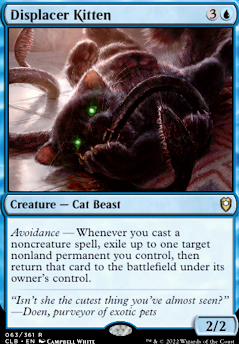
​Pieces: Displacer Kitten + Teferi, Time Raveler + 0-MV Artifact.

​The Advantage: This is a Protected Infinite. Because Teferi’s static ability is active, opponents cannot cast spells while the loop is executing.

​Result: Infinite Draw/Mana \rightarrow Oracle or Reservoir kill.

​5.) Hullbreaker Horror Loops

​A. The Tidespout Loop (Infinite Mana)

​Requirement: Two nonland permanents (Rocks) that produce more mana than they cost to cast (e.g., Sol Ring + Mox Opal).

​Creates: Infinite Mana and "Soft Locks." Use triggers to bounce every opponent’s permanent to their hand, effectively deleting their board state.

​B. The Top-Peel (Infinite Draw)

​Requirement: Hullbreaker Horror + Sensei’s Divining Top + Infinite Mana (from Loop A).

​Effect: Uses Hullbreaker triggers to bounce Top to hand with its draw ability on the stack.

​Result: Draws your entire library at instant speed.

​6.) Aetherflux Reservoir (The "Death Ray")

​Role: The ultimate "Storm" outlet.

​Synergy: Converts the high spell-density of Kitten and Hullbreaker loops into an immediate win.

​Clutch Utility: Allows for a win post-Ad Nauseam or Yawgmoth's Will without needing the graveyard or library (bypassing Rest in Peace or Orcish Bowmasters).

TERTIARY LINES (pod-dependent, niche)

7.) Orcish Bowmasters “machine-gun”

Not a real wincon but:

  • Kills pods during Twister loops
  • Wipes creature decks
  • Shuts down value engines

Can deal 20–30 damage with Twister/Will.

8.) Bloodchief Ascension

Not a primary win, but very effective because:

  • Y’shtola pings
  • Bowmasters pings
  • Deluge pings
  • Fetchlands
  • Street Wraith
  • Ad Nauseam turns
  • Will/Twister finish counters

Once active, every fetch/tutor/wheel becomes life-drain.

9.) Ranger-Captain Silence lock

Not a win by itself, but one of the strongest setups:

  • tutor Ranger
  • Ranger = Silence
  • Oracle wins under Silence

Backbreaking vs interaction-heavy tables.

Intuition — Conversion & Inevitability Tool

Intuition is not a deterministic win condition in this deck. Instead, it functions as a powerful conversion spell that transforms mana and card advantage into inevitability.

Unlike Breach based shells, Intuition here is used to force the opponent to give you the type of card you need, not a specific card.

When to Cast Intuition:

Midgame (Turn 2–4), after mana is established

When you already have:

  • A protected turn cycle
  • Or Yawgmoth’s Will in hand
  • Or enough mana to immediately capitalize

Intuition should never be cast blindly. It is a commitment spell.

Common Intuition Piles:

Must Find a Win

  • Demonic Tutor
  • Vampiric Tutor
  • Imperial Seal

Guarantees access to a win line on your next action.

Must Find Protection

  • Force of Will
  • Force of Negation
  • Pact of Negation

Used when preparing to force a kill window.

  • Must Find Mana
  • Mana Vault
  • Sol Ring
  • Grim Monolith

Converts a stalled hand into a winning turn cycle.

Oracle Setup (Midgame Only)

  • Thassa’s Oracle
  • Demonic Consultation
  • Tainted Pact

Note: Only use this pile if Yawgmoth’s Will is already in hand and your mana allows immediate recursion. This pile is not deterministic on its own.

Key Rule:

  • Intuition creates inevitability, not immediacy.
  • It guarantees access, not resolution.
  • And if your hand cannot capitalize on the card you receive, do not cast it.

FAST MANA / ACCELERATION (14):

Fast Artifacts (11):

  • Lion’s Eye Diamond
  • Chrome Mox
  • Mox Diamond
  • Mox Opal
  • Lotus Petal
  • Lotus Bloom
  • Mana Vault
  • Grim Monolith
  • Sol Ring
  • Talisman of Dominance
  • Talisman of Progress

Rituals (1):

  • Dark Ritual

Conditional / Land-Based Fast Mana (2):

  • Ancient Tomb
  • Gemstone Caverns

TUTORS / FINDERS (13):

Unconditional tutors (6):

  • Demonic Tutor
  • Diabolic Intent
  • Vampiric Tutor
  • Imperial Seal
  • Enlightened Tutor
  • Mystical Tutor

Conditional precision tutors (1):

  • Plunge into Darkness

Combo / line tutors (4):

  • Demonic Consultation
  • Tainted Pact
  • Intuition
  • Wishclaw Talisman

Graveyard tutors (1):

  • Entomb

Narrow / setup tutors (1):

  • Ranger-Captain of Eos - Finds 0-MV setup pieces (Lotus Petal/Moxen for Kitten loops) or protection/value (Esper Sentinel, Thassa's Oracle)

It has unusually high tutor density for Esper Flash.

CARD DRAW / VALUE ENGINE (14):

True draw engines (5):

  • Necropotence
  • Mystic Remora
  • Rhystic Study
  • The One Ring
  • Esper Sentinel

Engine-adjacent / swing value (2):

  • Smothering Tithe
  • Notion Thief

Cantrips (3):

  • Brainstorm
  • Ponder
  • Preordain

Free / conditional draw (4):

  • Gitaxian Probe
  • Street Wraith
  • Sensei's Devining Top (Engine. not draw)
  • Cephalid Coliseum (Conditional draw + Oracle Setup)

Grindy but compressed. Perfect for Flash-Combo.

INTERACTION / PROTECTION (22):

Free counters (7):

  • Force of Will
  • Force of Negation
  • Fierce Guardianship
  • Pact of Negation
  • Mental Misstep
  • Mindbreak Trap
  • Flusterstorm

Standard counters / stack control (3):

  • Swan Song
  • Mana Drain
  • Dovin’s Veto

Protective lock pieces (5):

  • Silence
  • Orim’s Chant
  • Grand Abolisher
  • Teferi, Time Raveler
  • Ranger-Captain of Eos (Silence on a body)

Removal suite (7):

  • Swords to Plowshares
  • Toxic Deluge
  • Deadly Rollick
  • March of Otherworldly Light
  • Otawara, Soaring City
  • Drannith Magistrate
  • Orcish Bowmasters

This is unusually high but it’s perfect for a deck that wins at flash and dominates stack wars.

DISRUPTION META PIECES (9):

Hard Meta Disruption (4):

  • Opposition Agent
  • Notion Thief
  • Drannith Magistrate
  • Orcish Bowmasters

Removal / Control (3):

  • Swords to Plowshares
  • Toxic Deluge
  • Deadly Rollick

Utility Disruption (2):

  • Strip Mine
  • Soul-Guide Lantern (Urza’s Saga target, graveyard hate)

FLASH / TIMING ENABLERS (4):

  • Borne Upon a Wind
  • Emergence Zone
  • Teferi, Time Raveler (Can flash sorcery-speed spells only. Not creature)
  • Ranger-Captain of Eos (Timing Window, not Flash)

GRAVEYARD / RECURSION / COMBO SUPPORT (4):

  • Yawgmoth’s Will
  • Entomb
  • Timetwister
  • Cephalid Coliseum

This gives a recursion, second chances, or deterministic piles.

WIN CONDITIONS / ENGINES (8)

Primary:

  • Thassa’s Oracle
  • Demonic Consultation
  • Tainted Pact
  • Ad Nauseam
  • Yawgmoth’s Will

Secondary Engines:

  • Displacer Kitten
  • Sensei’s Divining Top
  • Hullbreaker Horror

PAYOFFS (3):

  • Aetherflux Reservoir
  • Y’shtola, Night’s Blessed
  • Bloodchief Ascension

LANDS (29)

Fetch lands (8):

  • Bloodstained Mire
  • Flooded Strand
  • Marsh Flats
  • Misty Rainforest
  • Polluted Delta
  • Scalding Tarn
  • Verdant Catacombs
  • Windswept Heath

Dual / shock / filter / special color-producing lands (12):

  • Tundra
  • Underground Sea
  • Scrubland
  • Hallowed Fountain
  • Watery Grave
  • Godless Shrine
  • Morphic Pool
  • Exotic Orchard
  • City of Brass
  • Mana Confluence
  • Gemstone Mine
  • Command Tower

Utility / other special lands (9):

  • Ancient Tomb
  • Cephalid Coliseum
  • Emergence Zone
  • Otawara, Soaring City
  • Urborg, Tomb of Yawgmoth
  • Urza’s Saga
  • Strip Mine
  • Silent Clearing
  • Gemstone Caverns

Your deck mulligans aggressively for:

Priority #1: One of the draw engines

  • Mystic Remora
  • Rhystic Study
  • Necropotence
  • The One Ring

Priority #2: Fast mana + tutor

  • Chrome Mox / Diamond
  • Vault / Grim
  • Demonic Tutor
  • Intuition
  • Imperial Seal

Note: You are not looking for raw speed like RogSi. You are looking for mana + direction.

Priority #3: Protection

  • Force of Will
  • Fierce Guardianship
  • Force of Negation
  • Pact of Negation
  • Mental Misstep
  • Swan Song

Priority #4: Land quality

At least 2 lands or 1 land + rock.

Note: Protection is only good if you have something to protect.

Avoid hands that are:

  • All interaction, no engine
  • Slow-tutor hands with no mana
  • Y’shtola-only hands without a plan
  • All stax creatures but no gas
  • Three+ fetches, no business (rare but happens)
  • Hands that rely on topdecking an engine within 1–2 turns.

Turn 1

  • Deploy rocks / land.
  • Establish an engine (Remora/Rhystic).
  • Play Drannith if you expect fast combo.

Note:

  • You are not obligated to jam an engine T1 if it costs shields.
  • A protected Remora is better than a naked one.

Turn 2

  • Sit behind protection.
  • Begin sculpting a kill window.
  • Cast Y’shtola only if your hand wants to play tempo, not turbo.

Note:

  • Turn 2 is information-gathering.
  • You are testing shields, not forcing lines.

Turn 3

  • Most kills happen here.
  • Flash Naus, Flash Oracle, or protected Will/Twister loops.

Note:

  • If the window does not open, the deck is comfortable extending into Turn 4–5 behind engines and recursion.

1.) Cheap, narrow, spent early to win small fights.

  • Misstep
  • Swan Song
  • Flusterstorm

2.) Premium protection for tutors and combo pieces.

  • Fierce Guardianship
  • Dovin’s Veto

3.) Preemptive stack control. Used to avoid counter wars. Silence effects are prioritized over reactive counters when a kill is planned.

Silence Effects:

  • Silence
  • Orim’s Chant
  • Ranger-Captain

4.) Clutch protection or emergency stop only.

  • Force of Will
  • Force of Negation

5.) Used only when the game ends this turn.

  • Pact of Negation

Note: If you cast Force early, expect to lose later.

This deck is not forgiving. Most losses come from timing errors, not card quality.

If you lose, it is usually because you acted correctly… at the wrong moment.

1.) Jamming Engines Without Protection

Misplay:

  • Turn 1 Mystic Remora or Rhystic Study with no shields up.

Why it’s wrong:

A naked engine:

  • Gets removed immediately
  • Telegraphed your plan
  • Costs you tempo and information

Correct play:

  • A protected engine on Turn 2 is often stronger than an unprotected Turn 1 engine.

  • Passing with mana up is not a failure state in this deck.

Rule of thumb:

If you can’t defend it, you didn’t really cast it.

2.) Overvaluing Interaction in Opening Hands

Misplay:

  • Keeping hands with 3–4 interaction spells and no engine or tutor.

Why it’s wrong:

  • You are not a pure police deck.
  • Interaction without direction leads to eventual topdeck loss.

Correct play:

  • Interaction is only good if you have something to protect

  • You want mana + engine OR mana + tutor first

Rule of thumb:

Protection is not a plan — it’s insurance.

3.) Casting Y’shtola Too Early

Misplay:

  • Casting Y’shtola on Turn 2 “for value.”

Why it’s wrong:

  • She is not a turbo commander
  • She exposes you to removal before she pays off
  • She shifts you from predator to board-committer

Correct play:

Cast Y’shtola when:

  • You want to slow the table
  • You are playing tempo, not turbo
  • You already have card velocity or protection

Rule of thumb:

Y’shtola rewards patience, not speed.

4.) Casting Ad Nauseam at the Wrong Life Total

Misplay:

  • Firing Ad Nauseam without tracking expected damage.

Why it’s wrong:

Your deck is low CMC but not free:

  • Hullbreaker
  • Will
  • One Ring

Correct play:

  • Track your life proactively Use Y’shtola and incidental lifegain to buffer
  • Know when Naus is “draw 20” vs “draw 8 and die”

Rule of thumb:

Ad Nauseam is math, not hope.

5.) Overcommitting During Stack Wars

Misplay:

  • Firing multiple counters when a single Silence would end the fight.

Why it’s wrong:

  • This deck wins by compressing stack interaction, not escalating it.

Correct play:

  • Use Silence / Chant / Ranger proactively

  • Force opponents to act on your terms Let others fight first whenever possible

Rule of thumb:

The best counterspell is the one you didn’t have to cast.

6.) Forgetting You Can Pass

Misplay:

  • Feeling pressured to “do something” every turn.

Why it’s wrong:

  • Your greatest weapon is uncertainty.

Correct play:

  • Passing with mana open is a threat

  • Your opponents play worse when they fear flash wins

Rule of thumb:

Passing is an action in this deck.

7.) Failing to Rebuild After a Failed Attempt

Misplay:

  • Going all-in without a backup plan.

Why it’s wrong:

This deck is designed to recover:

  • Will
  • Twister
  • Engines
  • Tutors

Correct play:

Before committing, ask:

  • Can I rebuild?
  • Do I have recursion?
  • Can I pivot to control?

Rule of thumb:

You don’t need to win now; just before they do.

Final Reminder

This deck rewards:

  • Patience
  • Precision
  • Threat management

It punishes:

  • Impatience
  • Ego plays
  • Unprotected lines

You're not racing the table, you're hunting it.

Q: What kind of deck is this?

A: This is an Esper Flash Turbo-Control combo deck.

The deck is not all-in turbo like RogSi, nor is it a pure stax shell. It operates by:

  • Establishing early card advantage engines
  • Controlling the stack through Silence effects and premium interaction
  • Winning during opponents’ end steps or compressed turn windows

It excels at reactive dominance and timing-based kills.

Q: What is the primary win condition?

A: The primary win condition is Thassa’s Oracle backed by:

  • Demonic Consultation
  • Tainted Pact

These are usually executed:

  • At flash speed
  • With protection already established
  • Often during the last opponent’s end step

Q: Is Ad Nauseam a main plan or a backup?

A: Ad Nauseam is a main plan, not a desperation button.

This deck is built with:

  • A low average mana value
  • Free interaction -;Zero dead cards off Naus

Ad Nauseam is commonly cast:

  • At flash speed
  • After a Silence effect
  • Or when opponents tap low to interact with each other

Q: Why play Y’shtola instead of a traditional Esper commander?

A: Y’shtola provides three critical functions:

  • Sustainable card draw without committing to combat

  • Life buffering, which directly improves Ad Nauseam quality

  • Late-game inevitability in grindy pods

She is not required for early wins, but dramatically improves:

  • Turn 4–6 stability
  • Resource wars
  • Post-interaction recovery

Q: How important are Silence effects in this deck?

A: Silence effects are core to the deck’s identity.

They:

  • Replace counter wars with deterministic windows
  • Protect Ad Nauseam and Oracle lines more efficiently than counters
  • Allow the deck to win while holding fewer reactive spells

In many games, Silence is stronger than Force of Will.

Q: Why so much interaction?

A: This deck wins by controlling timing, not by racing.

High interaction density allows the deck to:

  • Protect engines
  • Prevent opponents from forcing wins
  • Sculpt safe kill turns

You're not trading interaction for speed. You're trading speed for inevitability.

Q: Why play Ancient Tomb and Gemstone Caverns?

A: These lands provide non-artifact acceleration, which is crucial in:

  • Collector Ouphe / Null Rod metas
  • Early engine deployment
  • Protected tutor turns

The life loss from Ancient Tomb is intentional and manageable.

Q: How aggressively should this deck mulligan?

A: Very aggressively.

Ideal opening hands include:

  • A draw engine or
  • Fast mana plus a tutor
  • At least one form of protection

Hands with only interaction and no direction should be shipped.

Q: When should Y’shtola be cast?

A: Y’shtola should be cast when:

  • The game is slowing down
  • You want to shift into tempo or grind
  • You have protection available

She should not be jammed early unless your hand supports it.

Q: Is this deck comfortable going long?

A: Yes.

Between:

  • Y’shtola
  • Timetwister
  • Yawgmoth’s Will
  • Multiple draw engines

The deck scales extremely well into turns 4–7 while maintaining win pressure.

Q: How does the deck handle fast combo pods?

A: By:

  • Prioritizing Silence effects
  • Deploying Drannith Magistrate early
  • Holding free interaction
  • Letting opponents fight first

This deck is excellent at punishing premature combo attempts.

Q: What are common mistakes when piloting this deck?

A: Common errors include:

  • Casting engines without protection
  • Overusing Force effects early
  • Treating Silence like a counterspell
  • Jamming Y’shtola too early
  • Forcing wins without redundancy

Patience wins more games than speed.

Q: What does a “perfect” win turn look like?

A: A typical clean win looks like:

  • End step Silence
  • Untap with shields
  • Flash Ad Nauseam or protected Oracle line
  • Minimal stack interaction

Game ends immediately

Q: Is Bloodchief Ascension a real win condition?

A: Yes, but it is a pressure payoff, not a primary combo.

It:

  • Punishes fetch-heavy pods
  • Amplifies wheel and Will turns
  • Creates inevitability without committing mana

Think of it as a threat multiplier, not a standalone win.

Q: Who should play this deck?

A: This deck rewards players who:

  • Track resources carefully
  • Understand stack sequencing
  • Prefer inevitability over speed
  • Enjoy flash-speed decision making

It is not beginner-friendly, but it is extremely powerful in experienced hands.

Suggestions

Updates Add

Comments

Casual

93% Competitive