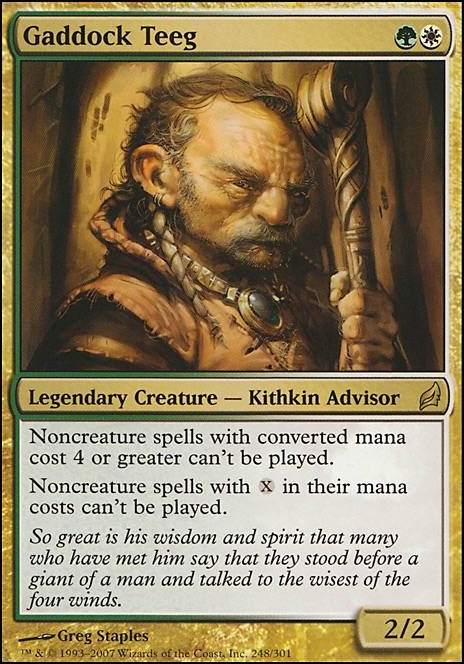
Welcome to Teeg Says ‘No!’

Hi there! Welcome to the description of this Selesnya, hate-bears deck; commanded by Gaddock Teeg. Beware of politicians, because like magicians they use words to transform reality into something that’s worth pursuing to their constituents, and worth dreading by their opposition. Teeg protects his people, by denying what you want to cast or use. He uses the laws of magic AND logic to deter you from your path, and he has many powerful followers that gladly spend their time (and lives) realizing his ends. Your creatures’ attacking/defensive capabilities: negated. Their triggered/activated abilities: useless. Your spells: powerless. Get ready for grand stretches of doldrums that will last long (unless you find the means to counteract them), punctuated by short moments of sheer terror. This deck is meant to be played casually. It’s not meant to be used in a competitive fashion, but of course anyone is welcome to try! Feel free to comment on anything you (dis)like throughout this description; hope you will enjoy it!

He’s the quintessential hate-bears commander. For a CMC of just 2 (for his first casting), one gets a 2/2 commander that prevents anyone from casting CMC4+ non-creature spells, including those pesky X-spells that so many players use as infinite-mana dumps. Of course this puts a giant targeting cross on one’s forehead, but that’s ok as Teeg’s Selesnya friends are useful and he’s just the beginning of all that inhibits!

The following parameters are used to determine the strength of the deck. For each, a score of 5 (very good), 4 (good), 3 (mediocre), 2 (bad) or 1 (very bad) has been allocated; when totalized this score represents the power rating of the deck.

  • Mana: indicates the availability of energy-sources within the deck.
  • Ramp: indicates the speed at which mana sources within the deck can be made available.
  • Card Advantage: indicates availability of filter- and draw resources represented within the deck.
  • Overall speed: indicates the deck’s potential for pace, based on resource availability and mana curve.
  • Combo: indicates the measure of combo-orientation of the deck.
  • Army: indicates the deck’s creature-army strength.
  • Commander: indicates how much the deck is commander-oriented/dependent (less dependency is better).
  • Resilience: indicates the measure in which the deck can prevent and take punches.
  • Spellpower: indicates the availability and strength of high-impact spells.

Mana: 2

Truthfully, this deck needs little when it comes to providing additional mana next to its land-base. There is some of course. Two mana dorks, three treasure generating-enchantments and a single mana rock provide a bit of extra mana-generating capacity.

Ramp: 3

Of course it’s possible to find some additional lands! From various sources, including four creatures and two enchantments.

Card Advantage: 5

Hate-bears becomes especially effective once one can combine several different restriction cards simultaneously in truly devastating combinations. So, a lot of additional card-finding mechanisms have been added to make sure this happens regularly. Amongst the opportunities are included seven (conditional)-draw options, three tutors (of which one is repeatable), one scry card and one top-deck resource (for lands and creatures).

Overall speed: 4

Though this deck doesn’t contain that many mana resources, its speed can still be quite high due to its ramping resources, card-advantage and the low average CMC the deck has (with 45 of its cards sitting at <= CMC 3).

Combo: 1

Nope, none of those in here.

Army: 5

Plenty of combat-power in this deck, ready to be unleashed on the opposition! None of the creatures are particularly strong and most of them just form a piece of the hate-bear puzzle. The deck also includes some token-soldier generation as well as decent combat boosters for the entire army.

Commander: 5

Gaddock Teeg’s power is spectacular, and his presence makes life very hard on some types of deck. However, he’s expendable and can also be replaced with cards that are slightly less powerful but share similar characteristics.

Interaction: 5

Preventing others from doing what they want is this deck’s forte. Inhibition is the name of the game, for the most part; especially when it comes to opposing spellcasting. No fewer than ten opportunities to inhibit non-creature spell and counter spell casting, five spells to destroy permanents and six other inhibitors of various types.

Resilience: 5

Adding great resilience to a deck that has some massive inhibition options ensures that it becomes very hard to truly harm its controller. This deck offers a few protection options (two cards), some hexproof (three cards), a few indestructibility options (four cards) and some excellent recursion (four cards). On top of that, it has two ways to save all its permanents from wipes.

Spellpower: 4

Most of this deck’s high-powered spells reside in the enchantment section (ten cards) but there’s also a few excellent instant protection spells here.


Total power score: 39

The reason for this deck’s relatively high power-score is multifold. First off, it’s easy to get off the ground due to its nice balance of resources and low average CMC. Second, it impacts every opponent participating in a negative way; some more than others depending on the inhibition one can play and the opposing decks one faces. Especially the casting-inhibitions can be brutal on most decks. Third, it’s resilient and its permanents are very hard to get rid of.

The general idea is to stack up on inhibition resources (usually in the form of creatures) the combinations of which strengthen one another and eventually have enough force to overwhelm the opposition through combat. There’s a few game-finishers here that help the latter bit along. Some general notes on the deck’s use:

  1. It requires a conservative style of play. Survival of the deck’s wielder (and his/her permanents) should take precedence over trying to do massive amounts of damage (unless the latter can close out a game in one’s favor of course).
  2. Attack whenever it’s possible to do so without losing (many) forces. There’s no rush to close out games and the more one can stack inhibition upon inhibition, the harder it will be for opponents to really hurt you anyway. Might as well take the time and finish it with an all-out attack once the means become available for one.
  3. Keep going with the casting of inhibition-spells and stack those effects; hate-bears always puts a target on one’s forehead, so one’s all in or one’s out.
  4. Teeg’s casting-inhibition is very powerful and should be in-game as much as possible. Try to keep him alive (do not attack or block with him), though not necessarily at all cost as he’s cheap to recast.
  5. Destruction-resources need to be used sparingly; the deck doesn’t have many. The ones included are here to get rid of opposing artifacts/enchantments that specifically somehow destroy or inhibit the deck’s creatures and/or artifacts and enchantments. Creature destruction can be done purely through combat.

At least three cards in the starting hand ought to be lands (or two lands and a cheap-to-cast dork/ramp/rock like Birds of Paradise, Exploration, Lotus Cobra or Sol Ring. This is a must; it’s recommended not to start a game without this hand (even if one has to mulligan down to three cards). The ideal hand would also contain some additional ramp and/or low-cost draw options.

You’re not going to be needing oodles of mana to make a major difference with this deck. Start out with a bit of resourcing (focusing more on additional draw than mana sources) and then switch primary casting to inhibition (and resourcing secondary). Aside from the cards mentioned in the previous section, some excellent early draw resources include stuff like Augur of Autumn, Esper Sentinel, Mirri's Guile and Sylvan Library while Land Tax and Weathered Wayfarer can fulfill some additional mana needs.

Once some basic resources are standing, focus on slowing the opposition down by introducing some early inhibition OR by focusing on cards that allow you to benefit from certain opposing actions. Cards belonging to the prior category would be Aura of Silence, Authority of the Consuls, Boromir, Warden of the Tower, Collector Ouphe, Deafening Silence, Drannith Magistrate, Grand Abolisher, Null Rod and Stony Silence, while cards from the latter category would include Archivist of Oghma, Aven Mindcensor, Runic Armasaur, Smothering Tithe and Smuggler's Share.

By now annoyance has set in on what’s being prevented and players will be looking to remove the deck’s stuff from the field so that their plans can proceed unimpeded. Hexproof and protection are required to keep stuff firmly situated on the battlefield. Resources to ensure that are numerous in this deck. They include Giver of Runes, Mother of Runes, Privileged Position, Shalai, Voice of Plenty, Sterling Grove and Tajuru Preserver. There’s also some one-shot deals included to keep forces where they are, like Heroic Intervention, Selfless Spirit and Teferi's Protection. In case something actually dies/is destroyed, there’s plenty of means available to return that to the battlefield. Some examples: Sun Titan and Wheel of Sun and Moon.

With the utilities set up to keep a continued presence a (near) certainty on the battlefield, it’s time to hammer down some more on the inhibitions one can setup for our dear opponents. Slightly more expensive to cast resources like Angel of Jubilation, Archon of Valor's Reach, Elesh Norn, Mother of Machines, Linvala, Keeper of Silence, Myrel, Shield of Argive, Sigarda, Host of Herons and Yasharn, Implacable Earth.

It’s fun to keep stacking inhibition upon inhibition onto opponents’ shoulders, but there comes a time when they’re practically begging to end it and put them out of their misery. Quite a few game-finishing creatures have been added to turn such ambitions into reality. We’re talking Craterhoof Behemoth, Elesh Norn, Grand Cenobite, Saryth, the Viper's Fang and Vigor.

There’s some fun to be had when combining Seedborn Muse with the following cards in this deck:
  • Gavony Township/Shalai, Voice of Plenty: Use some mana to give every creature +1/+1, and then do it again during someone else’s turn.
  • Saryth, the Viper's Fang: A fun one; allows to benefit from her granting deathtouch to all our stuff during our attacks, and then hexproof during all turns on which one’s just defending.
  • Yisan, the Wanderer Bard: Tutor for a potentially more powerful new creature every turn instead of just during one’s own turns; makes our board-state much more problematic for the opposition much faster.

Reliable sources of mana, and some utility:

The cards used to accelerate mana-availability:

  • Augur of Autumn: allows one to top-deck lands, which is just beautiful and later creatures which is even better.
  • Birds of Paradise: just a decent dork.
  • Exploration: because playing more lands than one a turn creates more available resources faster.
  • Land Tax: cheapest form of ramp to cast, and yet so powerful because it can be repeated whenever one’s behind in land count.
  • Lotus Cobra: putting land on the battlefield now yields an energy potential without tapping said lands.
  • Monologue Tax: there will be no free oratories in this city!
  • Smothering Tithe: an easily triggered treasure-generator
  • Sol Ring: are there EDH decks without this card?
  • Weathered Wayfarer: if one’s behind on lands with someone, this can be used to grab one.

The mechanisms that provide card advantage:

The mission is to stop you from doing stuff, and these cards will enable that.

  • Angel of Jubilation: temple-of-doom-sacrifices are a thing of the past.
  • Aura of Silence: let’s add some tax to your most powerful, permanent spells.
  • Authority of the Consuls: when your stuff enters the battlefield, it must bow (it’s polite).
  • Aven Mindcensor: search all of your cards? Nah … a slight sub-selection will do.
  • Boromir, Warden of the Tower: free spells? Not going to happen!
  • Collector Ouphe: that’s a nice paperweight you have there.
  • Containment Priest: if they’re coming out of nowhere, they’re not going anywhere.
  • Deafening Silence: you’ve just been put on NCS rations, have fun with that.
  • Drannith Magistrate: a GY-strategy? Casting from exile? That’s such a shame…
  • Elesh Norn, Mother of Machines: not added for this deck’s benefit (almost no ETB-abilities in this deck), but instead added to keep you from benefiting from yours.
  • Grand Abolisher: no-one gets to cast outside of their own turns; completely disables blue counter-decks.
  • Linvala, Keeper of Silence: so powerful it almost defies belief; many creatures’ value in the game depends entirely on their activated abilities and this wonderful angel shuts them all down.
  • Myrel, Shield of Argive: allows for some major disruption on the opposing side during the deck’s turns and generates tokens upon attacking to boot; what’s not to love?
  • Scavenging Ooze: graveyards can be great places to find food for this guy.
  • Stony Silence: you can shake it all you want; it still won’t work!
  • Thalia, Heretic Cathar: meant to slow our opponents down.
  • Yasharn, Implacable Earth: a boar that drops the heavy end of its tusks on a lot of Golgari, Grixis, Jund and Orzhov decks in that it disables some of their most powerful abilities and combos.

You were doing what now? Didn’t really notice because of these cards.

  • Giver of Runes/Mother of Runes: are you really saying that you’re trying to destroy, maim or otherwise harm that? But, but … it’s your friend?!
  • Heroic Intervention: here comes the pain! Or maybe not.
  • Privileged Position: you get hexproof! You get hexproof, you get hexproof! Everything is getting hexproof!
  • Prowling Serpopard: countering the deck’s creature spells suddenly stops.
  • Shalai, Voice of Plenty: can’t protect herself; just everyone else.
  • Sigarda, Host of Herons: shuts down a whole bunch of Golgari and Mardu stuff; no-one will force this deck to get rid of its treasured permanents anymore.
  • Sun Titan: the answer to: what if a resurrection engine could fight?
  • Tajuru Preserver: those Eldrazi are cool … too bad annihilator doesn’t work though.
  • Teferi's Protection: love the looks of dismay when opponents, thinking they’ve just played a winning set of cards, wind up having everything they’ve just done invalid.
  • Vigor: what doesn’t kill them, makes them stronger.
  • Wheel of Sun and Moon: infinite recycle of all the deck’s stuff.

A smattering of cool stuff that strengthens our permanents or destroys yours.

Some cards that didn’t make the cut but were considered:

  • Archon of Emeria: not a bad card, but the fact that she prevents from casting more than a single creature per turn is a turn-off.
  • Rest in Peace/Soulless Jailer: some resurrection options in this deck are nice, and these fly in the face of having such options available.

Appreciate the time you took to read this description. Hopefully it was entertaining and useful to you. If so, feel free to leave a +1 and/or feedback of any kind in the comments below. Thanks again!

Suggestions

Updates Add

Comments

Casual

93% Competitive

Revision 4 See all

(2 months ago)

+1 Beast Within main
-1 Clarion Conqueror main
+1 Containment Priest main
-1 Eternal Witness main
+1 Generous Gift main
-1 Luminous Broodmoth main
+1 Savannah main
-1 Selfless Spirit main
+1 Silverback Elder main
-1 Sterling Grove main
+1 Survival of the Fittest main
-1 Temple of Plenty main