Welcome to His Royal Highness of Blinkalot

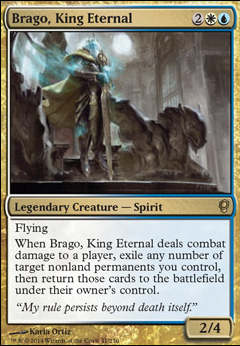
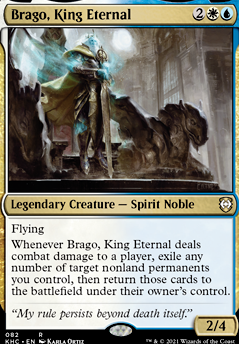
Hi there! Welcome to the description of this Azorius, control and ETB deck; commanded by Brago, King Eternal. From the High City of Paliano, comes a politician of skill unequalled across all the planes. An orator that no one could ignore, with arguments that dazzled all and negotiation skills that would encapsulate the worst of his adversaries. It is unfortunate that he came to pass early in his life, shortly after attaining the highest office in his career. Yet his spirit endured and lost none of the potency it had in life. In truth, he has always remained one of THE great powers within the Azorius guild. Sure, … some say he is but a puppet of Fiora’s Custodi order. Some say his spirit was hunted down and destroyed by the planeswalker Kaya. Do not listen to these naysayers, as all of them were deceived. For a long time, our king retreated into the nether realms to study ancient powers beyond the veil, and now he has returned. Strengthened by immense knowledge, awakened, by the transgressions of the unjust, the foul acts of the unrighteous and the corrupt. He returns to the hunt, placing his comrades and magical powers in battle when it best suits him. All manner of dark creatures and magic users beware … for your doom has come! This deck is meant to be played casually. It’s not meant to be used in a competitive fashion, but of course anyone is welcome to try! Feel free to comment on anything you (dis)like throughout this description; hope you will enjoy it!

Enter-the-battlefield triggers of permanents are usually a one-shot deal, which is why many of them are good at providing something very useful at relatively low cost. However, when such triggers can be repeated, then even seemingly innocent-looking advantages suddenly become a whole lot more dangerous to the opposition. Sure, it requires Brago to damage our foes, but there are ways to ensure this happens relatively easily. Also, when you’ve got a deck tuned to this kind of advantage, there is so much potential for value every turn from him blinking permanents out of and back into existence, it can become right out slightly ridiculous. On top of his prime power, Brago’s a capable combatant as a 2/4 flyer and costs a reasonable price to summon.

The following ten parameters have been used to determine the strength of the deck. For each, a score of 5 (very good), 4 (good), 3 (mediocre), 2 (bad) or 1 (very bad) has been allocated; when totalized this score represents the power rating of the deck (maximum score is 50 points).

  • Mana: indicates the availability of energy-sources within the deck.
  • Ramp: indicates the speed at which mana sources within the deck can be made available.
  • Card Advantage: indicates availability of filter- and draw resources represented within the deck.
  • Overall speed: indicates the deck’s potential for pace, based on resource availability and mana curve.
  • Combo: indicates the measure of combo-orientation of the deck.
  • Army: indicates the deck’s creature-army strength.
  • Commander: indicates how much the deck is commander-oriented/dependent (less dependency is better).
  • Interaction: indicates how much this deck can mess with opponents’ board states and turn-phases.
  • Resilience: indicates whether the deck can prevent and take punches.
  • Spellpower: indicates the availability and strength of high-impact spells.

Mana: 3

The number of direct mana-resources available within this deck is mid-range, compared to the average deck. Currently there is room for three rocks, two artifacts that cheapen casting and one enchantment that relinquishes treasure tokens whenever my opponents try to draw something without paying for it.

Ramp: 1

Some cards were added to find land; one of them is a one-shot deal (though that can change with Brago’s help), two of them can be repeated without the need for additional resources.

Card Advantage: 5

One of the deck-aspects at which the Azorius guild really excels. To ensure decent availability of resources, seven direct draw options have been added (taking into account that most of these should be cheap to use, which at least half of them are), two filter options, four tutors (these are in here to get a better chance at enabling a combo) and a single option to steal opponents’ stuff.

Overall speed: 4

Pretty good. In total, the number of spell-casting resources available in this deck amounts to twenty. With an average CMC of just over 3, this means we have a decent chance at kicking off well within the first few turns and retain momentum.

Combo: 4

Ow yeah, this deck can screw around with several things. Some combinations can grant infinite mana, while others can grant infinite blinks or even infinite turns. Then there are some combos that allow me to steal everything or put the rest of the board in a stasis lock.

Army: 2

In terms of combat power, this deck does employ a few minor-battlecruiser type cards. However, the vast majority of this deck’s creatures provide utility and inhibition value. A fair number of creatures make up the deck’s army though, so it’s definitely not powerless.

Commander: 2

There’s so much ETB value from blinking and Brago is the ultimate enabler of this. Not having him around is therefore seriously detrimental to most plays this deck. Some back-ups have been included for this kind of power, but it’s nowhere equal to his.

Interaction: 5

Seems to me there’s a lot of that in this deck. First there’s the eight options for spot removal; some against multiple permanents simultaneously. There’s also some sick mass inhibition and removal in here. Then there are three cards that restrict opponents’ spell casting and four cards that restrict the use of permanents or entire phases within turns.

Resilience: 3

An excellent way to protect permanents from harm, is by blinking them when they become the target of opposing spells/abilities (three options). Then there’s a way to grant permanents protection from specific colors, grant them hexproof and even (temporarily) phase them out of reality. Finally, life-gain can recoup some life lost.

Spellpower: 3

Blinking back-up is provided by creature- and non-creature options in the form of instants and a planeswalker. Some spells have been added that can grant an extra turn or two, a few high-powered wipes and let’s not forget the spells that can lock down entire boards.


Total power score: 32

Scores a little above average. Good combination of resources and speed and featuring a lot of interaction, which doesn’t just make it versatile and powerful but a lot of fun to use too. This deck can get crazy once its board-state is allowed to get out of hand. It holds its own in the average multi-player game.

The Azorius guild does very well in the inhibition department. There’s a plethora of ETB-cards available to them that are excellent on this front. To utilize these cards in the best way possible, one needs an early Brags. Also, one needs the means that will allow him to survive for more than a turn or two. Whether one chooses to prioritize some early ETBs versus the commander doesn’t really matter all that much regarding a game’s outcome if one keeps to the mantra of him appearing during the early game. Once he’s there, and inhibition options are available, the mid-game starts and it’s time to pick priority opponents and harass them first. Focusing on one or two at a time works best, but if the entire table decides to turn against the deck, it’s still a survivable predicament in some cases (though picking out (temporary) allies at this point greatly increases chances of survival (and winning)). This needs to be kept up until either the opponents have been destroyed, or one gets the chance to combo off and get some hilarious situation going.

At least three cards in the starting hand ought to be lands (or two lands and a cheap-to-cast rock like Arcane Signet, Mana Vault, Sol Ring, Pearl Medallion or Sapphire Medallion). It is recommended not to start a game without this hand (even if one has to mulligan down to three cards). The ideal hand would also contain some additional ramp and/or low-cost draw options.

There are some ideal early-game cards in here that are recommended to be prioritized. First and foremost are any of the cheap rocks mentioned in the previous section, as well as cheap ramp like Land Tax and Weathered Wayfarer. Then there’s some taxation options that can be used almost immediately to great effect, like Esper Sentinel and Mystic Remora (or Smothering Tithe). To prepare for Brago’s arrival, prioritize cards like Mother of Runes, Grand Abolisher and Swiftfoot Boots, so that he can immediately be fit with some protection upon entering.

Now our beloved commander can enter the field, as well as some early inhibition should it become available. Summon Brago, King Eternal along with stuff like Aqueous Form, Spirit Mantle, Steel of the Godhead or Whispersilk Cloak. Doesn’t really protect him against spells/abilities but turns him into an unblockable attacker which is very useful to damage opponents and have him blink the deck’s permanents. Speaking of those, depending on how fast opponents are at building up a board-state, choose what blink food appears first. If they’re fast, prioritize inhibition over additional resources. These would be cards like Glen Elendra Archmage, Reflector Mage, Soulherder or War Priest of Thune. However, if opponents are relatively slow, might as well take the time to drum up some more resources and make the mid- and end games that much more of an overkill. Cheap-to-cast options would then include Augury Owl, Charming Prince, Solemn Simulacrum or even Recruiter of the Guard. Lastly, try to get a doubling effect of ETB’s in here at this stage; to turn the ridiculousness of it all up a notch. Strionic Resonator or Panharmonicon or would be gorgeous, while Preston, the Vanisher will make it insane.

Time to single out one or two opponents and put down the hurt. Aside from some of the blinking options already available by now, one should have enough resources now to get some bigger fish around to support the deck’s strategy. For some inhibition/removal, use Azor, the Lawbringer, Reality Acid and Spine of Ish Sah. For some additional resources as well as some protection/recursion, there should now be means to summon and abuse Agent of Treachery, Beza, the Bounding Spring, Resolute Archangel and Sun Titan.

Aside from having Brago around to blink stuff, this is also the phase to build in some redundancy (if this hasn’t been done already) and get some more blink enablers in here. Deadeye Navigator, Eldrazi Displacer, Felidar Guardian or Venser, the Sojourner can help here. Eerie Interlude and Ghostway have also been included as one shot blinking deal. Vedalken Mastermind is great in this function as well. Not a full-on blink enabler but it often beats using him to help evade removal of a permanent.

By now one should be able to blink enough to make life much harder for several opponents; some of which may have expired resulting from said blinking. In terms of combat, the critters within this deck have also dealt decent damage by now (hopefully helped along using Cathars' Crusade). So, with a little luck, during this stage one can combo off with infinite mana, creatures, turns or whatever else.

  • Brago, King Eternal + Mana Vault/Sol Ring + Strionic Resonator: This combo requires Brago managing to have his ability triggered and an untapped Ring/Vault.
    1. Brago’s ability lands on the stack. This triggers Resonator.
    2. Tap Ring/Vault to provide mana to activate Resonator (which also taps) and copy Brago’s blinking ability.
    3. The copied blinking ability lands on the stack. Now resolve the stack, starting with the copied blinking ability.
    4. This blinks Ring/Vault (as well as any other non-land permanent one would want to do this with) and Resonator; they each return to the battlefield untapped, which allows for repeating the copying of Brago’s ability with Resonator again.
    So to summarize: infinite blinks (and infinite colorless mana if one uses Vault, as it nets one per cycle)!
  • Eldrazi Displacer + Peregrine Drake:
    1. Tap 3 (colorless) mana to activate Displacer’s ability and blink Drake in and out of existence.
    2. This triggers Drake’s untap ability and allows the untapping of five lands.
    Rinse and repeat for infinite untaps (and thus infinite mana).
  • Eldrazi Displacer + Gilded Drake: This combo is really swanky; Displacer is unique in how its blinking ability works, in that it can target a creature one does not control, blink it and then return it to its owner’s control. In other words, it can retrieve creatures that are stolen. In Drake’s case, it returns a creature that one willingly gave to an opponent, only to exchange it again (maybe with the same opponent) for something else worth stealing!
  • Static Orb/Stasis + Sword of Feast and Famine + Brago, King Eternal: With Brago around and damaging opponents, this combo locks up opposing boards for the most part, while Brago’s blink untaps all non-land permanents without the need for an untap phase. Add Sword to the mix, and one even manages to untap all the deck’s lands after a successful attack (please note that without Sword, this combo will fail when using Stasis and one doesn’t have an artifact available that can provide during the upkeep).
  • Static Orb/Stasis + Vedalken Mastermind:
    1. At the end of turn, summon Orb/Stasis; make sure to keep available.
    2. During last opponent’s turn, use Mastermind’s ability to bounce Orb/Stasis back into hand.
    Rinse and repeat during own turn.
  • Archaeomancer + Brago, King Eternal + Cyclonic Rift: This combo requires Brago’s ability to be triggered, Rift in graveyard and the means to generate at least 6. So Rift was either already used, milled or discarded before. When Mancer is blinked, use the ability to return Rift to hand and cast if after, bouncing all opposing non-land permanents. If at least one opponent is kept from summoning a flying blocker the following turn, these steps can be repeated every turn.
  • Archaeomancer + Brago, King Eternal/Felidar Guardian/Soulherder + Time Warp/Temporal Manipulation: When Mancer is blinked, use the ability to return Warp/Manipulation to hand and cast if after; allowing a new turn after the current one. Presto, infinite turns!
  • Archaeomancer + Displacer Kitten + Time Warp/Temporal Manipulation: When casting Warp/Manipulation, Kitten is triggered. Use Kitten’s ability to blink Mancer. This triggers Mancer’s ability, use it to return Warp/Manipulation to hand. Warp/Manipulation can be cast in the next turn. Presto, infinite turns!
  • Smothering Tithe + Stasis: This is a neat little trick to keep the board in Stasis lock, without the deck’s controller having to worry about having enough mana available to pay for the necessary upkeep costs.
  • Felidar Guardian + Clever Impersonator/Phyrexian Metamorph + Altar of the Brood: This combo starts with Guardian and Altar on the battlefield.
    1. Summon Impersonator and turn it into a copy of Guardian.
    2. This triggers the copied Guardian’s blink-power AND Brood’s milling power.
    3. Resolve the mill first and mill one card of all opponents’ libraries.
    4. Now resolve the blink and target the original Guardian.
    5. This triggers the original Guardian’s blink-power AND Brood’s milling power.
    Rinse and repeat.

Reliable sources of mana, and some utility:

The cards used to accelerate mana-availability:

  • Arcane Signet: cheap-to-cast, doesn’t come into play tapped and grants any Azorius mana whenever tapped.
  • Land Tax: arguably the best non-green land-fetching device that was ever created and it’s a staple in plenty commander decks featuring white.
  • Mana Vault: a great accelerator in the early game, and wonderful when combined with Brago as he can blink Vault and thereby untap it (saves the cost of untapping it in the conventional way).
  • Pearl Medallion: cheapens all the deck’s white spells; score!
  • Peregrine Drake: this guy basically comes into play for free, provided one starts out with enough land-based mana to summon him. If one can also blink him afterwards, that’s 5 land untaps for free.
  • Sapphire Medallion: cheapens all the deck’s blue spells; score!
  • Smothering Tithe: pay taxes for drawing! You don’t want to? Thank you for the mana!
  • Sol Ring: are there EDH decks without this card?
  • Solemn Simulacrum: this guy gets a lot more interesting with Brago around, as he can now land-fetch whenever he’s blinked. Too bad the card draw only gets triggered upon his death, instead of him leaving the battlefield.
  • Weathered Wayfarer: fetches any land, not just basics, provided someone else currently controls more lands.

The mechanisms that provide card advantage:

  • Agent of Treachery: steals something valuable when blinked and even enables draw when enough items have been stolen overall.
  • Archaeomancer: spell recursion is in several ways a great combo enabler; especially when we can ETB/XTB the hell out of this thing.
  • Charming Prince: filtering is the key to finding the stuff needed, so scrying on ETB is extremely useful, which can be repeated when blinking is applied.
  • Cloudblazer: not just card advantage, but some life-gain as well; in here because she’s great blink-food.
  • Emeritus of Ideation: when it ETB’s, it brings perhaps the most famous and certainly one of the most potent draw spells with it that has ever existed.
  • Enlightened Tutor: success with this deck can depend a great deal on its enchantments and artifacts, so it’s a good thing to have some tutoring options for these.
  • Esper Sentinel: draw unless opponents pay tax; most decide not to pay.
  • Gilded Drake: one of the greatest theft-cards MTG ever produced; cheap to use and allows one to steal whatever available powerful creature (provided it doesn’t have hexproof/shroud at the time).
  • Mystical Tutor: thrown in here to find spells that would be needed in emergencies or to find combo-piece spells like Rift or one of the Time-spells.
  • Omen of the Sea: upon ETB, this allows scrying and drawing; perfect.
  • Recruiter of the Guard: a tutor for some of the combo pieces that’ll be needed.
  • Sun Titan: helps to recover the vast majority of this deck’s permanents.

When you ought not be using certain permanents:

  • Curse of the Swine: you’re all PIGS! Pigs!
  • Cyclonic Rift: gets rid of all opposing permanents except lands for a measly 7 mana; which is almost win-enabling by itself under the proper circumstances.
  • Fierce Guardianship: potentially a free-to-cast counterspell; has wonderful applications for situations in which one is tapped out.
  • Glen Elendra Archmage: this wonderful girl provides two counterspells at negligible cost; but if she’s blinked, her -1/-1 counter (obtained through the persist mechanic) disappears; so … infinite cheap counterspells? Very nice!
  • Heliod's Intervention: gives the choice to kill off a bunch of enchantments and artifacts; or just a whole lot of life.
  • Reality Acid: opponent is forced to sacrifice a permanent. Great removal, especially when it can also be blinked (and thus re-used).
  • Spine of Ish Sah: by itself, as bit expensive as removal hardware but with Brago around it becomes much more cost-efficient.
  • Swords to Plowshares: your life gets increased, at least for a fleeting moment, yet your titan over there has been atomized into nothingness forever!
  • War Priest of Thune: breaks a spell on ETB; powerful when combined with blinking.

Protection from harm until the hammer can be brought down.

  • Aqueous Form: used to protect Brago during attacks; allows for scrying as well.
  • Azor, the Lawbringer: aside from him being a repeating Sphinx's Revelation, he prevents some major spell-casting opportunities for the opposition; downright killing if he can be blinked to anyone using a spell-slinging deck.
  • Grand Abolisher: opposing casting only happens in opposing turns.
  • Mother of Runes: protects permanents from targeted removal or other nastiness.
  • Reflector Mage: this is mean when blinked, as it can basically be used to prevent an opponent from casting (and using) their commander. Gets even more awesome when there’s blinking redundancy available, so that multiple commanders can no longer be used.
  • Spirit Mantle: great protection for an attacking Brago.
  • Stasis: no untap phase for anybody; combines very well with Brago as he blinks (and thereby untaps) all the deck’s (non-land) permanents when he successfully deals damage to opponents.
  • Static Orb: almost as restrictive as Stasis but does not require upkeep cost to survive.
  • Steel of the Godhead: makes Brago a hell of a lot tougher, unblockable and allows for draw on top of it all.
  • Stonehorn Dignitary: stops the strongest army from messing with this deck during combat; becomes crazy effective when blinked.
  • Swiftfoot Boots/Whispersilk Cloak: additional protection for Brago.
  • Sword of Feast and Famine: protection for Brago; also allows Brago to attack opponents featuring either of the colors for which Brago gains protection with impunity (so guaranteed blinking trigger).
  • Teferi's Protection: wonderful card to protect the deck’s board-presence in case someone decides to try and wipe it out.

In case Brago can’t make it to the party.

  • Deadeye Navigator: blinking through soulbond; very useful as it allows one to blink whatever is relevant, even without Brago successfully attacking first.
  • Eerie Interlude/Ghostway: one-shot mass blinking spells.
  • Eldrazi Displacer: such a good card for multiple reasons. First off, it’s activated just by paying mana, as long as resources are available one can keep blinking creatures with this (especially funny if one manages an infinite mana combo). Second, it can blink creatures controlled by opponents and return them to their owners. That may not sound like much of an advantage, but it can be downright nasty. For instance, this means it can return stolen creatures (which is also a great political tool) to their owners. When blinked, creatures also lose all counters placed on them, and that’s usually a bad thing for opposing creatures.
  • Felidar Guardian: unlike Brago, this wonderful card can blink any permanent (so even lands!), yet only one at a time though. It requires an ETB, so it needs a combination of other cards to make the whole concept more powerful.
  • Soulherder: blinks a creature at the end of turns; the least impressive example in this deck acting as a redundancy for Brago, but still quite useful. Also, when not blinked, Brago’s blinking can make it very strong quite quickly.
  • Thassa, Deep-Dwelling: an additional blink every
  • Venser, the Sojourner: helps overall strategy in three ways; he’s a blinking back-up for Brago, he has an ability that can make Brago unblockable and his ultimate yields an excellent inhibition mechanism.

And then there are these cards.

  • Altar of the Brood: this synergizes so well with Brago’s blinking; gets pretty insane when you reach the mid-game and no-one has had the change to destroy this beauty or perform a wipe.
  • Beza, the Bounding Spring: holy mackerel; what a great utility piece with a blinking engine like Brago around! Down in mana? It’ll provide Treasure! Down in life? Have some! Down in critters? Here come the fish! Down in hand-size? Then draw!
  • Elesh Norn, Mother of Machines/Panharmonicon: all ETB’s for creatures/enchantments/artifacts are triggered twice.
  • Phyrexian Metamorph: multifunctional copying creatures; can be used to copy just about anything, which is always useful.
  • Preston, the Vanisher: everything that gets blinked by Brago gets a white rabbit twin.
  • Strionic Resonator: allows the copying of any triggered ability, most notably Brago’s.
  • Temporal Manipulation/Time Warp: grants an additional turn; can be added to some combos to even grant infinite turns.
  • Vedalken Mastermind: bounces a permanent, great alternative for having them wiped out.
  • Jace's Mindseeker: the ability featured by this card has been proven very unreliable in past games. Sure, it also has some combat power, but there are better options. Decided to scrap it for something more reliable.
  • Mentor of the Meek: was featured in this deck at some point for card-advantage purposes, but removed in order to switch it out for a mechanism that didn’t require paying additional mana.
  • Reveillark/Karmic Guide: nice recursion tools and enablers of some (infinite) combos; both featured in the deck at some point but relatively expensive to cast. During play, turned out recursion options like these were not needed all that much, as the deck featured enough different tools to inhibit/defeat opponents anyways.

Appreciate the time you took to read this description. Hopefully it was entertaining and useful to you. If so, feel free to leave a +1 and/or feedback of any kind in the comments below. Thanks again!

Suggestions

Updates Add

Comments View Archive

91% Casual

Competitive

Revision 7 See all

(3 months ago)

+1 Emeritus of Ideation main
-1 Resolute Archangel main