TL;DR

This guide is WIP. Some parts aren't done.

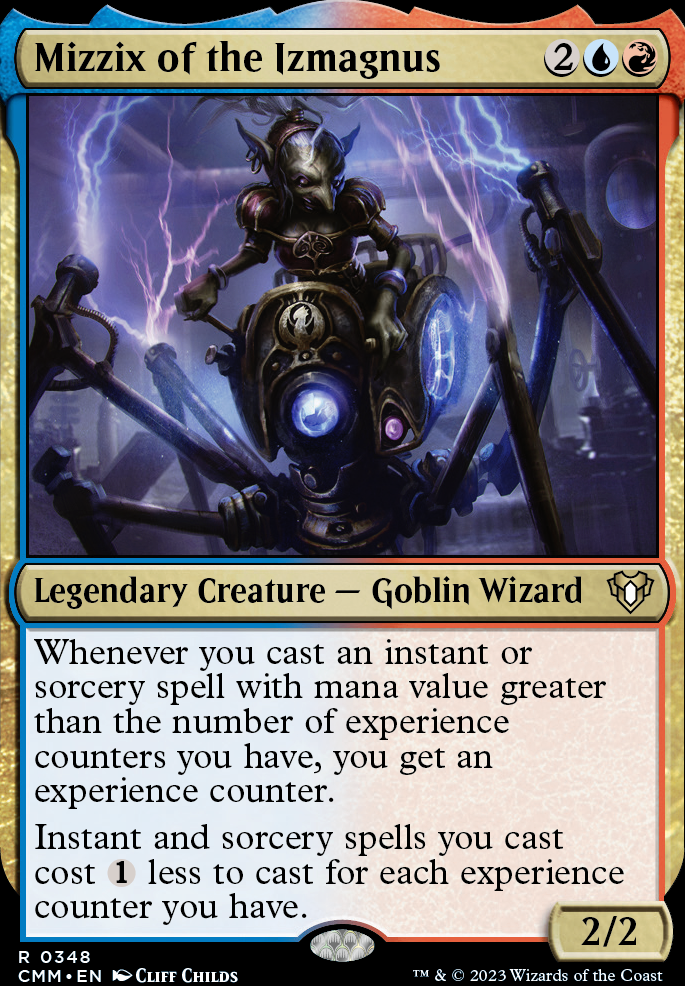
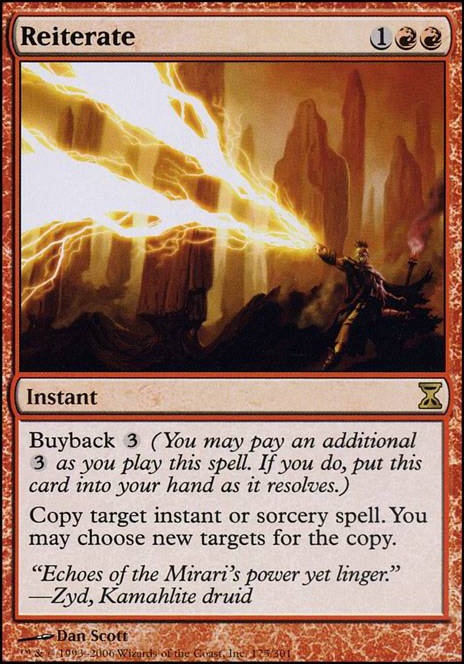
This deck aims to take major advantage of our Commander's cost-reduction ability, Mizzix of the Izmagnus, and using it in tandem with Reiterate and its Buyback feature. Cards like Desperate Ritual, Comet Storm, and Temporal Mastery act as powerful and reliable finishers for this deck. Cards like Cyclonic Rift, Abrade, and Baral, Chief of Compliance act as means of protection for our commander, while cards such as Ral, Storm Conduit, Keranos, God of Storms, and God-Eternal Kefnet provide a solid mid-game while you build up Experience Counters. You will passively gain some as you cast your first couple of spells, but to truly achieve the state of a "giga-genius," you will need to actively increase your experience as well. That's where cards like Blue Sun's Zenith, Beacon of Tomorrows, and Firemind's Foresight come in handy.

Your enemies will curse you as you combo cast your way to victory while taking all the turns in the world. GL HF!

Disclaimer/Warning

This deck is for REAL gamers, intellectuals, and megaminds. You MUST have watched Rick and Morty, read 1984, and have an active Reddit account to properly pilot this deck. So if it doesn't work it means YOU are the problem. I don't want to hear a PEEP of complaint [1].

If you are reading this, then you probably already know what Mizzix of the Izmagnus does because you're a real gamer. However, for the knuckle-dragging cavemen out there [1], let's go over the basics:

Mizzix's ability has two parts to it:

  1. Whenever you cast an instant or sorcery spell with mana value greater than the number of experience counters you have, you get an experience counter.
  2. Instant and sorcery spells you cast cost less to cast for each experience counter you have.

First, Mizzix will only reduce the generic () mana cost of a spell. It cannot reduce the colored mana cost or mana cost.

It's important to understand the CMC (Converted Mana Cost) of a card versus your current experience counters. For every card, with the exception of cards (discussed later), the CMC will be the sum of all the mana in the top right corner of the card. Regardless of the mana reduction applied by Mizzix, a card's CMC will always be constant. For example, consider the following board state:

  1. Let's say I have Mizzix of the Izmagnus on the field
  2. Let's say I have one Experience Counter
  3. Let's say I am casting Negate.

Based on this board state Negate would only cost but still grant us an Experience Counter on cast. This is because while Negate may have only have costed us "1" mana to cast its CMC has a total value of 2. If it helps, think of it as such: Mizzix doesn't change a card's CMC, just the amount you need to pay to cast it.

Beyond this, gaining Experience Counters is pretty straight forward: Get Mizzix of the Izmagnus out and start spell-slinging.

As mentioned previously, cards are just a little special. We will start by reading the rules as written (From Comprehensive Rules):

202.3b When calculating the converted mana cost of an object with {X} in its mana cost, X is treated as 0 while the object is not on the stack, and X is treated as the number chosen for it while the object is on the stack.

and

601.2. To cast a spell is to take it from where it is (usually the hand), put it on the stack, and pay its costs, so that it will eventually resolve and have its effect. Casting a spell includes proposal of the spell (rules 601.2a–d) and determination and payment of costs (rules 601.2f–h).

To summarize: cards will have a value of 0 for X everywhere except the stack (and by extension, when being cast). When you cast spells and are trying to determine whether you gain an Experience Counter or not, you need to remember that the current spell's CMC is based on the value of X on the stack (so not 0 ideally). For example:

  1. I cast Firemind's Foresight and fetch for some cards. For my 2 CMC instant, I can choose Pull from Tomorrow because X equals 0 everywhere but the stack.
  2. Let's also say Mizzix of the Izmagnus is on the field and I have 4 Experience Counters accrued.
  3. I start to cast Pull from Tomorrow but I want 4 so that Mizzix of the Izmagnus can reduce its cost.
  4. While Mizzix of the Izmagnus reduces the amount I need to pay (only ), the value of is still 4 while on the stack. This means its CMC on the stack is 6 ( + + )).
  5. Because the value of the CMC (when we cast it) is higher than our current amount of Experience Counters, Mizzix of the Izmagnus triggers and we would gain another.

Hopefully this made some sense of how cards interact with our commander, and how VALUABLE they are.

As previously stated, using a card's additional or alternate casting cost does NOT affect its CMC. However, referring back to the rules:

601.2. To cast a spell is to take it from where it is (usually the hand), put it on the stack, and pay its costs, so that it will eventually resolve and have its effect. Casting a spell includes proposal of the spell (rules 601.2a–d) and determination and payment of costs (rules 601.2f–h).

This means that our spells have their alternate casting costs reduced by our Commander's ability. For example, let's say I have a Cyclonic Rift in hand and Mizzix of the Izmagnus on the field, with 4 experience counters on me. I want to clear the board and overload Cyclonic Rift. Because of our experience counters, the alternate cost of becomes . However, because this is an alternate cost to a spell, we do not gain an experience counter because Cyclonic Rift still only has a CMC of 2

This one is pretty straight forward, but without going into the rules too much, copies will NEVER trigger Mizzix of the Izmagnus's ability. This is simply because you can never "cast" or "play" a copy of a spell. Instead, when something is copied, it simply comes into existence on the stack. Again, just to Reiterate (ba-dum-tsss), copies don't get played from your hand and aren't ever cast, they simply just come into existence.
While the deck can play out the same way each time, hopefully the following can show you some alternate play-styles that you could try for fun rather than competitive edge.

Conclusion

Hope you enjoyed! If you did read until the end, or even just do a quick look over, please let me know what you think. Suggestions, card replacements, etc. are all welcome. This deck is made to be some-what budget friendly.

[1] = Obviously Sarcasm

Suggestions

Updates Add

Comments

93% Casual

Competitive