The following parameters have been used to determine the strength of the deck. For each, a score of 5 (very good), 4 (good), 3 (mediocre), 2 (bad) or 1 (very bad) has been allocated; when totalized this score represents the power rating of the deck.
- Mana: indicates the availability of energy-sources within the deck.
- Ramp: indicates the speed at which mana sources within the deck can be made available.
- Card Advantage: indicates availability of filter- and draw resources represented within the deck.
- Overall speed: indicates the deck’s potential for pace, based on resource availability and mana curve.
- Combo: indicates the measure of combo-orientation of the deck.
- Army: indicates the deck’s creature-army strength.
- Commander: indicates how much the deck is commander-oriented/dependent (less dependency is better).
- Resilience: indicates the measure in which the deck can prevent and take punches.
- Spellpower: indicates the availability and strength of high-impact spells.
Mana: 2
Energy requirements for this deck are not huge, so it didn’t make sense to add loads of options to provide additional energy. The cards added to support a bit in this way, are one very effective mana dork, a mechanism that untaps lands upon a successful attack and three enchantments that expand a land’s mana-generation capacity.
Ramp: 2
The same principle that applied to the ‘Mana’-section, applies here. Not that much is needed in terms of land fetching. Therefore, choices were settled on two land-fetch sorceries and a single enchantment.
Card Advantage: 4
Enchantments being cast or hitting the battlefield can both be great sources of CA. The deck contains nine permanent options that will allow for such. Additionally, there’s a tutor for enchantments, should one have the need to search for a specific one.
Overall speed: 5
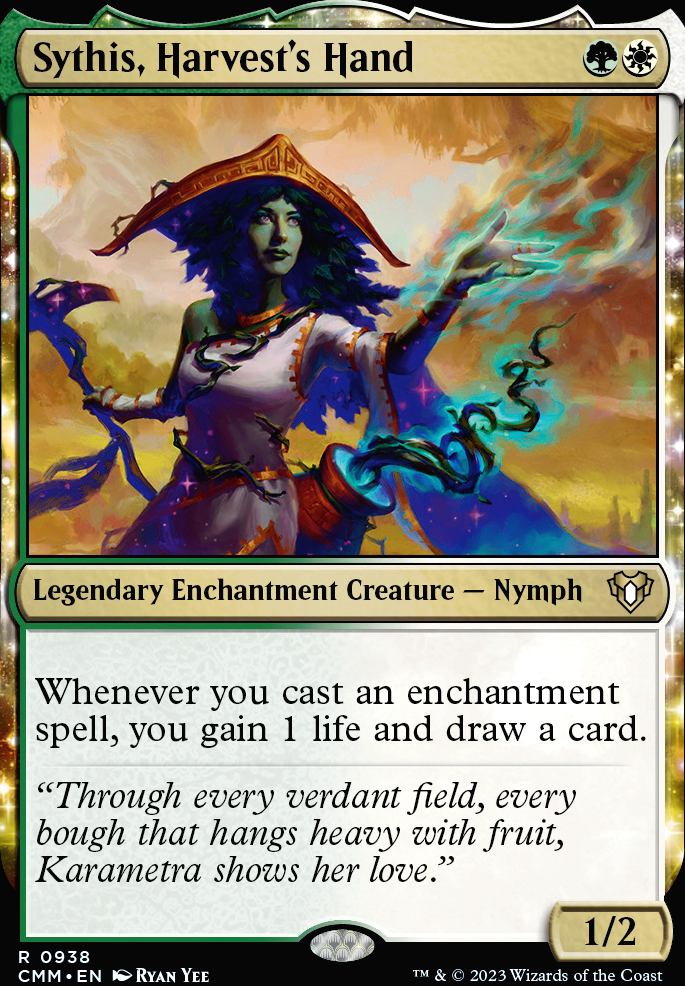
With a low average casting cost and a cheap-to-cast commander that facilitates additional draw by herself, this deck is usually able to start out strong and draw first blood. Said pain doesn’t need to come in the form of combat damage, there’s plenty of cheap ways to inhibit the opposition with enchantments.
Combo: 1
Nothing of truly infinite proportions has been added to this deck; it’s too much fun to prosper from the synergies featured in here and win through conventional means.
Army: 2
This deck doesn’t lean so much on its armed forces, at least not during the early game and only partway through the mid-game. Therefore, its forces are mostly focused on utility and on ensuring there’s some decent defense built up while the deck’s busy disabling opponents. During later phases, the deck will lean on token generation and several interesting creature boosters.
Commander: 4
During early phases, having Sythis, Harvest's Hand on the field will be exceptionally powerful and one of the major ways with which the deck can pull game-balance in its favor. However, draw upon the casting/ETB of enchantments is well-represented within the deck, and plenty of redundancy exists to take over from her should she become harder to cast.
Interaction: 5
One of the key features of this deck. Opposing permanents beware, for there are numerous forms of removal (fourteen options in total) available to get rid of you. Should this not be enough to deter, then one can also choose to inhibit options (with no fewer than seven cards) or even disable (two cards).
Resilience: 4
Aside from offering the methods to deter opposing plans through inhibition, the deck is also quite good at offering life-gain options (five cards) and providing some solid protection against removal.
Spellpower: 4
One of the deck’s other core aspects. Spellcasting is what it does, and powerful enchantments is what it does very well. Quite a few only target single creatures/permanents, but others have a much more widespread effect (twelve cards in all). Some mass protection and even mass recursion round out the stronger side of its spell arsenal.
Total power score: 33
A decently powerful deck. It’s good at making issues go away and ensuring the opposition won’t be able to hurt its controller significantly. Resources are readily available and most cards within this deck aren’t that expensive to cast (not even the stronger boosters). It can whip out a decent token army and even turn something very Voltron. Its hardest match-up would probably be a mill-deck; it can deal with most other deck-types.