
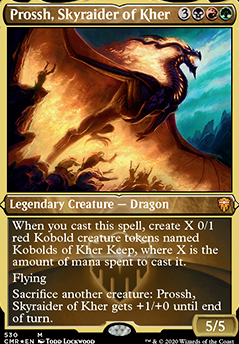
Prossh | A Story On Poor Dietary Choices [Primer]
Commander / EDH Aristocrats BRG (Jund) Group Slug Infinite Combo Midrange Sacrifice Tokens
Land (35)
- 1x Ancient Tomb
- 1x Blood Crypt
- 1x Bloodstained Mire
- 1x Bojuka Bog
- 1x Boseiju, Who Endures
- 1x Command Beacon
- 1x Command Tower
- 1x Copperline Gorge
- 1x Exotic Orchard
- 1x Fabled Passage
-
4x
Forest

- 1x Karplusan Forest
- 1x Luxury Suite
- 1x Mortuary Mire
- 1x Mosswort Bridge
-
4x
Mountain
- 1x Prismatic Vista
- 1x Savage Lands
- 1x Stomping Ground
- 1x Sulfurous Springs
-
4x
Swamp
- 1x Talon Gates of Madara
-
1x
Twisted Landscape
- 1x Undergrowth Stadium
- 1x Verdant Catacombs
-
1x
Ziatora's Proving Ground
Groupslug (7)
Acceleration (17)
- 1x Arcane Signet
- 1x Birds of Paradise
- 1x Bloom Tender
- 1x Dark Ritual
- 1x Elves of Deep Shadow
- 1x Elvish Spirit Guide
- 1x Food Chain
-
1x
Goblin Anarchomancer
- 1x Ignoble Hierarch
- 1x Mana Echoes
- 1x Manamorphose
- 1x Pitiless Plunderer
- 1x Sakura-Tribe Elder
- 1x Selvala, Heart of the Wilds
- 1x Skyshroud Claim
- 1x Sol Ring
- 1x Somberwald Sage
Protection / Reanimation (9)
- 1x Crop Rotation
- 1x Deflecting Swat
- 1x Eternal Witness
-
1x
Ghost Lantern
- 1x Heroic Intervention
-
1x
Honest Rutstein
-
1x
Revitalizing Repast
Flip
- 1x Untimely Malfunction
- 1x Victimize
Token Synergy (7)
Commander (1)
Card Manipulation (12)
- 1x Beseech the Mirror
- 1x Body Count
- 1x Deadly Dispute
- 1x Eldritch Evolution
-
1x
Garna, Bloodfist of Keld
- 1x Green Sun's Zenith
-
1x
Growing Rites of Itlimoc
Flip
- 1x Herd Heirloom
- 1x Pact of the Serpent
- 1x Seize the Spotlight
- 1x Skullclamp
- 1x The Great Henge
Removal (8)
- 1x Abrupt Decay
- 1x Assassin's Trophy
- 1x Chandra's Ignition
- 1x Culling Ritual
- 1x Cut / Ribbons
- 1x Grave Pact
- 1x Toxic Deluge
- 1x Tragic Slip
Aristocrats (4)
This is the story of a dragon who looked at a perfectly functional ecosystem and thought, “What if all of this was food?”
Prossh, Skyraider of Kher helms a sacrifice themed deck that thrives on excess. Excess tokens, excess mana, and eventually excess damage. The game plan is simple:
- land a combo piece.
- flood the board with expendable creatures (you can Counterspell Prossh, but the kobolds can only be prevented through Stifle effect).
- start converting them into value until something very large, very loud, and very final happens.
The deck leans heavily into sacrifice synergies and group slug effects. This isn’t a cEDH list, and it isn’t trying to be subtle. It’s a bracket-4 deck that plays proactively, rewards sequencing, and punishes tables that underestimate how quickly “a few Kobolds” can become a lethal problem.
In the end, this isn’t a cautionary tale. It’s just a story about what happens when a dragon refuses to eat responsibly.
Core Strategy
At its heart, this deck is about doing what Prossh, Skyraider of Kher does best: enter the battlefield, make a mess, and turn that mess into a win.
The plan is flexible, redundant, and unapologetically Jund. We make tokens, sacrifice them for value, and eventually convert that value into either infinite nonsense or one very decisive combat step.
1. Ramp & Deploy the Commander
The deck is built to land Prossh early and often. Fast mana like Sol Ring and Dark Ritual , efficient dorks such as Ignoble Hierarch and Bloom Tender, and land-based ramp like Skyshroud Claim let Prossh hit the table as early as turn 3–4.
Once Prossh resolves, you immediately get a pile of Kobolds. These are not meant to live long, productive lives. They exist to be turned into mana, cards, damage, or all three.
2. Generate Value & Assemble Pieces
The Kobolds are fuel. Sacrifice outlets like Goblin Bombardment and Skullclamp turn them into removal, card draw, and incremental damage. Even without going infinite, this engine pressures the table and keeps your hand full.
Meanwhile, the deck quietly assembles its endgame using tutors like Beseech the Mirror, Green Sun's Zenith, and Eldritch Evolution. Whether you’re finding a combo piece, a payoff, or a backup threat, the deck is very good at turning “random tokens” into “exactly what I need right now.”
3. Execute the Win
The deck has multiple ways to close a game, depending on what sticks and what gets disrupted.
Plan A: Food Chain
The cleanest win involves Food Chain and Prossh himself. Exile Prossh to Food Chain for mana (including his commander tax), recast him from the command zone, make more Kobolds, and repeat. This produces infinite creature mana.
From there, the deck can:
- Draw itself out with Pact of the Serpent and finish via Goblin Bombardment
- Dump mana into a massive Craterhoof Behemoth
- Or simply overwhelm the table with whatever payoff is most convenient
Plan B: Altar Loops & Group Slug
If Food Chain isn’t available, the deck happily falls back on Ashnod's Altar or Phyrexian Altar combined with token engines like Chatterfang, Squirrel General and Endrek Sahr, Master Breeder.
These loops often translate directly into damage thanks to Impact Tremors, Purphoros, God of the Forge, Agate Instigator, or similar effects. Sometimes the board just… ends itself.
Plan C: Overwhelm
When the table refuses to let you combo in peace, the deck can still win the honest way: turn creatures sideways and make it hurt.
Anthem effects like Beastmaster Ascension and Shared Animosity, plus finishers such as Craterhoof Behemoth or Chandra's Ignition on a very large Prossh, let the deck close games through combat without ever going infinite.
I will expand on the primer another time...
Suggestions
Updates Add
Comments
Attention! Complete Comment Tutorial! This annoying message will go away once you do!
Important! Formatting tips — Comment Tutorial — markdown syntax
Please login to comment
| Date added | 5 days |
| Last updated | 2 days |
| Legality | This deck is Commander / EDH legal. |
| Rarity (main - side) | 12 - 0 Mythic Rares 44 - 0 Rares 20 - 0 Uncommons 12 - 0 Commons |
| Cards | 100 |
| Avg. CMC | 2.94 |
| Tokens | Agate Instigator 1/1 R, Copy Clone, Kobolds of Kher Keep 0/1 R, On an Adventure, Servo 1/1 C, Squirrel 1/1 G, Thrull 1/1 B, Treasure |
| Votes | |
| Ignored suggestions | |
| Shared with | |
| Views |