The following parameters have been used to determine the strength of the deck. For each, a score of 5 (very good), 4 (good), 3 (mediocre), 2 (bad) or 1 (very bad) has been allocated; when totalized this score represents the power rating of the deck.
- Mana: indicates the availability of mana sources within the deck.
- Ramp: indicates the speed at which mana sources within the deck can be made available.
- Card Advantage: indicates availability of filter- and draw resources represented within the deck.
- Overall speed: indicates the deck’s potential for pace, based on resource availability and mana curve.
- Combo: indicates the measure of combo-orientation of the deck.
- Army: indicates the deck’s creature-army strength.
- Commander: indicates how much the deck is commander-oriented/dependent (less dependency is better).
- Interaction: indicates how much this deck can mess with opponents’ board states and turn-phases.
- Resilience: indicates the measure in which the deck can prevent and take punches.
- Spellpower: indicates the availability and strength of high-impact spells.
Mana: 2
Aside from four mana rocks and an enchantment that allows one to use any creature as a mana dork, this deck doesn’t contain additional energy sources.
Ramp: 3
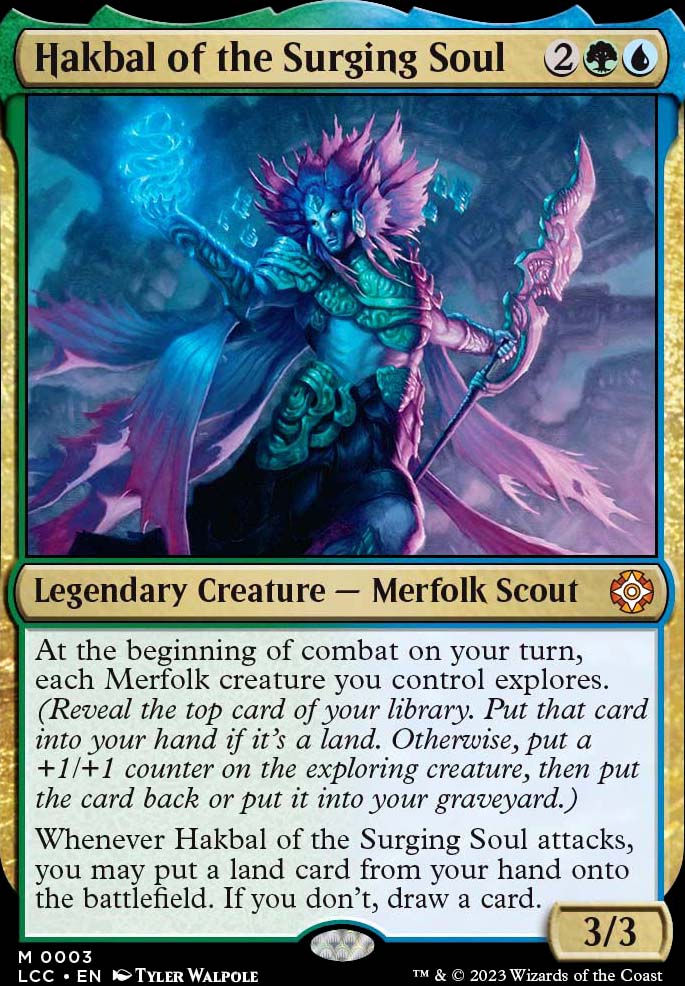
This is where Hakbal of the Surging Soul truly shines. His primary ability allows one to (potentially) grab lots of lands from one’s library, so that they can be played (later). Aside from him, the deck contains six additional permanents that allow for multiple land entries per turn and one non-permanent option.
Card Advantage: 5
This is where Hakbal’s secondary ability benefits his controller. Fortunately, he’s not the only great CA-resource in here. A staggering twelve additional options provide direct draw, and ways to top-deck, tutor and even steal have been included as well.
Overall speed: 4
Low casting costs combined with plenty of card-advantage and ramping make this deck plenty fast. Due to its simple nature, it’s also easy to adopt an aggressive posture from early on in games.
Combo: 2
Just a few of these in here, but not the focus of the deck. There are a few excellent synergies that ought not be overlooked.
Army: 4
A force of twenty-eight combatants that for the most part synergize well with each other makes up the deck’s army. Aside from boosting combat power of their kin, utility powers included amongst their gifts include making Merfolk unblockable, providing Merfolk with protection from spells, bringing token Merfolk into the fight and providing draw based on Merfolk attacks and damage.
Commander: 4
The exploration component that Hakbal brings is insanely powerful and it would be a shame to not see it in action when this deck is brought to bear. However, tribal decks are usually built on redundancy, and so is this one. This makes Hakbal’s absence felt, but not as a showstopper to obtain victory.
Interaction: 4
It’s partly blue, so obviously at least several of the deck’s interaction options is going to be counterspell-related (five of them, to be precise). The remaining interaction consists of destruction of opposing permanents (three cards), some bounce, forced tapping and inhibition.
Resilience: 3
Some abilities and spells have been included to stop hostile magic from hurting this deck. When including literal counterspells along with ways that grant hexproof to one’s permanents, the deck holds eight of such opportunities. There are also some recursion options to choose from, in case one loses stuff due to opposing action OR when one decides to explore things into the graveyard with Hakbal. A slight bit of life-gain has been included as well.
Spellpower: 3
Most the deck’s hard spell-wielding capabilities ought to be sought amongst its enchantments. Capabilities like mass token generation, mass counter allocation and mass provision of additional card-draw can be found here.
Total power score: 35
Its speed, ramp capability, massive CA-potential and versatile army are superb. The deck is simple in structure and use and will suit players of most experience levels. It’s capable of holding its own against decks with stronger creatures and can get out of control for one’s opponents quickly if it’s allowed to build upon its momentum. It has low mana requirements and will usually kick-off strong. Its weaknesses are that it has trouble dealing with flyers and isn’t great at stopping spell-slinging or mill-strategies.