
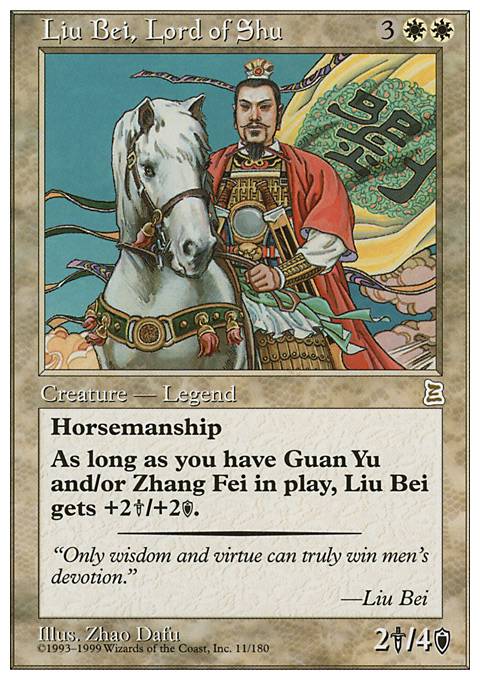
Portal Three Kingdoms - Liu Bei
Commander / EDH Banding Bracket 1 Casual Horsemanship Jank Mono-White Theme/Gimmick
Creature (28)
- 1x Alert Shu Infantry
- 1x Avacyn, Angel of Hope
- 1x Flanking Troops
- 1x Guan Yu, Sainted Warrior
- 1x Huang Zhong, Shu General
- 1x Icatian Infantry
- 1x Knight of the White Orchid
- 1x Kongming, "Sleeping Dragon"
- 1x Kongming's Contraptions
- 1x Loyal Retainers
- 1x Mangara, the Diplomat
- 1x Pang Tong, "Young Phoenix"
- 1x Pikemen
- 1x Shu Cavalry
- 1x Shu Defender
- 1x Shu Elite Companions
- 1x Shu Elite Infantry
- 1x Shu Farmer
- 1x Shu Foot Soldiers
- 1x Shu General
- 1x Shu Grain Caravan
- 1x Shu Soldier-Farmers
- 1x Thalia's Lancers
- 1x Ulamog, the Infinite Gyre
- 1x Valor
- 1x Volunteer Militia
- 1x Zhang Fei, Fierce Warrior
- 1x Zhao Zilong, Tiger General
Enchantment (3)
Land (36)
- 1x Ancient Den
- 1x Castle Ardenvale
- 1x Cathedral of Serra
- 1x Daru Encampment
- 1x Desert of the True
- 1x Drifting Meadow
- 1x Eiganjo Castle
- 1x Emeria, the Sky Ruin
- 1x Flagstones of Trokair
- 1x Fountain of Cho
- 1x Icatian Store
- 1x Karoo
- 1x Kjeldoran Outpost
- 1x Kor Haven
- 1x Mistveil Plains
- 1x New Benalia
- 15x Plains
- 1x Reliquary Tower
- 1x Sandstone Bridge
- 1x Secluded Steppe
- 1x Sejiri Steppe
- 1x Windbrisk Heights
Artifact (12)
Commander (1)
Sorcery (13)
- 1x Chronomantic Escape
- 1x Empty City Ruse
- 1x False Defeat
- 1x Guan Yu's 1,000-Li March
- 1x Misfortune's Gain
- 1x Peach Garden Oath
- 1x Ravages of War
- 1x Riding Red Hare
- 1x Terminus
- 1x Urza's Ruinous Blast
- 1x Vengeance
- 1x Virtuous Charge
- 1x Wrath of God
Instant (5)
Planeswalker (2)
Maybeboard
Creature (3)
Instant (3)
The Three Kingdoms period of China lasted from 220–280 AD after the collapse of the Han dynasty, and was succeeded by the Jin dynasty. Named after the three kingdoms of Wei (魏), Shu Han (蜀漢) and Wu (吳), it was a period of intense war featuring some of the greatest warriors and generals of Chinese history. It was also, for some reason, the setting for the final expansion of the Portal block, Portal Three Kingdoms, regarded as one of the worst expansions of all time. The low power level of Portal Three Kingdoms is comparable only to other legendarily weak expansions like Homelands and Masques block.
In this deck, you take up the mantle of Liu Bei, Lord of Shu and his comrades in your quest to conquer China! Or...at least win an EDH game. Liu Bei took a starring role in Luo Guanzhong's (羅貫中) 14th century work, Romance of the Three Kingdoms (三國演義). Although based on history, it was still first and foremost a novel, and a more accurate detail of the events of Liu Bei's life comes from Chen Shou's (陳壽) Records of the Three Kingdoms (三國志), which was written around the time of the Three Kingdoms period. Liu Bei is painted as a well liked and wise ruler who selected good advisors and ruled benevolently.

Notes on biography: This biography will be based on more historical accounts of Liu Bei (re: Mostly rewritten/plagiarised from his Wikipedia page), so I won't get into more legendary accounts such as the Peach Garden Oath. Also, I will try my best to include the Chinese words for new characters/areas mentioned as they appear, I'm using mostly Traditional Chinese just because...really, they're mostly what Wikipedia gives me. Whilst the regular script did emerge during the Three Kingdoms period, traditionally credited towards Zhong Yao (鍾繇) who lived in Cao Wei, it was still in its infancy and clerical script would probably still have been widely used too. In fact, I don't know why I even thought I needed to justify this in the first place. I can't even read Chinese or tell the difference between traditional or simplified characters at a glance.
Biography:
Liu Bei (劉備) lived from 161-223 AD and founder of the Shu Han dynasty. Though he was distantly related to the Han dynasty's ruling family, he grew up to a poor family without a father, and sold shoes and straw-mats along with his mother in order to survive. Nevertheless, he had great ambition, and even as a child expressed his desire to become an emperor. He become more politically active in 184, after the rise of the Yellow Turban Rebellion, and fought them multiple times. He was appointed by the Han government to Prefect (令) of the Anxi County (安喜縣), and later Prefect and Commandment (都尉) of the Gaotang County (高唐縣).
In 194, the armies of Cao Cao, Lord of Wei (曹操) (although he had not yet established the Kingdom of Wei) attacked Tao Qian (陶謙). Liu Bei, supervised by Tian Kai (田楷), lead their army to support Tao Qian. Cao Cao would later retreat after one of his subordinates, Zhang Miao (張邈) rebelled and allowed Lu Bu, Master-at-Arms (Although his name is actually more closely spelt Lü Bu, and will be referred to as such) (呂布) to take over. Tao Qian asked Liu Bei to station his army in nearby Xiaopei (小沛) and reinforced him with more troops. Liu Bei then deserted his supervisor for Tao Qian, who would become Liu Bei's mentor. Lui Bei then went about razing an army and amassing political connections, including from the two most powerful families in the Xu Province (徐州), the Mi (麋) family headed by Mi Zhu (麋竺) and Mi Fang (麋芳), and Chen (陳) family headed by Chen Gui (陳珪) and Chen Deng (陳登). Liu Bei married Mi Zhu's younger sister, Lady Mi (麋夫人).
Tao Qian died in 194, and the Mi family backed Liu Bei to be the new Governor of Xu Province. Liu Bei was hesitant at first, when Chen Qun (陳群) told him Yuan Shu (袁術) would fight for control of the Xu Province. After consulting with Kong Rong (孔融) and Chen Deng, Liu Bei took their advice and formed an alliance with Yuan Shao, the Indecisive (袁紹), who would eventually recognise Liu Bei's legitimacy as Governor of Xu Province.
In 195, Lü Bu was defeated by Cao Cao and sought shelter under Liu Bei. The next year, Yuan Shu sent general Ji Ling (紀靈) to invade Xu Province. Liu Bei amassed an army to counter Ji's advances. They would have a months long standoff where not much was accomplished. But back home, political strife was happening. Zhang Fei, Fierce Warrior (張飛), who Liu Bei had left in control of Xiapi Commandery (下邳郡), murdered Cao Bao (曹豹), the Chancellor of Xiapi after a quarrel. This caused enough unrest for Lü Bu (who was famous for betraying literally everyone he worked with) to take over, and capture Liu Bei's family. Upon hearing this news, Liu Bei immediately headed back for Xiapi Commandery, but most of his troops deserted along the way. With his remaining men, Liu Bei retreated to Guangling Commandery (廣陵郡) where Yuan Shu's forces defeated him, forcing him to again retreat to Haixi County (海西縣). Surrounded and with a lack of supplies, him and his men had to resort to cannibalism before surrendering to Lü Bu in return for his family's return. Lü Bu then ordered Liu Bei to help him resist Yuan Shu, fearing that Yuan Shu would turn on him after destroying Liu Bei. Liu Bei then moved to Xiaopei (小沛) and amassed an army of 10,000 men. Lü Bu, noticing Liu Bei's rising army and fearing he would turn on him, launched a preemptive invasion of Xiaopei.
Liu Bei fled to the imperial capital, Xuchang (許昌), taking shelter under Cao Cao, who was had been controlling the central Han government after bringing Emperor Xian of Han (漢獻帝) to Xuchang. Cao Cao would have the Emperor appoint Liu Bei as as Governor of Yu Province (豫州) and gave him control of some troops. Liu Bei then returned to Xiaopei to keep an eye on Lü Bu.
In 198, Lü Bu renewed his alliance with Yuan Shu to counter Cao Cao's growing influence and sent Gao Shun (高順) and Zhang Liao, Hero of Hefei (張遼) to attack Liu Bei at Xiaopei. Cao Cao sent Xiahou Dun, the One-Eyed (夏侯惇) to assist Liu Bei, but they were still defeated by Gao Shun. Liu Bei fled to Xunchang (許昌) for shelter under Cao Cao, who would personally bring Liu Bei along with an army to attack Lü Bu. After Lü Bu's defeat, he was captured and offered to join Cao Cao. Cao Cao considered this, but his advisors warned him that Lü Bu had betrayed literally everyone he worked for, and had Lü Bu executed.
199 would see Cao Cao enjoying strong political support, due to his control of the Emperor Xian and Han government. Liu Bei, along with many others including Dong Cheng (董承) would instigate a conspiracy to assassinate Cao Cao, after Dong Cheng claimed Emperor Xian had given him a secret edict to assassinate Cao Cao. At the same time, Liu Bei wished to leave Xunchang and be free of Cao Cao's control. Because of this, when word reached Liu Bei that Yuan Shu was to join with Yuan Shao after the former's defeat, Liu Bei requested to Cao Cao an army and permission to stop Yuan Shu. Cao Cao agreed and sent Liu Bei, along with Zhu Ling (朱靈) to stop Yuan Shu, who fled to Shouchun (壽春). Zhu Ling returned to Cao Cao, while Liu Bei remained to take control of the Xu Province after murdering Che Zhou (車冑). Liu Bei then moved to Xiaopei and left Guan Yu, Sainted Warrior (關羽) in charge of Xu Province's capital, Xiapi Commandery.
While this was happening, Yuan Shao was preparing to attack Cao Cao in the Henan (河南) region. Liu Bei sent his advisor, Sun Qian (孫乾) to negotiate with Yuan Shao and request that he launch an immediate attack on Cao Cao, but Yuan Shao refused. In 200, Cao Cao discovered Dong Cheng's conspiracy and had all the participants rounded up and executed along with their families. Liu Bei survived the purge because he was not in Xuchang.
After Cao Cao had achieved stability in Xuchang, set off for Yuan Shao. He fortified many key crossing points along the south banks of the Yellow River (黃河) and set up a main camp at Guandu (官渡). Whilst doing this, he sent subordinates Liu Dai (劉岱) and Wang Zhong (王忠) to battle Liu Bei, but they were defeated. Cao Cao then made a highly risky move: He predicted that Yuan Shao would not make any advances so he secretly left his defensive position along the Yellow River and personally led an army to Xu Province to attack Liu Bei. Under the weight of Cao Cao's attacks, Liu Bei's forces quickly disintegrated and Xu Province fell to Cao Cao. Zhang Fei protected Liu Bei as he fled from Xiaopei after his defeat; Guan Yu, isolated in Xiapi Commandery, was captured by Cao Cao's forces and decided to surrender and temporarily serve under Cao Cao. Liu Bei headed north to join Yuan Shao, who welcomed him. He participated in the Battle of Yan Ford (延津之戰) alongside Yuan Shao's general Wen Chou (文丑) against Cao Cao's forces, but they suffered a defeat and Wen Chou was killed in battle.
In the meantime, Liu Pi (劉辟), a former Yellow Turban rebel, started a revolt in Runan Commandery (汝南郡). Liu Bei convinced Yuan Shao to "lend" him troops to assist Liu Pi. Liu Bei and Liu Pi then led their forces from Runan Commandery to attack Xuchang while Cao Cao was away at Guandu, but they were defeated and driven back by Cao Ren (曹仁). Liu Bei then returned to Yuan Shao and urged him to ally with Liu Biao (劉表), the Governor of Jing Province (荊州). Yuan Shao then sent him with some troops to Runan Commandery to assist another rebel leader, Gong Du (共都/龔都). Liu Bei and Gong Du defeated and killed Cai Yang (蔡陽), one of Cao Cao's officers who led troops to attack them.
In 201, Cao Cao led his army to attack Liu Bei in Runan Commandery after his victory over Yuan Shao at the Battle of Guandu (官渡之戰). After Cao Cao's victory over Liu Bei, he fled to take shelter in Jing Province (荊州) under Liu Biao (劉表). Liu Biao did not trust Liu Bei, although he did treat him as an honoured guest. Despite this lack of trust between the two, Liu Biao did allow Liu Bei to station his troops in Xinye County (新野县) to guard against Cao Cao's advances.
After staying in Jing Province for around 7 years, Liu Bei met Liu Biao and wept, when asked why, Liu Bei responded: "In earlier times, I've never left the saddle. My thighs were thin. Now I do not ride anymore, they are fat and flabby. The days and months pass like a stream, and old age will come, but I have achieved nothing. That's why I am sad."
In 202, Cao Cao sent Yu Jin (于禁) and Xiahou Dun (夏侯惇) to attack Liu Bei, although Liu Bei successfully ambushed them and defeated them at the Battle of Bowang (博望之戰). In 207, Cao Cao planned a campaign to conquer the Wuhaun (烏桓) people in the north. But was apprehensive that Liu Biao may attack his base, although Cao Cao was assured by Guo Jia (郭嘉) that Liu Biao would not do so out of fear that Liu Bei was more powerful than him. Cao Cao agreed with Guo Jia, who would be proven right when Liu Biao refused to attack Xu, against Liu Bei's advice.
Jing Province, away from the eastern battlefields and under Liu Biao's efficient rule, would become prosperous and a popular destination for the educated classes fleeing from the wars. Liu Bei would ask Sima Hui (司馬徽), who was known for his reclusiveness, about scholars. Sima Hui's friend, Pang Dedong (龐德公), would name Zhuge Liang (諸葛亮) and Pang Tong, "Young Phoenix" (龐統) as exceptional talents able to comprehend the events quite well. Xu Shu (徐庶) would also recommend Zhuge Liang to Liu Bei. It would take Liu Bei three visits to finally have an audience with Zhuge Liang. Zhuge Liang would present Liu Bei with the long term Longzhong Plan (隆中對), outlying the takeover of Jing Province and Yi Province (益州), setting up a two-pronged final strike at the imperial capital.
Liu Biao would die in 208, being succedded by his younger son, Liu Cong (劉琮), who would surrender to Cao Cao without informing Liu Bei. By the time Liu Bei would be informed of Liu Cong's surrender, Cao Cao's army had reached Wan (宛). Liu Bei and his troops would abandom Fancheng District (樊城区), leading civilians and some of Liu Biao's followers on an exodus southward. By the time they reached Dangyang (當陽), Liu Bei's followers numbered in the 100,000's and they moved at only 10 li (里) a day (approximately 4158 metres). Liu Bei would send Guan Yu ahead to wait for him in Jiangling County (江陵縣) where abundant supplies and arsenal were stored, with Jing Province's fleet.
As Cao Cao was afraid Liu Bei would reach Jiangling County before him, he lead his cavalry on persuit. In a day and a night, Cao Cao would catch up with Liu Bei, capturing most of his people and baggage at the Battle of Changban (長坂之戰). Liu Bei, leaving even his family behind, fled with only a few of his followers. With Guan Yu's fleet, they crossed the Mian River (沔江) (I'm not actually sure which river this is) to Jiangxia Commandery (江夏郡), and the Yangtze River (長江) to Hankou (漢口), taking shelter under Liu Qi (劉琦), elder son of Liu Biao. Liu Qi objected to Liu Cong's surrender to Cao Cao, holding onto and maintaining Jiangxia Commandery and Xiakou, allowing more of his father's subordinates to escape Cao Cao.
While still in Dangyang, Lu Su, Wu Advisor (魯肅) would hint to Liu Bei that he should ally with Sun Quan, Lord of Wu (孫權) (although he had not yet established the Kingdom of Wu) against Cao Cao. As Liu Bei's representative, Zhuge Liang would follow Lu Su to meet Sun Quan in Chaisang County (柴桑縣), where they would discuss an alliance against Cao Cao.
Liu Bei and Sun Quan would found an alliance against Cao Cao's southward expansion. Cao Cao and the Sun-Liu alliance would meet at the famous Battle of Red Cliffs (赤壁之戰), which ended in a decisive win for the Sun-Liu alliance. Cao Cao would retreat northward, leaving behind Cao Ren (曹仁) and Xu Huang (徐晃) to defend Jiangling County, and Yue Jin (樂進) to defend Xiangyang (襄陽).
The forces of Sun Quan, lead by Zhou Yu, Chief Commander (周瑜), would attack Cao Ren's forces to wrestle for control of Jiangling County. Liu Bei recommended Liu Qi to be the new Inspector of Jing Province and led his men to capture the four commanderies in southern Jing Province – Changsha (長沙), Lingling (零陵), Guiyang (桂陽) and Wuling (武陵). Liu Bei set up his base at Gong'an County and continued to strengthen his forces. Liu Bei would set up his base at Gong'an County (公安縣), continuing to strengthen his forces. In 209, Liu Qi would die, leaving Liu Bei to succeed him as inspector of Jing Province.
In order to further strengthen the alliance between Liu Bei and Sun Quan, Liu Bei would travel to Sun Quan's territory to marry Sun Quan's younger sister, Lady Sun (孫夫人). After this political marriage, Sun Quan would not only recognise the legitimacy of Liu Bei's control over southern Jing Province, but would agree to "lend" Nan Commandery (南郡) to him.
Because of these developments, former subordinates of Liu Biao, unwilling to serve under Cao Cao, would come to join Liu Bei. After Zhou Yu's death in 210, and Liu Bei's increasing influence of the souther Jing Province, Sun Quan's northern positions were becoming more difficult to maintain. Lu Su would succeed Zhong Yu as Sun Quan's frontline commander. Lu Su would move the headquarters to Lukou (陸口), yielding all commanderies of Jing Province (except Jiangxia Commandery) and access to Yi Province to Liu Bei. In diplomatic terms, Sun Quan's side thought that they were "lending" Jing Province to Liu Bei as a temporary base that should be returned to them after Liu Bei found another base.
In 211, warlord Lui Zhang (劉璋), who was governour of Yi Province, learned that Cao Cao was planning to attack fellow warlord Zhang Lu (張魯) in Hanzhong Commandery (漢中). As Hanzong was a strategic location and northern gateway to Yi Province, Liu Zhang (劉璋) would follow the advice of Zhang Song (張松) and send Fa Zheng (法正) to form an alliance of Liu Bei. Although privately, Zhang Song and Fa Zheng didn't aprove of Lui Zhang's leadership and looked to Liu Bei was a more legitmate successor. Liu Zhang would invite Liu Bei to join him in Yi Province to capture Hanzhong Commandery before Cao Cao did.
Liu Bei led several ten thousand soldiers into the Yi Province after leaving behind Zhuge Liang, Guan Yu, Zhang Fei and Zhao Yun (趙雲) to guard the Jing Province. Liu Bei was welcomed by Liu Zhang, and the two were friendly. Zhang Song had organised for Fa Zheng to report to Liu Bei that with the assistance of Pang Tong, they could ambush Liu Zhang at the meeting spot, but Liu Bei believed this plan was far too hasty for an act of such importance. Liu Zhang sent a proposition to have Liu Bei made Commaner in Chief and colonel director of the retainers. Liu Bei, in turn, proposed Liu Zhang to be General Who Subdues The West and Governor of Yi province. Liu Zhang provided more troops to Liu Bei had him supervise the White River Army. These reinforcements gave Liu Bei over 30,000 men, all well equipped, and plenty of horses too. Liu Zhang left for Chengdu (成都), concurrent with Liu Bei heading for the Jiameng Pass (劍門關), which was at the border between Liu Zhang and Zhang Lu's territories. Liu Bei chose to focus on gaining influence and building connections in the area rather than engaging Zhang Lu. He gained a reputation as being kind and virtuous, and had secured the hearts of the masses.
In 212, Cao Cao would launch a campaign against Sun Quan, who called Liu Bei for assistance. Liu Bei sent a message to Liu Zhang that read: "Cao Cao campaigned against Sun and now they are in danger. Both me and them were like "lips and teeth". Moreover, Guan Yu is fighting against Yue Jian at Qingni (清泥). If I don't go to help him now and he is defeated, then he will invade Jing province and the danger will be greater than Zhang Lu. Zhang Lu is looking to preserve his state. He isn't worth worrying about." Liu Bei requested an additional 10,000 soldiers and more provisions to defend the Jing Province. Unfortunately, Liu Zhang only gave him 4000 troops and half the supplies Liu Bei had requested. Liu Bei used this "spurning" to motivate his troops saying: "I'm fighting the enemies of the province. My men are tired and cannot enjoy a peaceful life, while Liu Zhang amasses wealth in his palaces but reward merits feebly. He hopes for the worthy and the brave to go fight in his place. But how can he think as such?"
Two men, Meng Da (孟達) and another advisor, Fa Zheng (法正) joined Liu Bei's side whilst a subordinate to Liu Zhang, Zhang Song (張松) stayed in Chengdu to serve as a double agent. Worried that Liu Bei would leave, Zhang Song sent a letter to Liu Bei and Fa Zheng where he told them that success was near and to not give up. Zhang Song's brother, Zhang Su (張肅), discovered Zhang Song's secret communications with Liu Bei and reported them to Liu Zhang. Liu Zhang was furious about the fact Zhang Song was helping Liu Bei take over Yi Province and executed Zhang Song and ordered his officers guarding the passes to Chengdu to keep secret documents and letters to Liu Bei.
Liu Bei was furious about this, and lured Yang Huai (楊懷) and Gao Pei (高沛), two of Liu Zhang's subordinates guarding Boshui Pass (博水關) into a trap and executed them for this disrespectful behaviour. He then took command of their troops and had Huang Zhong, Shu General (黃忠) and Zhou Ying (卓膺) lead their soldiers against Liu Zhang. Liu Bei entered the different passes, taking commanders and their families as hostages, and advanced with his troops and turned to attack Fu County (涪縣) (in modern day Miangyang, Sichuan).
In the spring of 213, Liu Zhang sent 5 men, Wu Yi (吳懿/吳壹 (His name was recorded as 吴壹 in certain sources due to naming taboos), Zhang Ren (張任), Deng Xian (鄧賢), Leng Bao (冷苞) and Liu Gui (刘瓂) as well as other officers to stop Liu Bei at Fu County. Liu Bei soundly defeated them, and those men had to retreat to Mianzhu (綿竹) (in Denyang, Southwest China) where they were killed or captured by Liu Bei's forces. Despite being Liu Zhang's most trusted vassal, Wu Yi, changed allegiance and joined Liu Bei. Li Yan (李嚴) and Fei Guan (費觀) were sent to stop Liu Bei, but they surrendered to him as well. In fact, Li Yan would end up joining Liu Bei's forces. As Liu Bei's strength grew, he sent commanders to pacify other prefectures. Among those men sent were Zhuge Liang (諸葛亮), who is better known by his courtesy name and nickname, Kongming, "Sleeping Dragon" (孔明, 伏龍) (who apparently has an anime called "Ya Boy Kongming!" where he gets transported to modern Japan and uses his military tactics to help his new friend, Eiko Tsukimi become a music star. Very interesting!) Other notable men he sent were Zhang Fei and Zhao Yun. They led their armies to pacify Jiangyang (江陽) (now known as Luzhou in Sichuan, China), Chongqing (重慶) and Baidicheng (白帝城). Only Guan Yu stayed behind to defend Jing province.
The remnant forces were now under control of Liu Zhang's son, Liu Xun (劉勛) (not to be confused with Lu Xun, Scholar General (陸遜)) and he had retreated to Luo County (瀘縣) (I'm pretty sure that this name is synonymous with Lu County). Pang Tong began a siege, but was killed by a stray arrow. This siege ended up taking nearly a year, with the county only falling in 214 to Liu Bei. Previously, when Liu Bei launched his campaigns against Liu Zhang; Zhao Jian (趙戩) a Wei official who served as a clerk in the chancellor's office believed Liu Bei would fall mentioning his past failures and Yi's natural defences. Zhao Jian was chastised by Fu Gan (傅幹) who said: "Liu Bei is generous and lenient; his men are willing to fight to the death for him. Zhuge Liang is a perceptive administrator able to adapt to changing situations. He is honorable, talented in planning and worked as his chancellor. Zhang Fei and Guan Yu are brave and also possess righteousness. Both of them are known as warriors who are a match for ten thousand men (萬人敵) and are his commanders. These three men are heroes. Knowing of Liu Bei's awareness along with those three heroes assisting him. How he could not succeed?"
Liu Zhang had continued to hold up inside Chengdu. Ma Chao, Western Warrior (馬超), who was a former warlord himself and a vassal under Zhang Lu, defected to Liu Bei's side and joined in his attack on Chengdu. Though terrified by Ma Chao's army, the citizens insisted on putting up a desperate defence against the enemy. However, Liu Zhang chose to surrender to Liu Bei, not wanting to see further bloodshed. Liu Bei then succeeded Liu Zhang as the Governor of Yi Province, relocating Liu Zhang to Gong'an County (公安縣) in Jing Province (located in Hubei). The Yi Province was incredibly rich and Liu Bei had a banquet prepared for the officers and soldiers. He also gave them gold and silver and distributed fabrics and grain to the common people.
Liu Bei would marry's sister, Wu Xian (吳莧) (Lady Wu) and went on many public tours that would help him to consolidate his control on the newly conquered Yi Province. Zhuge Liang was promoted to an office that granted him control over all affairs of the state and appointed Dong He (董和) as Zhuge Liang's deputy. Fa Zheng was appointed as his strategist, Guan Yu, Zhang Fei and Ma Chao were appointed as his commented, Xu Jing (許靖), Mu Zhu (麋竺) and Jiang Yong (簡雍) as his guests. Liu Bei's followers, new and old, were entrusted with new responsibilities and promoted to new ranks with Liu Zhang's followers promoted into prominent positions so their talents wouldn't be wasted. Those with ambition all competed for Liu Bei's attention.
Noticing Liu Bei's conquest of the Yi Province, Sun Quan sent Lu Su as an emissary, demanding the return of commanderies in Jing Province. Liu Bei refused and told him to wait until he took Liang Province (涼州). Furious, Sun Quan sent Lü Meng (呂蒙) and Ling Tong (凌統) to lead a 20,000 man attack against southern Jing Province. They succeeded in capturing Changsha, Guiyang and Lingling commanderies. Meanwhile, Lu Su and Gan Ning (甘寧) advanced into Yiyang County (弋陽縣) with 10,000 men trying to block Guan Yu, taking over command of the army at Lukou (淥口). Liu Bei personally lead an army of 50,000 men to Gong'an County whilst Guan Yu lead 30,000 men to Yiyang county. Just as war was about to break out, Liu Bei recieved news that Cao Cao was planning to attack Hanzhong Commandery, following Zhang Lu's fleeing to Baxi (巴西) (I'm pretty sure it's referring to Sichuan).
Liu Bei was worried about Cao Cao seizing Hanzhong Commander, requesting a border treaty with Sun Quan for the Jing Province with Jiangxhia, Changsha and Guiyang going to Sun Quan, whilst Liu Bei would have Nan, Lingling and Wuling returned to him. This set the new border along the Xiang River (湘江). Liu Bei led his army back to Ba commandery (巴郡) and had Huang Quan (黃權) sent to lead troops to meet Zhang Lu, however, Huang Quan had already surrendered to Cao Cao.
In 215, Cao Cao defeated Zhang Lu at the Battle of Yangping (陽平之戰) and seized Hanzhong Commandery. Sima Yi, Wei Field Marshal (司馬懿) and Liu Ye (劉曄) advised Cao Cao to take advantage of the victory and attack Yi Province, which was still unstable under Liu Bei's new government and Liu Bei was away in Jing Province. Cao Cao was not fond of the terrain of the region, and instead left Xiahou Yuan (夏侯淵), Zhang He (張郃) and Xu Huang to defend the Hanzhong Commandery.
Anticipating a prolonged war, Zhang He lead his army to Dangqu Commandery (宕渠郡) to relocate the population of Ba Commandery to Hanzhong Commandery. Meanwhile, Liu Bei appointed Zhang Fei as the Administrator of Baxi Commandery and ordered him to take over the region. A 50 day battle ensued, where Zhang Fei defeated Zhang He after a surprise attack. Zhang He retreated to Nanzheng County (南鄭縣) and Liu Bei consolidated control over the Ba region.
In 217, Fa Zheng advised Liu Bei of the importance of seizing Hanzhong Commandery from Cao Cao. Liu Bei sent Zhang Fei, Ma Chao and others to capture Wudu Commandery (武都郡) whilst concurrently assembling an army and advancing towards Yangping Pass. Zhang Fei was forced to treat after his aids Wu Lan (吳蘭) and Lei Tong (雷銅) were defeated and killed by Cao Cao's forces. Liu Bei engaged Xiahou Yuan at Yanping Pass, trying to cut enemy supply routes by sending general Chen Shi (陳式) to Mamingge (馬鳴閣), but was routed by Xianhou Yuan's subordinate, Xu Huang. Liu Bei pressed on Zhang He at Guangshi (廣石), but did not achieve any success, though, Xiahou Yuan and Zhang He weren't able to stop Liu Bei from mobilising forces around the area. The war was a stalemate, Cao Cao decided to gather an army in Chang'al to fight Liu Bei.
In Spring of 219, Liu Bei and Xiaohou Yuan had been battling for over a year. Liu Bei led the main army to the south of the Mian River (沔水), ordering Huang Zhong to set up camps on Mount Dingjun (定軍山), giving them a vantage point over Xiahou Yuan's encampment in the valley below. Liu Bei sent 10,000 troops to attack Zhang He and set fire to Xiahou Yuan's barricades. This would culminate in the Battle of Mount Dingjun (定軍山之戰), when Fa Zheng, seeing an opportunity, signalled for Liu Bei to launch an assault. Huang Zhong would attack the enemy from above, and routed Xiahou Yuan's unit. Xiahou Yuan and Zhao Ang (趙昂), Cao Cao's appointed Inspector of Yi Province, were killed in this battle.
Zhang He, the informally elected successor of Xiahou Yuan, retreated to the northern bank of the Han River (漢江), awaiting reinforcements from Cao Cao from Chang'an. Liu Bei knew Cao Cao would come, yet also knew he would hold Hanzhong. Securing all the strategic points and exits of the passes linking Chang'an and Hanzhong, Liu Bei faced Cao Cao for several months, but never engaged Cao Cao in battle. This would work out in Liu Bei's favour, as Cao Cao had to retreat as his soldiers began to desert him. Zhang He would also retreat to Chencang County (陳倉縣) (present day Baoji, Shaanxi) to set up defences in case Liu Bei invaded.
Liu Bei led his main army to Nanzheng County, and sent Meng Da and his adopted son, Liu Feng (劉封) to capture Fangling (房陵) and Shangyong (上庸) commanderies from Shen Dan (申耽).
In 219, Cao Cao was declared by Emperor Xian (漢獻帝) as King of Wei, a de jure vassal to the Emperor. After Liu Bei conquered Hanzhong Commander, his subjects urged him to declare himself a vassal king too, challenging Cao Cao. He declared himself King of Hanzhong (漢中王), setting up his headquarters in Chengdu, capital of Yi Province. He designated his son, Liu Shan (劉禪) as his heir apparent. He put Wei Yan (魏延) in charge of Hanzhong Comamndery, and Xu Jing and Fa Zheng were appointed as Grand Tutor and Prefect of the Masters of Writing respectively. Guan Yu, Zhang Fei, Ma Chao and Huang Zhong were appointed Generals of the Vanguard, Right, Left and Rear.
In early winter, 219, Sun Quan's forces led by Lü Meng invaded Liu Bei's territories in Jing Province. Sadly, Guan Yu was captured and executed. Furious, Liu Bei ordered his troops to begin preparing for war with Sun Quan. In 220, Cao Cao died and was succeeded by his son, Cao Pi (曹丕). Cao Pi usurped the throne from Emperor Xian, ending the Eastern Han dynasty and establishing Cao Wei (曹魏), declaring himself Emperor Wen of Wei (魏文帝).
Liu Bei, hearing reports that the Han Emperor was killed, declared mourning and adopted morning clothes. He gave the Emperor the posthumous title of The Filial Commiserating Emperor (孝愍皇帝).
After a dispute with Liu Feng and fearing Liu Bei would hold him responsible for the death of Guan Yu, Meng Da and many of his followers defected to Wei. They conquered Fangling, Shanyong and Xicheng commanderies from Liu Feng, assisted by Xu Huang and Xiahou Shang. Returning to Chengdu, Liu Bei was furious with the losses of Liu Feng and his refusal to send reinforcements to Guan Yu. At the advice of Zhuge Liang, who feared Liu Feing's martial prowess and expressed concern that Liu Feing may switch allegiance, Liu Bei had Liu Feng put to death, permitting him to commit suicide. Liu Feng's last words were "I regret not listening to Meng Da!" (Meng Da had attempted via letter to persuade Liu Feng to join him in defecting to Wei). Liu Bei shed tears at Liu Feng's death.
In 221, Liu Fei declared himself emperor too, establishing Shu Han (蜀漢). He claimed his intention was to keep the Han dynasty's lineage alive. He changed the reign year and appointed Zhuge Liang as his chancellor and Xu Jing as his minster over the masses. He established a bureaucracy and ancestral temple where he offered sacrifices to the founding emperor of the Han Dynasty, Emperor Gao (漢高祖). He designated Lady Wu as his empress and made his son Liu Shan crown prince. Later, he made his other sons Liu Yong (劉永) and Liu Li (劉理) as crown princes of Lu and Liang respectively. Things seemed to be going alright, for now.
In the weeks before 221, an impressive yellow aura manifested in the sky, seen by many as an omen. In August 221, Liu Bei personally led an army to attack Sun Quan, trying to avenge Guan Yu and retake lost territories in Jing Province, starting the Battle of Xiaoting (猇亭之戰). Zhuge Liang was left in charge of state affairs in Chengdu. Liu Bei refused Sun Quan's letter seeking peace. Unfortunately, sworn brother to Liu Bei, Zhang Fei, was assassinated by two subordinates, Fan Qiang (范彊) and Zhang Da (張達), who feared punishment for their failure to design saddles for the Shu forces. These cowards decapitated him and defected to Wu, bringing Zhang Fei's head to Sun Quan. No doubt, this loss devestated Liu Bei, now 60 and suffering from illnesses, but he was still able to achieve initial victories against the Sun commandants stationed at Wu and Zigui until Lu Xun ordered a retreat to Yiling (夷陵). Lu Xun took a defensive position and refused to engage the invaders.
Lu Xun knew Liu Bei's army was not expecting a sudden strike, he ordered a counterattack, setting fire to Shu camps linked by wooden fences. 40 camps of Liu Bei's expedition force were destroyed in this attack and the remaining troops were defeated and forced to flee west to the Ma'an Hills (馬鞍山), setting up a defence. Lu Xun caught up and besieged Liu Bei there, before they could recapture. Liu Bei managed to escape overnight to Baidicheng, ordering his men to discard their armour and set it aflame to form a fire blockade. Lu Xun was unable to overcome the blockade and not press any further attack. Liu Bei retreated to Yufu County (魚復縣), which he renamed to Yong'an (永安; literally "everlasting peace"). After this defeat, Liu Bei lamented about the omen he saw, "My defeat is Heaven's will!"
Cao Pi, sensing opportunity, invaded Wu, which was technically a vassal kingdom under Wei at the time. Cao Pi's plan to keep Sun Quan and Shu's relations sour backfired, and Sun Quan, hearing Liu Bei was in Baidi, sent an envoy for peace. Liu Bei accepted and sent Zhong Wei (宗瑋) in response. The two rekindled an alliance against the common enemy of Wei.
When Liu Bei heard of the invasion of Wu, he wrote to Lu Xun saying: "The enemy (Wei) is at Jiangling now. If I launch another attack again, in your opinion, do you think I will succeed?"
Lu Xun replied: "I am afraid your army has recently suffered defeats and has yet to recover. Now is the time for you to make reconciliations, rest and recuperate. This is not the time for you to launch another assault on us again. However, if you do not consider carefully and plan to dispatch all your remaining forces on another attack, I assure you none of those you send here will return alive."
When the administrator of Hanjia (漢葭), Huang Yuan (黃元), heard that Liu Bei was ill, he cowardly rebelled because he feared that after his death, his bad relationship with Zhuge Liang would bring him problems. He was defeated by Cheng Hu (陳曶) and executed.
Liu Bei stayed in Baidicheng until he died from his illness on the 10th of June, 223. On his deathbead, he named Zhuge Liang and Li Yan as regents to support Liu Shan and encouraged his sons to live well and do right. His posthumous decree to Liu Shan was as such: "At first, my illness was only minor but it later evolved into other serious diseases. Those were more dangerous and couldn't be cured. If a man dies at fifty, it is not considered an early death. I am already past sixty. What is there further to regret? I'm not worried about me; but I'm worried about you and your brothers. When Master She came, he told me that the chancellor thought highly of you and saw you as a bright man exceeding his expectation. If he thinks so highly of you then I can leave. Be vigilant! Be vigilant! If an evil is minor, resist it nonetheless. If a good deed is trifling, perform it all the same. Only wisdom and virtue can truly win men's devotion. I was not a virtuous man; do not emulate me. You should study the Book of Han and the Book of Rites in your free time and read different philosophers such as the Six Secret Teachings and The Book of Lord Shang which elevate the soul. Then you can seek the worthies."
Liu Shan would reign as Emperor Gongsi of Han (公嗣) for 40 years, the longest of all emperors in the Three Kingdoms era. Unfortunately, Shu Han would not survive past its second Emperor, and was conquered by Wei in 263. Liu Shan would be relocated to the Wei capital of Luoyang and given the title of Duke Anle (安樂公) until his peaceful death in 271. By then, Cao Wei had become the Jin dynasty (晉), and Wu would continue until its conquest by the Jin in 280, bringing an end to the Three Kingdoms era.
Thank you to everyone who took the time to read this fully, I know that it took literally more than 6 years to complete this, and it's basically just paraphrased from Wikipedia, but I had a blast writing it and hope you enjoyed the history lesson. I'd been meaning to finish this for a long time, so much changed since then, I moved cities, coverted to Islam, started uni. I was a teenager when I left this half finished biography, I'm glad that today, on the 15th of November, 2025 at about 19:50, I finially finished this biography.
Strategy:
There isn't really much one can give in terms of playstyle. Portal Three Kingdoms was a very bad set, many of the cards here are directly outclassed by other cards. But the large amount of Humans makes for good synergy with Vanquisher's Banner, the mono-white focus makes for good discounts with Oketra's Monument, and the large amount of Legendaries makes for MAXIMUM BANDING with Cathedral of Serra. Make humans and turn 'em sideways I guess.
I had a great time reading about Liu Bei accomplishments on Wikipedia. And I figured that you guys might enjoy some videos if you're interested in an incredible period of Chinese history. So here!
Suggestions
Updates Add
Comments
Attention! Complete Comment Tutorial! This annoying message will go away once you do!
Important! Formatting tips — Comment Tutorial — markdown syntax
Please login to comment
| Date added | 6 years |
| Last updated | 6 months |
| Legality | This deck is Commander / EDH legal. |
| Rarity (main - side) | 8 - 0 Mythic Rares 35 - 0 Rares 23 - 0 Uncommons 19 - 0 Commons |
| Cards | 100 |
| Avg. CMC | 3.56 |
| Tokens | Emblem Elspeth, Knight-Errant, Emblem Elspeth, Sun's Champion, Human 1/1 W, Soldier 1/1 W, Treasure, Warrior 1/1 W w/ Vigilance |
| Folders | EDH decks |
| Votes | |
| Ignored suggestions | |
| Shared with | |
| Views |