
Land (24)
- 4x Darksteel Citadel
- 1x Forest
- 4x Ghost Quarter
- 1x Island
- 2x Mountain
- 4x Silverbluff Bridge
- 4x Slagwoods Bridge
- 4x Urza's Saga
Instant (4)
Creature (13)
- 2x Bilbo, Thief in the Night
- 1x Haywire Mite
- 2x Loki, God of Mischief
- 4x Obsidian Charmaw
- 4x Sowing Mycospawn
Sorcery (11)
Artifact (8)
Planeswalker (1)
Sideboard
Instant (6)
Artifact (2)
Creature (1)
Land (1)
Maybeboard
Artifact (3)
Creature (2)
Ponza is back! (9/26 updated!)
This is Opal Ponza, it evolved out of a Boom/Saga/Wizards deck I had been tinkering with for about a year before the Opal unban. I've brewed the deck a ton of different ways in every /X color pair and this Temur version started out as my 2nd brew attempt after the unban (also tried an izzet tamiyo/emry shell which felt lukewarm and too much like boring old tier-1 affinity). This reworked version is designed to push the accelerative and colorfixing power of Mox Opal to support the core of brutal ponza creatures alongside blue engine cards and sideboard counterplay.

If you don't know what Ponza is, it's a tempo strategy named after a Calzone which uses land destruction to deny opponents while simultaneously ramping into big threats. The classic Modern deck used cards like Utopia Sprawl, Mwonvuli Acid-Moss, and Stormbreath Dragon. It was a unique deck that called back to an older era of magic and was famously unfun to play against.
Boom / Bust is another land destruction deck which traditionally used Darksteel Citadel and Flagstones of Trokair enabling the 2-cost Boom or 6-cost Bust in the late-game to asymmetrically wipe opponents' lands but not our own. This was usually supplemented by additional hate cards like Leonin Arbiter and midrangey beaters like Serra Paragon to close out games. In Modern this deck is most often built as Boros or Izzet (the deck also called Boomshine for Rise and Shine). A lot of people have played these decks but the traditional builds have since fallen out of favor thanks to Modern's power creep.

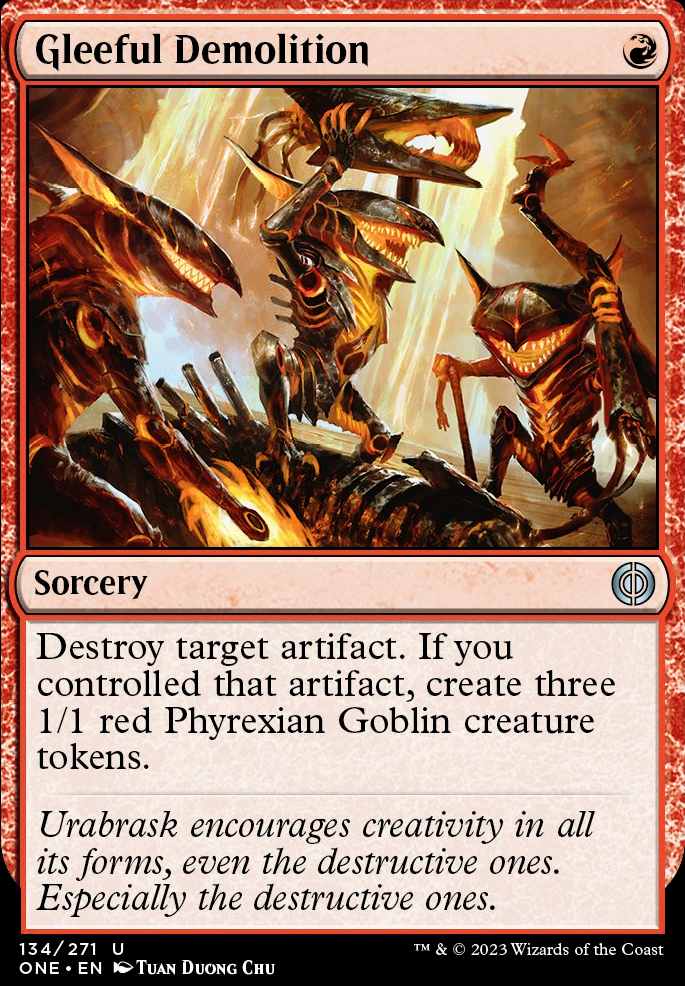
My shell started off as a combination of Boom/Bust with Mono-Red Saga. It makes sense that the indestructible artifact lands pair well with Urza's Saga, creating an affinity-like boom/bust stompy archetype which sees surprisingly little play in today's Modern. Pretty much only other deck I've seen that utilized Boom+Sagas was the Boomshine deck, now virtually unplayed. My build picks up where that deck left off. Opal Ponza wants to play fast and aggressive, checking opponents with destruction and hate then stomping them down before they can recover. With this in mind I put an emphasis on lightweight, flexible offensive/defensive spells like Galvanic Blast and Gleeful Demolition the latter of which I have found to be a sleeper all-star. The deck uses these spells modally; either as pressure or stop-gap board control helping to stall, accumulate mana, and eventually overwhelm opponents with saga value/blow them out with Bust. Opals do a fantastic job both accelerating aggressive plays in the starting turns as well as powering out 4-6 mana haymakers multiple turns early with Cleansing Wildfire assisting.
We rely more on raw card power than advantage to win. Eliminating the added "air" from draw spells and instead maximizing threat potency/attached value helps the deck to curve out more efficiently. This way we don't get saddled with tempo loss from casting cantrips or draw spells when the gameplan hinges on tempo. If you have 4 mana on turn 3 you want Sowing Mycospawn in hand, not to Thoughtcast into it. Acknowledged that drawing cards is very powerful and this is indeed in some ways a sacrifice. In a long game that has gone into topdeck mode the raw individual card power of the Sagas and Mycospawns and Charmaws and Busts kicks in again, granting multiple cards worth of value from single topdecks and this provides the late-game grind power.
A note on mulligans/the manabase:
The Darksteel lands are really important. Overall there is little reliance on specific card synergies (meaning our cards are usually good by themselves and don't need access to other cards in the deck, contrasted with e.g. atraxa+goryo's) except our artifact lands turn on Mox Opal, Ghost Quarter, Urza's Saga, Boom / Bust, Gleeful Demolition, Cleansing Wildfire, and Galvanic Blast–so the bulk of our spells. This makes it critical to mull for a darksteel land and hopefully red mana + a turn 1-2 play. Keeping 1 landers becomes pretty reasonable when that land is a bridge because we are likely to draw into mana with 27 sources and lots of 1-2 mana spells, but there is no guarantee to draw darksteel with only 12 sources. This makes the deck operate theoretically a bit like an Eldrazi or Tron deck; our manabase enabling the overall higher card power. Compared to Eldrazi I think Opal Ponza has a tighter more interactive early game but also a lower power ceiling next to Ugin, Emrakul, and Broodscale combo. Our land destruction is really good in these matchups again because those decks rely so much on their special manabase to function. Same story in Saga mirrors. The darksteel land is of course weak to getting Karn'd or exiled but the manabase is still 50/50 so Karn isn't always a game-ender. Our color fixing is also deceptively strong thanks to Ghost Quarter and Urza's Saga, the latter counting as a slow colored source via opal. Another advantage of this manabase is that it's %100 painless–this feels good as a stompy deck trying to race other aggro decks who use fetches and shocks.
A Tangent - Why Nihil?
Nihil Spellbomb may seem like a curious choice for the gy hate slot. I have broken down the potential options and it is these characteristics that make Nihil the subjectively objective best choice despite the card draw effect being (mostly) outside our colors.
Relic of Progenitus - Pro: Repeat proc Loki, Exiles all, Draw+exile -- Con: Non-recurrable, Holds up , Bilbo Nonbo
Scrabbling Claws - Pro: Repeat proc Loki, Recurrable -- Con: Only exiles 1, Holds up
Soul-Guide Lantern - Pro: Free to hold up, Exiles all, Recurrable, ETB -- Con: Doesn't proc Loki, No draw+exile
Nihil Spellbomb - Pro: Free to hold up, Exiles all, Recurrable, *Draw+exile -- Con: Needs Opal to draw
Ghost Vacuum - Pro: Free to hold up, ReUSEble, Top end ability -- Con: Doesn't proc Loki, No draw, 1 at a time
Tormod's Crypt - Pro: Free to hold up, Free, Recurrable -- Con: Does nothing else, meh
So imo Nihil has the most workable downsides. It's free to hold up, procs loki on use, can loop with Bilbo, Thief in the Night, and it exiles the whole yard+draws once we have an opal. My second pick is probably Scrabbling Claws for a build with both loki and bilbo. Soul-Guide Lantern is the popular choice but I don't like that you can't get both effects together. The more I think about it the more Scrabbling Claws might be sweet just because it goes so well with both loki and bilbo, which none of the other options do. Not being able to exile the entire grave however is a downside against a deck like delirium.

And that's pretty much the deck! All in all I've tried to keep my build close in spirit to Brian Kowal's The *Original* Ponza deck; a deliciously destructive Calzone of death incorporating all the finest ingredients of Cheese–Burn, Meats–Beats, and Sauce–Land destruction to be found in Richard Garfield's kitchen.
Sep. 2026 - This deck is now almost two years old and the previous iterations even older than that. But we continue to get powerful new tools that work well with the shell, so I've continued to play with and update this list pretty regularly. It's probably the strongest most consistent deck I've ever brewed for an eternal format. So before Bilbo came out I was playing a version of the deck: Molten Opals II, this version emphasized ramping into Charmaw and Mycospawn by going pure gruul trading Thoughtcast card advantage for more ramp and 4-ofs of these haymakers. Now I have shifted back to Temur in order to make use of sweet new engines in Bilbo, Thief in the Night and Loki, God of Mischief (I know I said card advantage was bad, shhh), these both provide repeat advantage and simultaneous beats unlike Tamiyo or Emry. I've also maintained the 4-of charmaw and mycospawn from the gruul build as these are the game winning cards and playing with 4-ofs felt a lot more consistent than 3-ofs + Thoughtcasts, which ties back into what I said about eliminating air and maximizing card efficiency and power.
Suggestions
Updates Add
Comments
Attention! Complete Comment Tutorial! This annoying message will go away once you do!
Important! Formatting tips — Comment Tutorial — markdown syntax
Please login to comment
Casual
96% Competitive
| Top Ranked |
|
| Date added | 1 year |
| Last updated | 18 hours |
| Legality | This deck is Modern legal. |
| Rarity (main - side) | 7 - 1 Mythic Rares 20 - 8 Rares 10 - 5 Uncommons 20 - 1 Commons |
| Cards | 61 |
| Avg. CMC | 2.65 |
| Tokens | Bird 2/2 U, Construct 0/0 C, Emblem Tezzeret, Cruel Captain, Food, Phyrexian Goblin 1/1 R |
| Folders | Land Destruction |
| Votes | |
| Ignored suggestions | |
| Shared with | |
| Views |