Combos Browse all Suggest
Legality
| Format | Legality |
| 1v1 Commander | Legal |
| Archenemy | Legal |
| Arena | Legal |
| Block Constructed | Legal |
| Canadian Highlander | Legal |
| Casual | Legal |
| Commander / EDH | Legal |
| Commander: Rule 0 | Legal |
| Custom | Legal |
| Duel Commander | Legal |
| Freeform | Legal |
| Gladiator | Legal |
| Highlander | Legal |
| Historic | Legal |
| Historic Brawl | Legal |
| Legacy | Legal |
| Leviathan | Legal |
| Limited | Legal |
| Modern | Legal |
| Modern Beyond Horizons | Legal |
| Oathbreaker | Legal |
| Pauper | Legal |
| Pauper Duel Commander | Legal |
| Pauper EDH | Legal |
| Pioneer | Legal |
| Planar Constructed | Legal |
| Planechase | Legal |
| Quest Magic | Legal |
| Vanguard | Legal |
| Vintage | Legal |
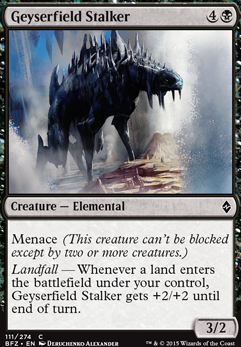
Geyserfield Stalker
Creature — Elemental
Mencace (This creature can't be blocked except by two or more creatures.)
Landfall — Whenever a land enters the battlefield under your control, Geyserfield Stalker gets +2/+2 until end of turn.








trippy_mcfly on
 Cumly Cube

4 months ago
Introducing Cumly Cube 1.4! Two months ago, Cumly Cube was updated to Cumly Cube 1.3, which was touted as balanced and without any notable flaws. There is no more insidious poison than hubris! Many cards remained that were too strong, or close to unplayable. Many archetypes existed in the cube but had too little support to ever be worth drafting. Many cards failed to fit the ethos of Cumly Cube. With 89 more cuts and adds, I am now pleased to announce that, this time, Cumly Cube has reached a final form! Perhaps a few cards are still too strong, too weak, or out of place, but the vast majority of the draft pool is now in an acceptable state. Any further changes to Cumly Cube 1 will exist as minor updates, swapping out only a few cards at a time. This means that there will never be a Cumly Cube 1.5, only 1.4.1, 1.4.2, etc.
Here are the changes, provided with brief justifications:
REMOVED:
ARTIFACT
- Basilisk Collar: equipment is not part of Cumly Cube 1
- Hedron Archive
 : cut to weaken the artifact archetype
- Mox Diamond: cut to weaken the artifact archetype
- Mox Opal: cut to weaken the artifact archetype
- Mox Tantalite: cut to weaken the artifact archetype
- Sensei's Divining Top:cut to weaken the artifact archetype

CREATURE
- Academy Manufactor: cut to weaken the artifact archetype
- Archfiend of Spite: madness is not part of Cumly Cube 1
- Arsenal Thresher: too weak
- Augmenting Automaton: too weak
- Autonomous Assembler: Assembly-Workers have been cut from Cumly Cube 1
- Baleful Force: too weak
- Battleground Geist: cut for a better Spirit card
- Belligerent Hatchling: too weak
- Bloodpyre Elemental: too generic of a red card
- Bloom Hulk: there are better proliferate engines available in Cumly Cube
- Copperhorn Scout: cut to weaken the Elf creature type
- Crosis, the Purger: too annoying to play against
- Deathrite Shaman: cut to weaken the Elf creature type
- Deus of Calamity: too weak
- Dutiful Replicator: Assembly-Workers have been cut from Cumly Cube 1
- Dwynen's Elite: cut to weaken the Elf creature type
- Emperor's Vanguard: cut to weaken green
- Farhaven Elf: cut to weaken the Elf creature type
- Fear of Exposure: cut to weaken green
- Fertilid: cut to weaken green
- Galazeth Prismari: cut to weaken the artifact archetype
- Geyserfield Stalker: too weak
- Greater Gargadon: suspend is not part of Cumly Cube 1
- Hallowed Priest: cut for an identical card to support the Cat creature type
- Heedless One: cut for a similar card to better support the Elf creature type
- Hematite Golem: too weak
- Hunted Horror: too weak
- Impetuous Devils: too generic of a red card
- Jeskai Student: too weak
- Junktroller: too weak
- Lashweed Lurker: emerge is not part of Cumly Cube 1
- Llanowar Visionary: cut to weaken the Elf creature type
- Lodestone Golem: we have seen enough of this card in other formats
- Lunar Avenger: too weak
- Maze Behemoth: cut to weaken green
- Mishra's Self-Replicator: Assembly-Workers have been cut from Cumly Cube 1
- Morselhoarder: too weak
- Night Incarnate: too generic of a black card
- Omnath, Locus of the Roil: cut to weaken the Elemental creature type
- Phantom Nishoba: too weak
- Quirion Ranger: cut to weaken the Elf creature type
- Scalding Devil: cut to make room for more interesting Devil creatures
- Self-Assembler: Assembly-Workers have been cut from Cumly Cube 1
- Seton, Krosan Protector: cut to weaken green
- Soul of Zendikar: cut to weaken green
- Teferi's Sentinel: too weak
- Thought Monitor: cut to weaken the artifact archetype
- Torbran, Thane of Red Fell: too generic of a red card
- Ulamog, the Infinite Gyre: cut to make room for more balanced Eldrazi creatures
- Walking Ballista: cut to remove an infinite combo payoff accessible from the Cumly Zone
ENCHANTMENT
- Aura Shards: too powerful
- Blood Moon: we have seen enough of this card in other formats
- Impending Disaster: too weak
- In Bolas's Clutches: cut for a similar but more expensive version of this effect
- Night Soil: cut due to the presence of two other very similar cards
- Revel in Riches: too powerful
- Urban Utopia: cut to weaken green
LAND
- Ancient Tomb: too powerful
- Flagstones of Trokair: too weak
- Mishra's Workshop: too powerful
- Urza's Saga: too powerful
INSTANT
- Accelerate: too generic of a red card
- Bedevil: spot removal has been removed in favor of removal found in commands, charms, and confluences
- Fading Hope: too generic of a blue card
- Fissure: spot removal has been removed in favor of removal found in commands, charms, and confluences
- Fracture: spot removal has been removed in favor of removal found in commands, charms, and confluences
- Frazzle: too generic of a blue card
- Inside Out: too weak
- Lens Flare: spot removal has been removed in favor of removal found in commands, charms, and confluences
- Schismotivate: too weak
- Seize the Initiative: too weak
- Volt Charge: spot removal has been removed in favor of removal found in commands, charms, and confluences
PLANESWALKER
- Karn Liberated: too generic and powerful of a draft pick
- Nissa of Shadowed Boughs: animating lands is not part of Cumly Cube 1
SORCERY
- Broken Bond: spot removal has been removed in favor of removal found in commands, charms, and confluences
- Chain Reaction: too generic of a red card
- False Dawn: too weak
- Grim Tutor: too powerful
- Ice Storm: spot removal has been removed in favor of removal found in commands, charms, and confluences
- Lava Flow: spot removal has been removed in favor of removal found in commands, charms, and confluences
- Sinkhole: spot removal has been removed in favor of removal found in commands, charms, and confluences
- Tezzeret's Gambit: too powerful
- Wildfire: too generic of a red card
ADDED:
ARTIFACT
- Banner of Kinship: encourages building around creature types
- Conduit of Worlds: supports graveyard synergies
- Pillar of Origins: encourages building around creature types
CREATURE
- Aetherjacket: supports the Thopter creature type
- Ajani's Pridemate: replaces Hallowed Priest to support the Cat creature type and lifegain synergies
- Akroan Conscriptor: supports spellslinger synergies
- Alibou, Ancient Witness: supports the Golem creature type and other artifact decks
- Ancient Cellarspawn: supports the Demon, Horror, and Nightmare creature types
- Angelic Aberration: supports the Angel and Eldrazi creature types
- Axgard Artisan: supports the Dwarf creature type
- Bloodwater Entity: supports spellslinger synergies
- Brass Herald: supports the Golem creature type and encourages building around creature types
- Campus Guide: supports the Golem creature type
- Chief of the Foundry: supports the Construct creature type and other artifact decks
- Chrome Courier: supports the Thopter creature type
- Cursed Wombat: supports the Nightmare creature type and +1/+1 counter decks
- Darksteel Colossus: supports the Golem creature type
- Duergar Hedge-Mage: supports the Dwarf creature type
- Eidolon of Blossoms: supports the enchantment archetype
- Endbringer: supports the Eldrazi creature type
- Essence Depleter: supports the Eldrazi creature type
- Gimli, Mournful Avenger: supports the Dwarf creature type
- Gishath, Sun's Avatar: supports the Dinosaur creature type
- Herald of Slaanesh: supports the Demon creature type
- Hunting Velociraptor: supports the Dinosaur creature type
- Immaculate Magistrate: replaces Heedless One to support the Elf creature type
- It That Heralds the End: supports the Eldrazi creature type
- Kozilek's Channeler: supports the Eldrazi creature type
- Mayhem Devil: supports the Devil creature type
- Patrician Geist: replaces Battleground Geist to support the Spirit creature type
- Petravark: supports the Beast creature type
- Pillardrop Warden: supports the Dwarf and Spirit creature types
- Precursor Golem: supports the Golem creature type
- Prosperous Pirates: supports the Pirate creature type
- Quandrix Pledgemage: supports the Merfolk creature type and spellslinger synergies
- Roaming Throne: supports the Golem creature type and encourages building around creature types
- Rootwater Hunter: supports the Merfolk creature type
- Shambling Suit: supports the Construct creature type and other artifact decks as well as enchantment decks
- Shantotto, Tactician Magician: supports the Dwarf creature type and spellslinger synergies
- Smokebraider: supports the Elemental creature type
- Solarion: supports the Construct creature type
- Species Specialist: encourages building around creature types
- Squealing Devil: supports the Devil creature type
- Tayam, Luminous Enigma: supports the Beast and Nightmare creature types
- The Balrog of Moria: supports the Demon creature type
- The Lady of Otaria: supports the Dwarf creature type
- Three Tree Mascot: adds mana fixing and encourages building around creature types
- Titans' Vanguard: supports the Eldrazi creature type
- Torch Fiend: supports the Devil creature type
- Ulamog's Dreadsire: supports the Eldrazi creature type
- Vengeful Devil: supports the Devil creature type
- Venomcrawler: supports the Demon creature type
- Wavecrash Triton: supports the Merfolk creature type and spellslinger synergies
- Zara, Renegade Recruiter: supports the Pirate creature type
ENCHANTMENT
- Destructive Flow: offers a land destruction engine that can provide a large advantage in some decks
- Efficient Construction: supports the Thopter creature type
- Keldon Twilight: offers a creature destruction engine for aggressive decks
- Lay Claim: replaces In Bolas's Clutches as a more expensive control spell
- Might Makes Right: encourages large creatures and can be used in conjunction with sacrifice synergies as a creature destruction engine
- Porphyry Nodes: offers a creature destruction engine for slower decks
- Retreat to Kazandu: supports landfall synergies
- Shivan Harvest: offers a land destruction engine and supports sacrifice synergies
- Sunken Hope: offers a creature bounce engine for slower decks
- Whirlwind of Thought: supports spellslinger synergies
LAND
- Foundry of the Consuls: supports the Thopter creature type
INSTANT
- Atarka's Command: commands have been added to Cumly Cube to provide interaction and versatility
- Aura Mutation: quite similar to Artifact Mutation
- Brokers Confluence: confluences have been added to Cumly Cube to provide interaction and versatility
- Cabaretti Confluence: confluences have been added to Cumly Cube to provide interaction and versatility
- Dromoka's Command: commands have been added to Cumly Cube to provide interaction and versatility
- Kolaghan's Command: commands have been added to Cumly Cube to provide interaction and versatility
- Lorehold Command: commands have been added to Cumly Cube to provide interaction and versatility
- Maestros Charm: rounding out the charms in Cumly Cube to provide interaction and versatility
- Maestros Confluence: confluences have been added to Cumly Cube to provide interaction and versatility
- Obscura Charm: rounding out the charms in Cumly Cube to provide interaction and versatility
- Obscura Confluence: confluences have been added to Cumly Cube to provide interaction and versatility
- Ojutai's Command: commands have been added to Cumly Cube to provide interaction and versatility
- Pulse of the Fields: supports lifegain synergies
- Quandrix Command: commands have been added to Cumly Cube to provide interaction and versatility
- Riveteers Charm: rounding out the charms in Cumly Cube to provide interaction and versatility
- Silumgar's Command: commands have been added to Cumly Cube to provide interaction and versatility
- Silverquill Command: commands have been added to Cumly Cube to provide interaction and versatility
- Siren's Ruse: supports the Pirate creature type and blink synergies
PLANESWALKER
- Saheeli, Filigree Master: supports the Thopter creature type
- Vraska, Golgari Queen: supports sacrifice synergies
SORCERY
- Renegade Tactics: replaces Accelerate as a less typical red card
- Roar of the Crowd: encourages building around creature types
- Temporary Insanity: stealing creatures is a small but important part of Cumly Cube
- Witherbloom Command: commands have been added to Cumly Cube to provide interaction and versatility
divinagon on
 Jund Landfall

9 years ago
This isn't an aggro deck, so I wouldn't want Scythe Leopard or Makindi Sliderunner over either of the other two. Jaddi Offshoot helps against the "Everything's a One Drop" decks, and Geyserfield Stalker isn't a terrible card in this deck. It gets +2/+2 every time a land enters, which is a lot for me, has menace, and I can give it trample in multiple ways. Also, I'm not going to run black in a deck for three cards, all of which being the same.
cmsrDPM on
Jund Landfall
9 years ago
On Traverse the Ulvenwald I really don't see an easy way for you to get delirium. Land, creature, and even Planeswakler sure. But you don't want to lose your artifacts and the only sorcery is Transverse.
Also perhaps Scythe Leopard and Makindi Sliderunner over Jaddi Offshoot and Geyserfield Stalker.
MagicalHacker on Any holes in this new …
9 years ago
So I'm not a huge fan of the current Horde format for a few reasons:
- Not every tribe has tokens
- There's nothing stopping someone from making an unstoppable horde deck
- The horde deck can sometimes hurt itself randomly
- The flavor feels off, since in a zombie apocalypse, for example, you are not attacking a single person, but the zombies attacking you.
- Flavor fail: you get to prepare for a horde?
- All the survivors winning or losing simultaneously is both a flavor fail and a mechanics fail because sometimes team members die, so the better representation in game of what the real balance is would be separate losing.
- Ulamog, the Infinite Gyre and/or Kozilek, Butcher of Truth would be nearly impossible to defeat in an eldrazi horde deck, because to win, you have to get the horde to an empty library, but when you damage the life total, it mills that many cards, which could get one of these guys, resetting the deck.
- Infinite mana means the horde wins when it gets anything that has a mana dump, so more cards that are unbeatable.
All in all, this current format is the textbook definition of flavor fail AND poor mechanic balance. So I present...
Horde 2.0!
Here are the rules (skip over the parentheses for basic rules):
Horde deck construction:
- Choose a creature subtype and a plane. The deck is constructed of one of each of all creatures with that subtype printed in a set on that plane and one of each other card that produces a token with that subtype printed in a set on that plane.
Gameplay rules:
- The players win when the horde has zero cards on the battlefield, in their hand, and in their library.
- At the beginning of the game, the horde puts cards from the bottom of its library into its sideboard until it has a number of cards in its library equal to 20 times the number of other players.
- The horde always goes first, but it does not draw cards. Instead, it plays with the top card of its library revealed and can cast that card.
- These additional actions happen each upkeep: 1. If it is the horde's turn, it adds mana equal to the turn number multiplied by the number of opponents. 2. Flip a coin for each activated ability they can activate in order of what creatures have entered the battlefield, and for each heads, the horde activates that ability and flips again for that ability if it can still be activated. (Noncreatures must activate an ability if able.) 3. The horde casts cards from their deck. (Once a spell that can counter another spell can be cast, mana is taken out of the pool for that spell, it is put into the hordes hand, and whenever an opponent casts a legal target for the counterspell, the horde flips a coin and casts the counterspell if they get a heads; creatures with alternate ways to cast them are randomly chosen which way to be cast.)
- The horde has no life total, so whenever an effect would check its life total, it checks the number of cards left in its library instead.
- If the horde would be dealt damage or lose life, put a card from the top of the library of the horde deck into the sideboard. If it would gain life, put a cards from the bottom of the sideboard to the bottom of the library.
- All creatures the horde controls attack each turn if able, starting with the newest creature. (Any player may block these creatures. The horde attacks the player with the highest total Cmc among permanents they control.)
- The players' life total is the total of their starting life totals combined. Whenever the players have lost an amount of life equal to what would be one player's starting life total, the player with the smallest total Cmc among permanents they control loses the game. (Lifegain cannot bring them back. This continues for each increment of "starting life totals". If that player cannot lose, the next player with the lowest total of Cmc among permanents they control loses instead.)
- If the horde has to make any choices, this is how it chooses: Firstly, it wants to make positive effects for itself. For this, it wants to choose the highest cmc card, then the oldest cmc card. Secondly, it wants to make negative effects for opponents. For this, it wants to choose the highest Cmc card, then from the player with the highest Cmc total among his or her permanents, then the newest card. Thirdly, the horde can make choices when it comes to positive effects for opponents or negative effects for itself. For positive effects for opponents, it wants to choose the lowest Cmc card, then choose from the opponent with the lowest cmc total among permanents they control, then the newest card. For negative effects for itself, it wants to choose the lowest cmc card, then the newest cmc card. Lastly, for all other choices, it will make a choice at random (coin flips used for the horde deciding whether or not to do a particular action, such as a may effect; if the horde has to pick the value of X, it is randomized with a d10).
Also, here's a sample decklist:

Horde 2.0: Zendikar Eldrazi
Unknown
SCORE: 2 | 36 VIEWS
So here are my questions:
- Is it descriptive enough to play a game without a question about rules every other turn?
- Is there anything I can do to make it simpler while keeping the flavor and mechanics nearly identical?
- Are the any cards that would break the spirit of the format that I should be aware of so that I can adjust the rules appropriately?
Thank you guys!
chirz2792 on
 Green/Black Destruction Deck

9 years ago
Cards I would suggest to add in for right now would be Foul Orchard, Temple of Malady, 4 forests, 3 swamps, Arcane Lighthouse, Butcher of Malakir, Dictate of Erebos, Sakura-Tribe Elder, Elvish Mystic, Burnished Hart, Brood Monitor, Terastodon, Murder, and Krosan Grip. Cards I would suggest taking out for those are Tasigur, the Golden Fang, Warden of the First Tree, Broodhunter Wurm, Canopy Gorger, Geyserfield Stalker, Giant Mantis, Herald of the Pantheon, Reaver Drone, Saddleback Lagac, Shambling Attendants, Tajuru Pathwarden, Woodland Wanderer, Zulaport Chainmage, Hedron Crawler, Elemental Uprising, Lead by Example, Gladehart Cavalry, Swell of Growth, and Jaddi Offshoot. I know that's a long list of cuts and adds but you have a lot of cards in here hat aren't relevant to what this deck is trying to do so I would suggest cutting those first :). Also wondering what's your budget like? Because there are a few cards I want to suggest but I'm not sure if they're too expensive or not so let me know about that and what you think about my suggestions.