Pattern Recognition #394 - Toughness Matters
Features Opinion Pattern Recognition
berryjon
15 January 2026
399 views
15 January 2026
399 views
Hello Everyone! My name is berryjon, and I welcome you all to Pattern Recognition, TappedOut.Net's longest running article series. Also the only one. I am a well deserved Old Fogey having started the game back in 1996. My experience in both Magic and Gaming is quite extensive, and I use this series to try and bring some of that to you. I dabble in deck construction, mechanics design, Magic's story and characters, as well as more abstract concepts. Or whatever happens to catch my fancy that week. Please, feel free to talk about each week's subject in the comments section at the bottom of the page, from corrections to suggested improvements or your own anecdotes. I won't bite. :) Now, on with the show!
Hello and welcome back! Today, I won't be talking about Lorwyn directly (though there will be a couple mentions later). Instead, I'm going to delve a little into a subject that came up because I got an interesting card with my prize pack last Friday after FNM.
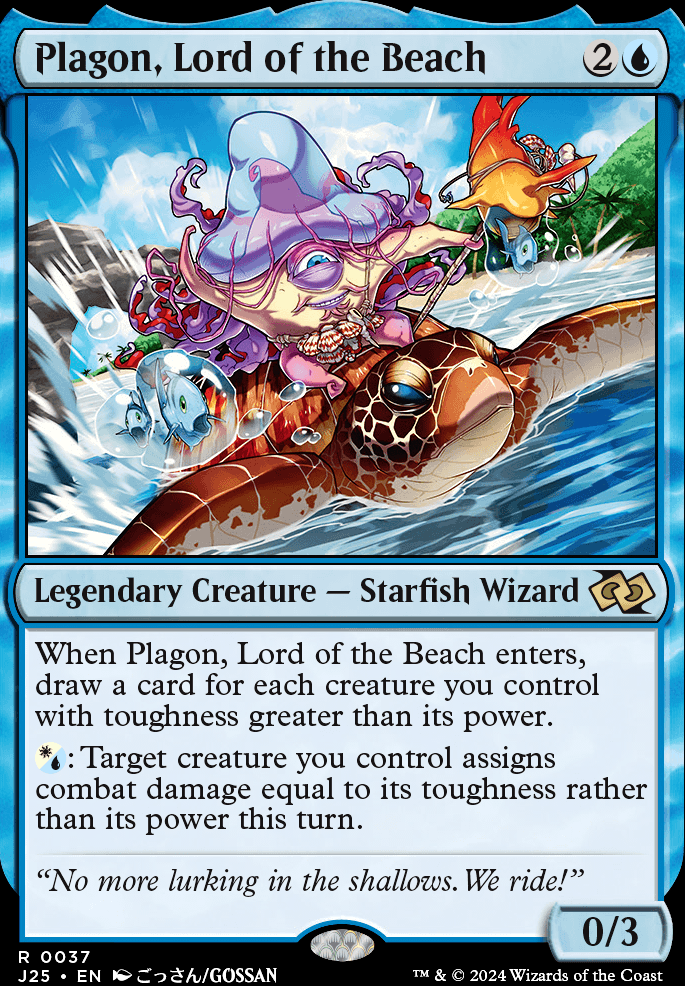
This was in my pity-pack, and you know what? I'm not disappointed at all!
But this cute guy did give me a subject I could talk about with something a bit more positive than my initial thoughts about what to talk about! So let's talk about toughness matters.
So, Toughness. The number after the slash in the lower-right hand corner of the creature. For the vast majority of cases, this is the number that slightly less relevant to the creature and its use. There are far more cards that care about power than there are about toughness, and it is something that is baked into the game. You don't win (normally) by sitting back and doing nothing, just taking the blows and ignoring them. You win by being active and aggressive. Or at least assertive - looking at you, mono- control decks.
And as such, Power on a creature is often the more important stat. It is something that is more active in nature, it is the one that can be applied to your opponents face, your opponents Planeswalkers and even their creatures. The Fight mechanic, going all the way back to Arena, checks for power more than toughness. And then things like Deathtouch and Trample value power more over toughness.
So making Toughness Matter is difficult. Large creatures in this regard have the issue of being hard to remove. There is a massive difference in ease of killing when a creature has two toughness versus, say, 7. The amount of effort to overcome that number can scale up ridiculously. Which, I suppose, is where symol:B gets direct removal, with cards like Hero's Downfall and can also remove with a bit more conditions, such as needing to be tapped or just plain attacking.
Then the size of effective removal in Standard can also have a knock-on effect for creature sizes. I'm not sure how many of you were around for this, but Lightning Bolt was last in Standard with M10, and the knock-on effects when any creature with a toughness of three or less was effectively dead-on-board to a single was enough to remind Wizards why they depreciated that card in the first place in favor of Shock and Lightning Strike. It was too good for what it was supposed to do, and it's stayed that way. And if you ever see a common creature with four toughness, and some very low power, it's because someone was plotting out a three-damage spell. Like Yoked Ox. In fact, there were thirty creatures in that set that could survive a Bolt to the face. And 80 that couldn't. Which is a little on the high side for survivability.
Trying to find that right balance where a creature is just tough enough, but also not too tough can be extremely challenging for a variety of reasons, and you're not here for any of that numbers stuff. I know what you're all really here for.
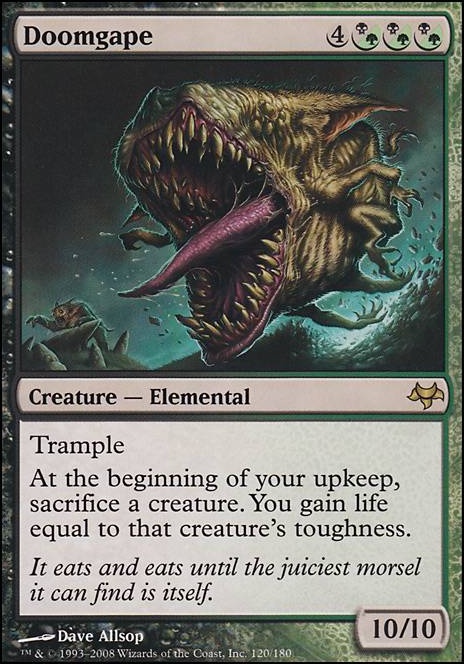
Oddly enough, Toughness Matters didn't start with him. It started a bit earlier. In Mirage, with Grim Feast. This creature rewarded you for killing your opponents creatures by giving you life equal to their toughness. But it did have the drawback of you losing a life each turn. Which on the whole didn't really matter? You either had enough life to make it irrelevant, or you were dead anyways, no matter what happened. Worthy Cause began a long theme of self-sacrifice for a boost to your life total. Animal Boneyard, Proper Burial and even to Ayli, Eternal Pilgrim. The idea that your creatures can give up their lives to make you last just a little bit longer is something that is very .
And truth be told, was great at improving your toughness! Cards like Castle wouldn't even see the light of day today, but when you are counting every point of toughness you can, it adds up after a while. I'm not about to list them all, but trust me, they exist.
But the problem with most of these cards is that they still treated Toughness as something that was passive. That is was something that sat there until it was expended for whatever reason. That it was a resource to be spent. But much like your life total, it did nothing in of itself. It was either enough, or it wasn't and there wasn't really much of a spectrum between the two ends.
Which is where, at long last, the card you're all really waiting for was printed.
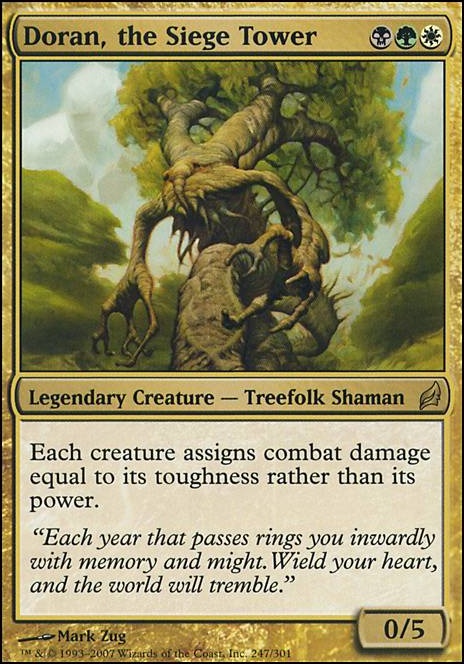
I can't say that this was the first card that allowed you to take your Toughness as the relevant combat stat for dealing damage, but it is the one that really made it work. Doran opened up the door to the idea that all those poor cards with low costs, but equally low impact - they now had value. Kami of Old Stone wasn't exactly a Standard powerhouse when it was around, but with Doran? It didn't swing for 1. It could hit for seven. At Mana Value 4? There are only sixteen cards in the game that can do that. And that's just off the top of my head!
The thing about the flip of toughness now dealing damage is where that number is always valued at being lower in mana value for a creature than the power. And at the same mana value, a 3/1 will have less going for it than a 1/3. Look at, say, Outlaw Medic and Furious Forebear. One provides consistent value on the battlefield and when it leaves, while the other has an additional cost to just have the opportunity to cast it again.
Toughness Matters cards work out far better than they should seem to because first and foremost, toughness is cheap. In terms of mana and accessibility, Wizards has more often than not, printed cheap creatures for drafts and limited that have higher toughness than power in order to slow down more aggressive aspects to the set, and this standardized decision in creature design means that when you get cards that care more about toughness than power, there is plenty of easily accessible creatures to work with.
You know, I think that's why this sort of archetype tends to be occasionally popular. It's extremely easy to buy into because the cards that support it don't always have an effective measure outside of it. Newer players can get these cards without stressing their wallets, and because so many of these creatures are common, they can be pulled from draft-chaff piles. Which is some stores, is practically free!
DO NOT STEAL CARDS.
Now, there are two side-points I want to bring up. The first is Defender Matters cards, like Arcades, the Strategist, which allows your Defenders to attack as though they didn't have that ability, and because Defenders tend to have more toughness than power - there are 31 Defenders where the power is higher than the Toughness - the Toughness Matters effect to deal damage with the larger number is a necessary synergy. In fact, you can make the case that Toughness Matters is a subset of Defender matters due to how often one is rolled into the other.
But they are not the same. There is overlap, yep, but one does not equal the other! Please do not make that mistake!
The other side-point comes from Zilortha, Strength Incarnate. This experimental design asked of Wizards that if they can make Toughness become power, how can they make Power become Toughness? Well, what you see here is the single, solitary result. In the colours of creatures with higher power than toughness a lot of the time, this card gives them a better chance to survive damage.
Just damage though. Effects that reduce toughness to zero or less, like Toxic Deluge still check against the Toughness.
So yeah. Toughness can matter. But only when you build your decks to take advantage of it. On the whole, power does tend to be more useful in of itself and its easier to just have the thoughts of 'higher power means better'. And that's not incorrect. It's just easier. And the game is designed that way.
Making Toughness matter means knowing what you're doing, and accepting that a lot of your regular options won't work as well. You'll have to switch around how you think of things, and how you prioritize what you do and how. But it can be done.
Give it a try!
Thank you all for reading and I hope to see you all next week! I may have something to work with regarding Lorwyn, I may not.
Until then, please consider donating to my Pattern Recognition Patreon. Yeah, I have a job (now), but more income is always better, and I can use it to buy cards! I still have plans to do a audio Pattern Recognition at some point, or perhaps a Twitch stream. And you can bribe your way to the front of the line to have your questions, comments and observations answered!
Cracked my box of Lorwyn Eclipsed! Got Doran, Besieged by Time!
This may be fun....
January 16, 2026 7:21 p.m.
Not really the same, but still older than doran. We also have the switch power/toughness cards:
https://gatherer.wizards.com/search?rules=switch&rules=power&rules=toughness
hyalopterouslemur says... #1
Wave of Reckoning is my stealth pick: It destroys everything with power greater than or equal to toughness (as well as everything with deathtouch).
January 16, 2026 3:26 p.m.